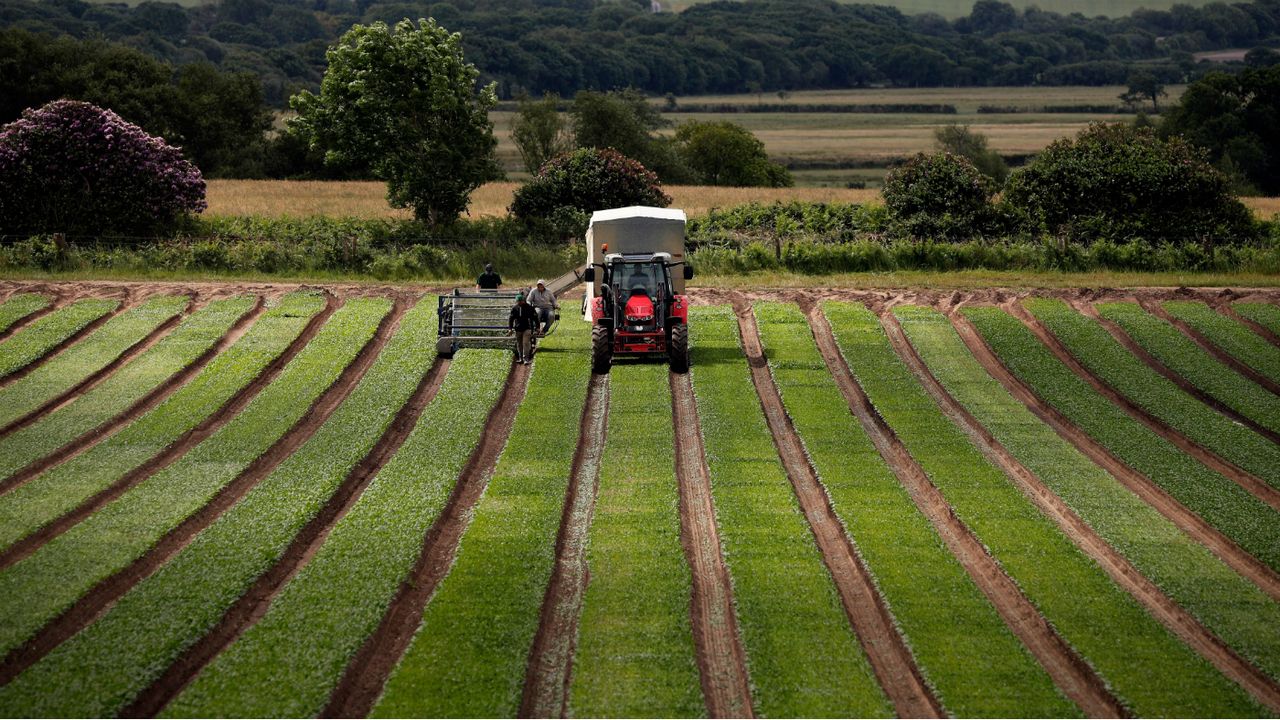
Ukrainian farmers hope for help from the International Monetary Fund as the country’s financial and political crisis has toughened lending conditions during the key spring sowing campaign, farmers and bankers say.
Some farmers have been forced to use cheaper seeds or cut the amount of fertilizer they can purchase while others have struggled to get loans to replace old equipment.
“No matter who I’ve asked — nobody grants loans,” says Mykola Strigak, a farmer with 70 hectares of land in Kirovohrad in central Ukraine. “They don’t say they would not grant (the loan), but they set conditions that could not be fulfilled.”
Strigak, who wanted a loan to buy new machinery, says banks asked for collateral worth more than twice the loan’s value.
The IMF Board of Governors will meet on April 30 to consider an aid package for Ukraine, one the world’s key grain exporters.
“Once aid comes and the banking sector stabilises, the agriculture sector will be the first to receive financing because it’s showing a sustainable growth,” says Elena Voloshina, head of the International Finance Corporation (IFC) — the World Bank’s private sector financing arm — in Ukraine.
The IMF tentatively agreed in late March to provide a $14 billion to $18 billion two-year aid package to help Ukraine recover from months of political and economic turmoil.
IFC’s Voloshina says local currency depreciation has significantly affected banks. “They have problems now: credit resources are short, limited and more expensive,” she says.
Ukrainian banks are also having their own problems with liquidity, said Vadim Bodaev, vice-president of the large agricultural holding company AgroGeneration.
“We’ve applied to many banks and they say: ‘Political instability — let’s wait’,” Bodaev says. “This process can last until Ukraine starts to receive Western finance, when the hope for stabilisation would appear.”
Strigak says his creditors were offering loans with an annual rate of about 18 percent, which reaches 33 percent when insurance and other costs are taken into account. This exceeds his usual margin on crops of 30 percent.
Raiffeisen Bank Aval in Ukraine says farmers were mainly getting one-year loans in local currency with an annual rate of between 20 and 25 percent.
Unsown lands, shared risks
According to the IFC’s Voloshina, middle-sized companies were the worst hit so far, while large companies were able to raise loans and small farms continue to use their own cash.
“The amount of these accumulated resources looks adequate for 2014. Critical may be the year of 2015, when the reserves will be close to exhaustion,” analysts at UkrAgroConsult say.
Voloshina sayd it appeared some land remained unsown because of the financial problems farmers were facing.
Ukrainian analysts said in March farmers might leave about 20 percent of arable land unsown this spring as a result of a lack of funds. They says a smaller area could reduce Ukraine’s 2014 grain output by around 11 million metric tons.
Ukrainian farms have sown 4.7 million hectares of spring grain as of April 28, or 56 percent of the expected sowing area, the agriculture ministry says.
Most analysts expect the 2014 grain crop to be between 55 million and 59 million metric tons, down from an all-time-high harvest of 63 million metric tons in 2013.
The IFC, which has invested around $800 million in Ukraine’s agricultural sector since 2004, runs an advisory program aimed at increasing access to finance for Ukrainian farmers.
Participants in this sector — mainly farmers, banks and suppliers of inputs like seeds, fertilizers — should seek risk-sharing structures now, Voloshina says.
IFC together with the European Bank for Reconstruction and Development are also promoting use of warehouse and crop receipts in the sector, which would guarantee that a farmer repays the loan in cash or product, she adds.
Source - http://www.agweek.com/