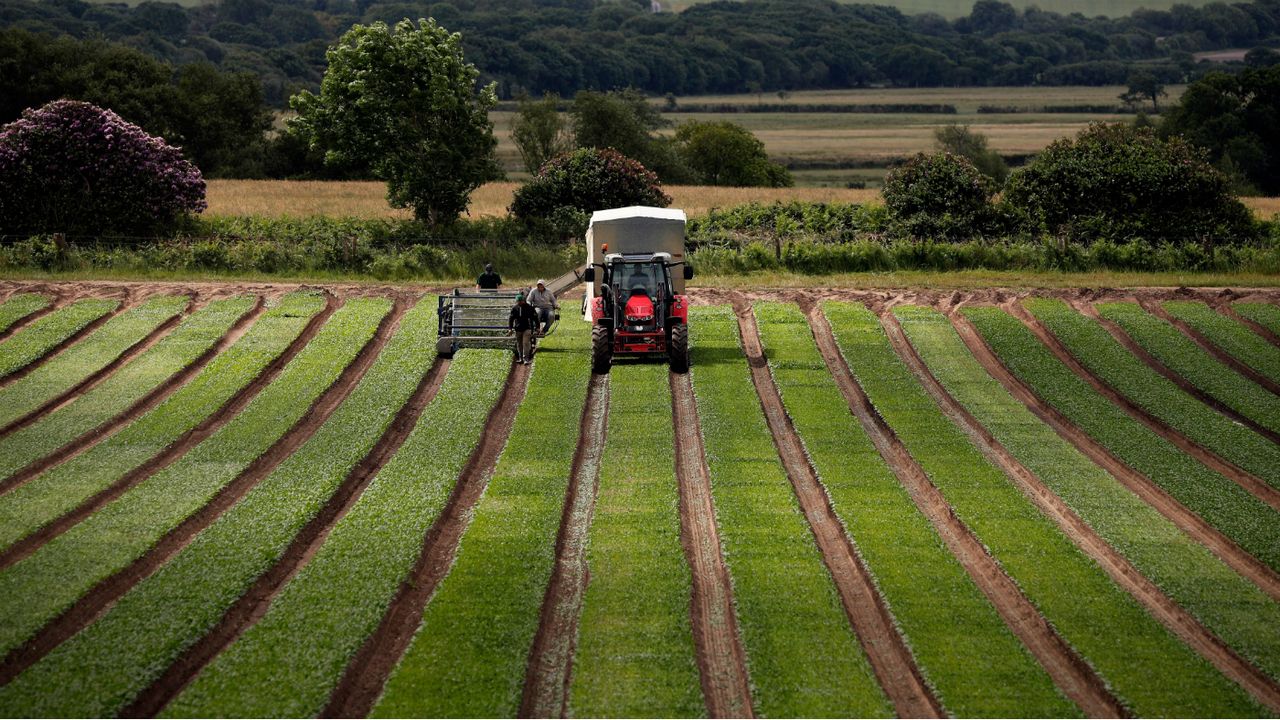
At Harris Farms in California’s Central Valley, it is not difficult to discern the effects of the state’s continuing drought. Fields that in previous years would have been lined with tomatoes or broccoli now contain nothing but brown earth. Around two thirds of the farm’s 14,000 acres are fallow, and for the first year since it started to grow salad leaves more than three decades ago, the farm has planted not a single head of lettuce.
In a normal year, said its executive vice-president, William Bourdeau, Harris Farms plants 3,000 acres of lettuce. “On a good yield you get about 1,000 cartons of lettuce per acre. On 3,000 acres that translates to about three million cartons of lettuce.
“And each carton contains 24 head of lettuce, which equates to around 72 million heads of lettuce that we didn’t grow and put into the market this year. And that’s just one of our crops. And we’re just one farm.”
California grows almost 70 per cent of America’s lettuce, which has gone up in price more than any other fruit or vegetable this year. It is no coincidence that in its regular forecast, the US Department of Agriculture estimated last week that fresh fruit and veg prices would rise by 6 per cent this summer.
The three-year drought afflicting America’s South-west has already affected California’s farming communities, but it is now beginning to be felt by consumers in the US and beyond.
The whole state is officially in “severe drought”, and up to a third of it is in “exceptional drought”. In 2013 less rain fell on California than in any year since it achieved statehood in 1850. The region’s rivers and reservoirs are at their lowest ebb ever. Outside the state capitol in Sacramento, the lawns have been allowed to grow brown, while the Getty Museum in Los Angeles recently drained its water features and turned off its fountains.
While the drought may dent some aesthetics in the big cities, it is most deeply felt in the Central Valley, California’s agricultural backbone. The state’s $45bn (£26bn) farming industry produces almost half the fruits, vegetables and nuts grown in the US, and to do that it uses 80 per cent of California’s water. Almonds alone account for 10 per cent of the state’s water use – not surprising, given that California produces 80 per cent of the world’s almonds.
With water becoming more and more expensive, California farmers have allowed 500,000 acres of land to lie fallow this year. The consequences of the drought are stamped on signs at the roadside up and down the Central Valley. They read: “No Water = No Jobs”, and “No Water = Higher Food Costs”.
The California Farm Bureau has estimated that the average American family should expect to spent $500 more on food in 2014, because of the water shortage.
Professor Richard Howitt, an expert on the economics of water management at the University of California, Davis, believes the impact of the drought on food prices will be modest this year, but could become more pronounced in 2015 if the climate fails to improve. “Fruits, vegetables and nuts are all such valuable crops that farmers will pay up to $1,000 per unit of water – about 10 times more than normal – in order to keep growing them,” Professor Howitt said. “But if we don’t get a good El Niño this winter, then the groundwater will get so low that some wells will start to go dry. That would cause a great deal of heartache and significant crop loss. I don’t expect big drought-induced shifts in food prices this year. But next year, yes.”
Environmentalists have accused California’s agricultural industry of damaging coastal ecosystems with its unquenchable thirst, but the farmers blame their water woes in large part on what John Harris, the chief executive of Harris Farms, described as “unreasonable” environmental restrictions. “We’d like to see more attention paid to human needs versus the fish needs,” Mr Harris said.
In February, President Obama’s administration announced a $200m drought aid package for California. But that will be of little use in combating the effects of what some scientists fear may be a “mega-drought”, lasting as long as 200 years.
“On average, it was 15 per cent drier over the last 1,000 years or so than in the 20th century,” she said. “Even if it reverts to that norm, it will be a hardship. But if we look back to medieval droughts, the region was 40 to 50 per cent drier.”
Meanwhile, man-made climate change exacerbates the effects of cyclical drought: “On top of the drought we have warming, which is going to cause yet more dryness,” Professor Ingram said.
So what will California’s farms do if the present conditions continue, or worsen? As Mr Bourdeau put it: “I’m not sure how you have a farm, if you don’t have any water.”
Source - http://www.freshplaza.com/