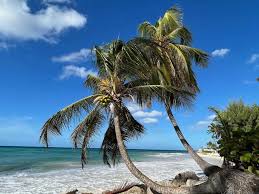
Coconut palms are king throughout the tropics, serving as the foundation for human lives and cultures across the Pacific Ocean for centuries.However, 200 years of planting by colonial interests transformed the palm from the revered "Tree of Life" to a cash crop monoculture grown on Pacific atolls for a singular purpose—production of coconut oil (copra) for export around the world.
Despite wide interest in the global footprint of palm crops, the distribution of coconut palms across tropical Pacific atolls has received little attention until now. Published in Environmental Research Letters, research from UC Santa Barbara and The Nature Conservancy provides the first comprehensive map of the vast footprint of coconut palm agriculture across nearly every Pacific atoll.
"Coconut oil used to be essential to atoll economies, but today most coconut palm plantations are abandoned and overgrown," said lead author Michael Burnett, a doctoral student in UCSB's Department of Ecology, Evolution, and Marine Biology. "With the growing climate threats facing Pacific atolls, it's critical to figure out where these abandoned plantations are using up critical land and water resources, and where there may be opportunities to restore the native forests to the benefit of islands and islanders."
Coconut palms now represent over half of the tree cover on these low islands, confining formerly widespread native broadleaf trees to small fractions of their natural range.
"That's a problem," Burnett said, "because replacement of broadleaf forests with coconut monocrops has been linked to groundwater depletion, declining seabird populations, and adverse impacts on adjacent coral reefs. Understanding the present extent of coconut plantations is crucial for confronting sustainability challenges facing communities across the Pacific's 266 atolls."
This loss of unique ecosystems on Pacific atolls is staggering. It even exceeds the rate of deforestation due to oil palm production, at least in relative terms, in other parts of the world. For instance, 10.8% of Borneo's land area had been converted to oil palm monocrops by 2015. Meanwhile, coconut palms presently cover 58.3% of the mapped atolls' total forested area and 24.1% of their total land area.
What's more, 51.2% of these coconut canopies occur in monocultures indicative of plantation agriculture and drastic ecological changes. Despite the abandonment of many plantations in recent decades, the authors found that coconut palms still surpass native broadleaf trees in terms of canopy area. Yet, forest conversion on Pacific atolls has scarcely received a fraction of the scholarly attention devoted to mapping oil palm-driven forest conversion.
"As the world comes to terms with tradeoffs associated with converting primary forest to croplands, we should not ignore atoll forests and the opportunity to recover these dynamic, resilient systems," said Alex Wegmann, lead scientist for The Nature Conservancy's Island Resilience Strategy and an author on the paper. "There is increasing evidence that atolls play an important role in ocean health as nodes of biological connectivity and as nutrient concentrators—restoring and protecting atoll ecosystems should be an 'ocean health' priority."
Fortunately, coconut palm plantations have untapped potential for ecosystem restoration, resource conservation, and climate resilience. The paper's vegetation maps are a first step in helping Pacific atoll communities visualize the state of their forests and evaluate the best potential uses—for coconut production, broadleaf forest restoration, or any path in between.
"Coconuts and coconut trees are deeply woven into the lives and livelihoods of Pacific peoples and communities, symbolizing resilience and sustenance," said Elizabeth Terk, Micronesia conservation director for The Nature Conservancy.
"However, restoring abandoned copra plantations on atolls to native forests offers invaluable ecological benefits, such as biodiversity recovery and climate resilience. Striking a balance between cultural heritage and environmental stewardship is essential for a sustainable future. Mapping the extent of copra plantations on atolls is a crucial step for informed decision-making, helping to provide a clearer picture of land use, enabling us to balance economic needs with ecological restoration and climate adaption efforts."
Ecosystem management projects, including the conversion of abandoned coconut plantations to native forests and the restoration of seabird colonies, have shown great promise on atolls. Yet these are invariably multi-year endeavors, and such efforts must be pursued with urgency by local stakeholders to achieve resilience in the face of accelerating climate impacts.
"These maps," said Burnett, "are part of a growing body of science exploring the numerous opportunities for conservation and resilience on atolls. We hope they will help atoll communities chart their own futures in an era of global change."
Source - https://phys.org