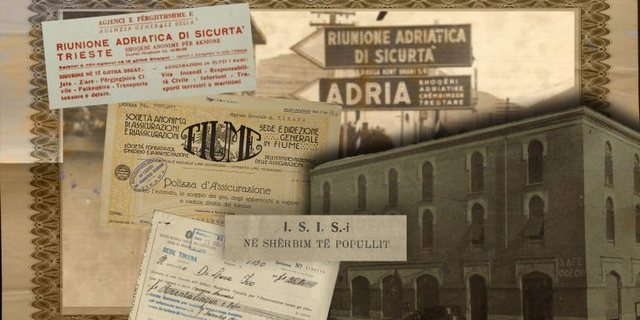
The insurance market in Albania begins to develop in the 20s-30s, when the country knows a new phase of economic development and investments.
In this period, in the main cities of Albania, in Tirana, Durrës, Saranda, Korçë or Shkodër, some of the most well-known insurance companies in the world opened their subsidiaries.
First, it is the Albanian merchants who insure their goods against fire or drowning, to continue with an expansion in the insurance offer, which included almost all businessmen who developed economic activity in Albania.
Most of the insurance companies were Italian, while there were also British ones. In fact, a good part of the insurance activity was related to the great need that was created by the foreign labor force to insure,
Generali Assicurazioni
The most well-known is "Generali Assicurazioni" of Trieste, a very well-known company founded in 1831. The initial presence of this company in Albania was through agents. The representative of the company was Vincenzo Rocco, who had a company in Durrës with 4 employees and was active in the field of selling life and fire insurance policies.
In the framework of the Italian economic expansion policy in Albania, this company decides to invest in Albania not only in the field of insurance but also in real estate.
And while it had its representative office in Durrës in terms of insurance activity, the company decided to create an important center in Tirana, where a new urban plan was being discussed that promised a construction boom in the capital. As a result, "Assicurazioni Generali" realized what can be described as the first major private real estate investment in Tirana.
The building was completed in the first months of 1932. In July of that year, the first lease agreements were signed. The premises of the first floor were leased to shops and offices of other public services as envisaged in the project while some other premises of the floors above were to be used as company offices and as a place of accommodation for Rocco.
This building would be a "shopping center" until 1937 when the lease contracts for the shops would be canceled and the premises were given to the Bank of Naples.
Meanwhile, during this period, the company expanded its activity in the field of insurance by opening offices not only in Tirana and Durrës but also in Shkodër, Vlorë, Fier, Berat, Sarandë, Gjirokastër and Vlorë.
FIUME company
The Fiume company has also played an important role in the Albanian insurance market. This company opened branches in all prefectures and sub-prefectures of Albania. The center of this company was in Fiume, today Rijeka, Croatia, and it was connected to the National Insurance Institute in Italy.
This company offered fire, gas explosion, theft, peril, transportation, third party liability and even lightning insurance.
The capital of the company was 12 million liras. The representative of the company for Albania was Francesco Giordano.
Riunione Adriatica di Sicurta
It was a joint stock company with a capital of 100 million liras. The center of this company was in Trieste. In Albania, this company had agencies and sub-agencies throughout the country and offered insurance services in all branches, life, fire, civil liability, disaster, land and sea transport.
This company was established in 1838 and owned 30 thousand agencies in 30 countries, including Albania.
This company was established in London and in the 30's it also had its subsidiaries in Albania. The representatives of this company was the Mano Brotherhood.
This company was one of the earliest insurance companies in the world, established in 1710 in London by 25 well-known businessmen.
The official representatives of this company in Albania was the Mano Brotherhood of Korça, but there were branches in other cities where they were represented by the relevant agents.
These companies exercised their activity in Albania until the end of the Second World War, where the change of the political and economic system brought about their departure from Albania. In this period, the insurance market becomes fully state-owned, like all other sectors of the economy.
Insurance in the period 1944-1991
After the Second World War and with the establishment of the communist regime in 1944, the insurance market was nationalized, like all other economic sectors. In 1949, the State Insurance Institute (Part of the Savings and Insurance Institute) was established, which offered life insurance and other non-life insurance on buildings, goods and various public services.
Referring to the documents of the time, the Institute carried out life insurance and non-life insurance. Insurance of buildings, household goods, agricultural crops, live things, life insurance and passenger insurance was carried out at the institute. For the first time in Albania, insurance was extended to villages.
Life insurance and exclusion in cases of crimes
Life Insurance was valid for life, death and disability cases. The 1949 Life Assurance Regulations provided that any person between the ages of 16 and 55 could be insured with the Institute. The life insurance contract was concluded for different amounts that depended on the age of the insured person and the term of the insurance. Life insurance was paid 250-300 lek per month.
The regulation was detailed on death benefits, but also defined some exceptions. For example, in the case when the insured person lost his life or had an accident during a criminal act, then the Insurance Institute did not pay the insured amount. Also, the regulation provided for some other exceptions.
"ISIS does not pay the insured amount in the following cases:
When the death of the insured is intentionally caused by the person designated to receive the insured amount (beneficiary)
When the insured's death or disability is caused by military operations; in this case, the beneficiary in case of death, or the insured in case of disability, has the right to receive an amount equal to what is paid in case of premature termination of the insurance contract"
Life insurance contracts were concluded for a term of 15 to 20 years. Life insurance was entirely voluntary.
Property insurance and the division of Albania into 2 insurance zones
Property insurance was divided into 3 categories and with two rates. Tariff A was used for buildings, furniture, household items while Tariff B was used for goods and shops where handicraft workshops were located. For security purposes, the entire territory of Albania was divided into two areas; Zone 1 and Zone 2.
Zone 1 included Tirana, Durrës, Korça and Vlora, while all other cities and villages were part of Zone 2. Private property insurance was voluntary, unlike state property insurance which was compulsory.
The division of buildings into categories for insurance purposes was based on the type of material with which they were built and the type of material with which their roof was covered.
Compulsory travel insurance
In addition to the activity of branches in each district, the institute was also active in automobile transport agencies, seaports and railway stations, collecting premiums related to the compulsory insurance of passengers traveling by means of public transport. This was a profitable activity that was guaranteed by the daily ticket sales. Passenger insurance was mandatory.
The provision of agricultural crops
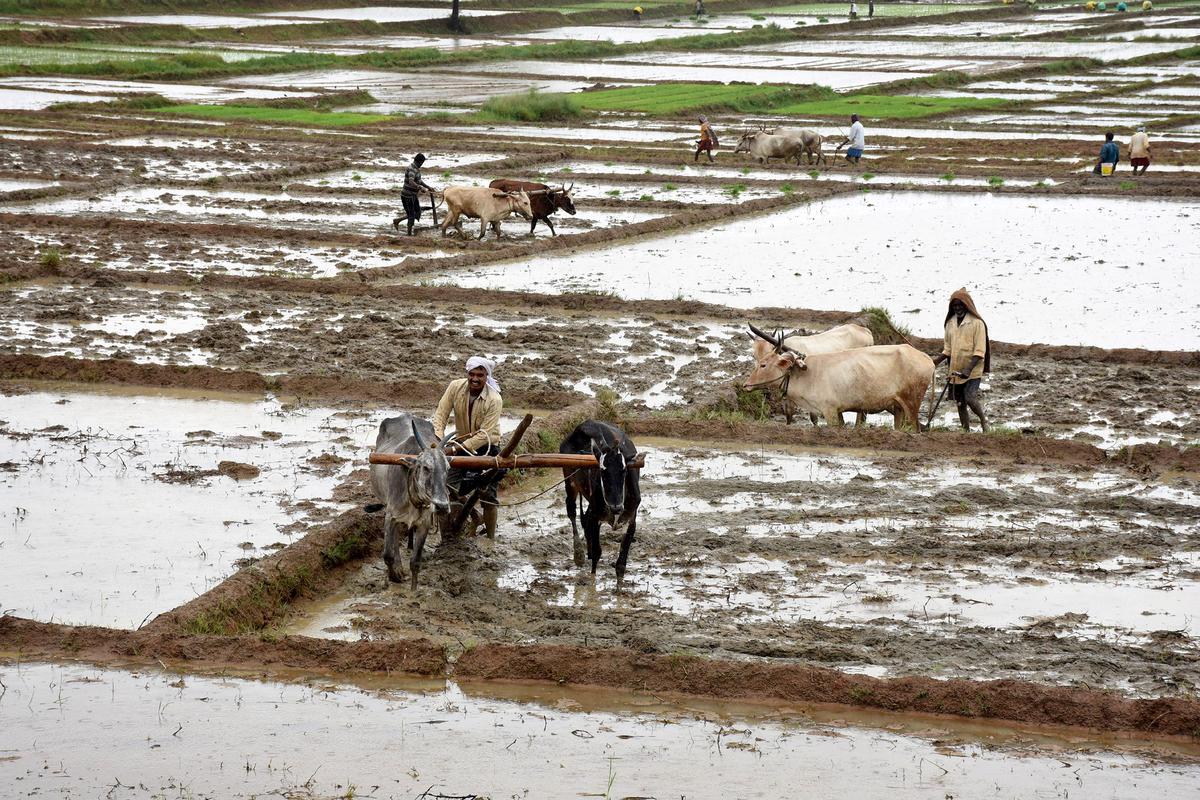
One of the insurance products of the centralized economy period was the insurance of agricultural products. The insurance of agricultural crops covered crops from the risks of fire, hail, torrential rains, hurricanes, frosts or floods. For the insurance of agricultural crops, an annual quota was paid that varied for each type of plant. For example, for the insurance of one hectare of wheat, an average of 220 Lek was paid, while for the insurance of one hectare of sugar beet, 400 Lek etc.
Insurance of shepherds and cattle
Another insurance product of those years was livestock and shepherds insurance. Even in this case, the fee was annual. The State Insurance Institute reimbursed damages caused by diseases and accidents of the living thing and reimbursed damages caused by slaughter in cases where slaughter was ordered by the veterinarian for health reasons.
How did external insurance work?
Starting from January 1961, external insurance was also organized that brought benefits to the country in foreign currency. In this context, Albania concluded agreements with insurance companies with all the countries with which it had commercial relations. The change in the geography of Albania's trade exchanges would also bring a change in the geography of foreign insurance in the 70s. In the mid-70s, Albania managed to sign insurance contracts with countries such as Vietnam, Korea or Algeria.
External insurance and reinsurance for goods that were exported and imported, insurance of vehicles circulating in the territories of other states as well as insurance of ships of the marine fleet were made based on the regulations of the Ministry of Finance.
All goods that were imported were secured by the institute, while goods that were exported were secured only in cases where the buyer requested it.
The Institute had branches in all the cities of Albania and had its agents or employees charged with this task.
The "collapse" of the economic system and the birth of INSIG
The insurance market remained state-owned until the 90s, when the change in the political and economic system gradually brought about the liberalization of the market and the return of foreign insurance companies to the Albanian market.
Subsequent legal changes resulted in the separation, in August 1991, of the Institute of Savings and Insurance. Apart from the Savings Bank in 1991, the Albanian Parliament created the only state institution that carried out insurance and reinsurance activities in the Republic of Albania, INSIG. In this way, for the following years INSIG carried out the activity of compulsory insurance of motor vehicles for liability to third parties until the period when private companies joined the market...
Source - www.voxnews.al