Agriculture remains one of the largest and most complex industries in the global economy, contributing over $3 trillion annually to global GDP and supporting the livelihoods of billions of people worldwide, according to data from the Food and Agriculture Organization and World Bank.
Yet despite its scale, agricultural investment has remained largely inaccessible to smaller participants, food supply chains continue to suffer from opacity and fraud, and crop insurance remains slow and out of reach for many producers.
At the same time, decentralized finance continues to evolve, with increasing focus on real-world asset integration as investors seek models grounded in tangible economic activity.
AgriFi, a blockchain-based agricultural finance ecosystem built on the Polygon network, is developing infrastructure that connects these two worlds, enabling structured participation in agriculture through tokenized farmland, data-driven transparency, and performance-linked staking mechanisms.
The ecosystem is organized around the $AGF token, an ERC-20 asset on Polygon that serves as the economic layer connecting three core areas of platform activity: food supply chain transparency, tokenized farmland investment, and parametric crop insurance. Rather than functioning as a single-purpose digital asset, $AGF is designed to provide holders with multiple stackable utilities, including passive staking yield, ownership of agricultural real-world assets, a share of farming revenues, and a voice in how the protocol develops.
A Structural Shift in How Agriculture Connects to Finance
Traditional agricultural investment is constrained by high capital requirements, geographic limitations, and limited liquidity. Meanwhile, many DeFi systems operate independently of real-world productivity.
AgriFi’s approach introduces a hybrid framework where:
- Agricultural assets are represented through tokenized structures
- Farm-level data enhances transparency
- Blockchain ensures verifiable participation
- Staking operates within a defined participation model
This creates a system where digital financial activity is aligned with real-world agricultural operations
AGF Token: A Functional Layer Within the Ecosystem
The AGF token is not designed as a single-purpose asset. Its role is defined by how it interacts with different layers of the AgriFi ecosystem.
The $AGF token is an ERC-20 asset deployed on the Polygon network, a Layer-2 scaling solution for Ethereum chosen for its near-zero transaction fees and high throughput, both necessary for a protocol that handles frequent interactions with tokenized farmland structures, including staking distributions, and participation in governance decisions that shape the ecosystem over time.
What makes this structure important is that the token does not sit outside the system as a tradable instrument alone. It operates within the system, linking user participation to underlying agricultural activity and platform-level mechanisms.
AGF acts less as a standalone asset and more as a connective layer between real-world farming operations and decentralized financial participation.
Four Utilities That Define What $AGF Does
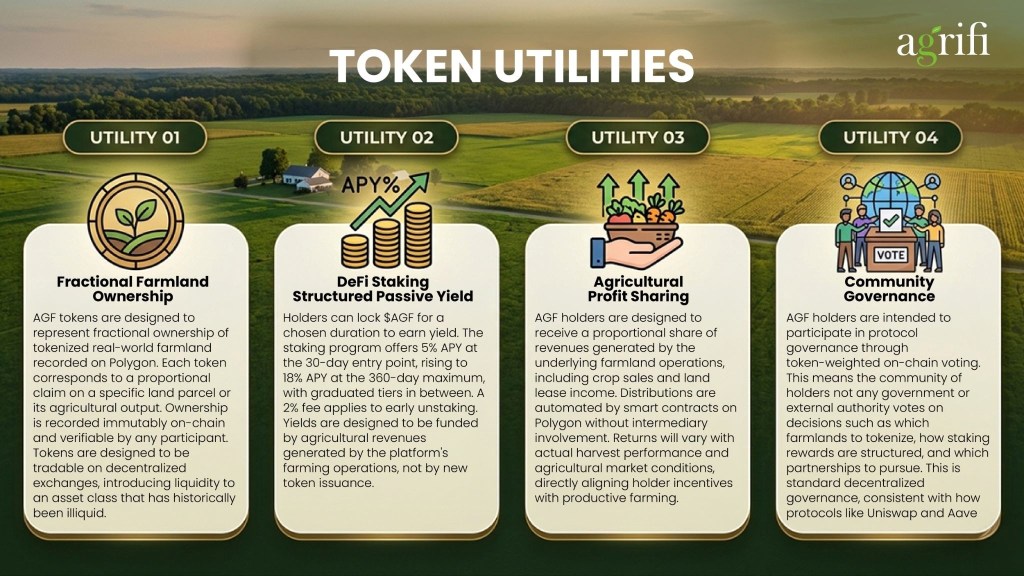
$AGF is designed to provide four distinct and stackable utilities within the AgriFi ecosystem. Each addresses a different dimension of how a holder interacts with the platform, from owning a stake in real farmland, to earning passive yield, to sharing in harvest revenues, to participating in community decisions.
Staking Structure: Lock Periods and Yield
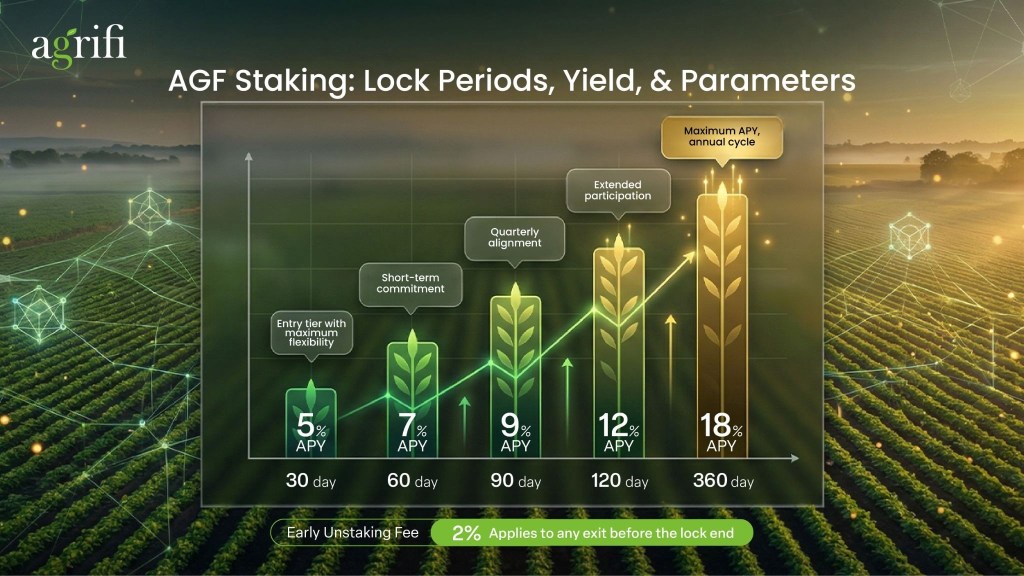
AgriFi’s staking framework is designed around multiple lock durations, rewarding longer commitments with higher yield. The structure is intended to encourage participation aligned with agricultural cycles rather than short-term speculative activity. Both the entry-level 30-day option and the maximum 360-day tier are explicitly documented; graduated tiers exist across 60, 90, and 120-day periods in between.
The documented yield range spans from 5 percent to 18 percent APY, depending on participation duration
The system is governed by smart contracts on Polygon, where:
- Rewards are calculated transparently
- Distribution logic is executed on chain
- A 2 percent early exit adjustment supports stability
This structure is designed to encourage longer-term alignment with agricultural cycles rather than short-term speculative behavior.
Staking yields in the AgriFi model are intended to be funded by revenues from the platform’s agricultural operations, a structural distinction from protocols that distribute yield through new token issuance. Actual returns will depend on platform performance and agricultural market conditions, and are not guaranteed
Multi-Layer Architecture
One of the more important aspects of the AgriFi ecosystem is how it connects real-world farming operations with blockchain-based financial logic. The platform is built on a layered architecture that separates responsibility while maintaining integration.
- Layer One: Blockchain Layer
Handles $AGF token transactions, staking participation, governance mechanisms, and on-chain ownership records. Deployed on Polygon for near-zero fees and high throughput.
- Layer Two: Business Logic Layer
Manages tokenization structures, farmland allocation models, staking reward calculations, profit distribution frameworks, and participation mechanics through smart contracts.
- Layer Three: Operational Layer
Integrates real-world agricultural activity, IoT farm monitoring, crop data, supply chain records, and insurance triggers with the on-chain infrastructure above it.
“Decentralized finance has introduced new ways to participate in financial systems, but the connection to real-world activity is still developing,” said Veronica Trump, CMO at AgriFi
“Our focus is to create a framework where agriculture and blockchain operate together in a structured and transparent way. The goal is not disruption for its own sake, but improving how participation, visibility, and access work within the system.”
Data-Driven Transparency: IoT Farm Monitoring
A defining feature of AgriFi’s architecture is its integration of IoT-enabled farm monitoring. This is not decorative; it is functional infrastructure that connects physical farm conditions to on-chain smart contract logic. IoT devices capture operational data including soil conditions and moisture levels, water usage and irrigation patterns, crop development and environmental conditions, and weather metrics relevant to both crop management and insurance coverage thresholds.
This data feeds the protocol in two key ways. First, it provides verifiable, real-time transparency into the performance of tokenized farmland assets, giving $AGF holders visibility into what their investment is doing. Second, it powers the parametric crop insurance mechanism, where smart contracts use oracle-fed IoT data to determine whether coverage thresholds have been reached and to trigger payouts automatically. By combining off-chain agricultural data with on-chain verification, AgriFi aims to reduce the information gaps that typically characterize agricultural investment and insurance markets.
$AGF Within the Real-World Asset and DeFi Landscape
The tokenization of real-world assets has expanded significantly in recent years, particularly across sectors such as real estate and financial instruments.
Agriculture, despite being one of the most fundamental sectors globally, has been slower to integrate into this framework.
This is partly due to its complexity. Agricultural assets are dynamic, location-specific, and influenced by environmental and operational factors. Translating these characteristics into a digital framework requires more than simple token representation.
AgriFi’s approach is to treat agriculture as an active system rather than a static asset.
By combining tokenized access, operational data, and structured participation models, this approach makes agricultural real-world assets accessible through fractional on-chain ownership. It also introduces liquidity through decentralized exchange participation The platform introduces a way to represent agricultural activity within a blockchain environment without oversimplifying it.
This positions agriculture as an emerging segment within the broader real-world asset landscape, with its own characteristics and participation models
About Agrifi
Agrifi is driving an agricultural revolution, harnessing blockchain technology to transform the agricultural supply chain. Our mission is to enhance transparency, efficiency, and sustainability in agriculture while empowering farmers and supporting small-scale agricultural practices.
Source - https://newsaffinity.com