When lettuce prices jumped to $10 off the back of extreme weather in New South Wales and Queensland it sent a shockwave through the nation, but some farmers in the flood zone were left relatively unscathed – because they grow under cover.
Now experts say protected cropping could be the key to keeping cabbage out of burgers and in spring rolls where it belongs and getting farmers back to planting after extreme weather.
What is protected cropping?
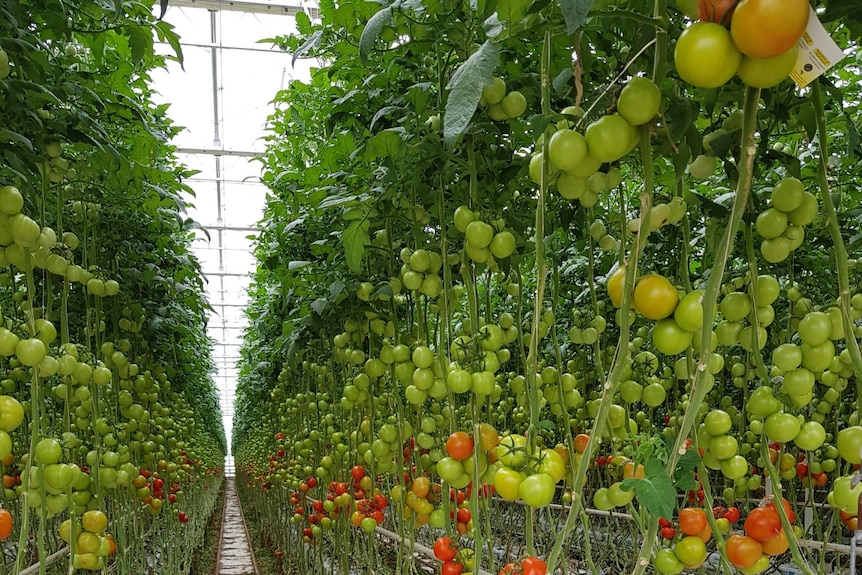
Protected cropping is the production of horticultural crops under or within structures.
It's more than just greenhouses according to Paul Gauthier, who is a professor of protected cropping with the Queensland Alliance for Agriculture and Food Innovation.
He says there are three different types of protective cropping.
"It can be a high tunnel that protects the crop from the weather, it can be inside a greenhouse, or it can be in a structure where it is fully indoors and the plants never see the sunshine," he said.
Protected cropping allows farmers to control the environment of the plants they grow, including the temperature, water and soil in some systems that use hydroponics.
Professor Gauthier says it can protect plants from the negative effects of weather.
"By putting everything indoors and controlling your inputs you can start predicting what the outcome is going to be and your plants are protected," he said.
"In the case of a storm event, as long as your building can resist the storm, then all of your plants will be safe and you can continue to produce food."
Skyrocketing demand
The system has been popular in Europe for years but it seems demand is taking off in Australia too.
Protected Cropping Australia is the industry body that represents farmers using hydroponics or greenhouses.
Executive officer Sam Turner says it is one of the fastest-growing production systems in the world.
"Internationally we see growth rates up to 10 per cent and in Australia we're seeing adoption rates around that 5 per cent mark," he said.
"There has been significant growth in the industry over the last five to 10 years and that seems to be accelerating in Australia."
Mr Turner says along with weather protection, the boom is being driven by the efficiencies that protected cropping provides.
"Some systems use up to 90 per cent less water for the same yields [and] yields are far higher because the plants are situated in a much more conducive environment," he said.
"It is easier for labour because there is a much more consistent crop, crop quality is a lot higher and it is a lot easier to manage pest and disease issues."
Can protected cropping mitigate flood events?
Tommy Vo and Michael Nguyen are growers of vegetables like eggplants and cucumbers in the Lockyer Valley in Queensland.
When two floods in 11 weeks tore through the area a few months ago, Mr Nguyen said he did suffer some crop losses, but nothing compared to neighbouring traditional farmers.
"Growing undercover means we have been able to mitigate the loss better because we are well protected," he said.
"With the recent floods this year we have kept out of the rain and protect ourselves pretty good given the circumstances."
Mr Vo said growing undercover meant not only was his crop protected from the rain but the farm also recovered from the flood faster.
"I had the flood that come through, the heavy rain come through and within a week I got a new crop in straightaway," he said.
"I just cleaned out, put new weed mats in, new coco peat in, all within a week.
"Even if you have crop loss, your turnaround time is a lot quicker than an open field grower."
Controlling the weather, instead of relying on it
Professor Gauthier says with more extreme and variable weather events hurting traditional farms, protected cropping will inevitably become more common.
"It will allow us to predict in the future what we can grow," he said.
"If the weather is getting too warm, some plants won't be able to grow in some areas of the world so we will need to be able to start controlling the environment rather than being dependent on it."
In the past, good growing conditions and available land meant Australian farmers did not need to invest in crop protection. Mr Turner says that is likely to change.
"With the recent floods around the country, we're seeing a lot of growers who traditionally wouldn't be looking at protective cropping moving into some type of protected system just as an insurance policy against some of the wild weather that we're seeing," he said.
Mr Nguyen and Mr Vo hope to inspire more growers in the Lockyer Valley to get on board with protected cropping.
"Sharing knowledge is power and the more we can share the more we can build a thriving industry," Mr Nguyen said.
"With Australia's growing demands and population increasing, I think the future will be brighter if we put the word out there."
Source - https://www.abc.net.au