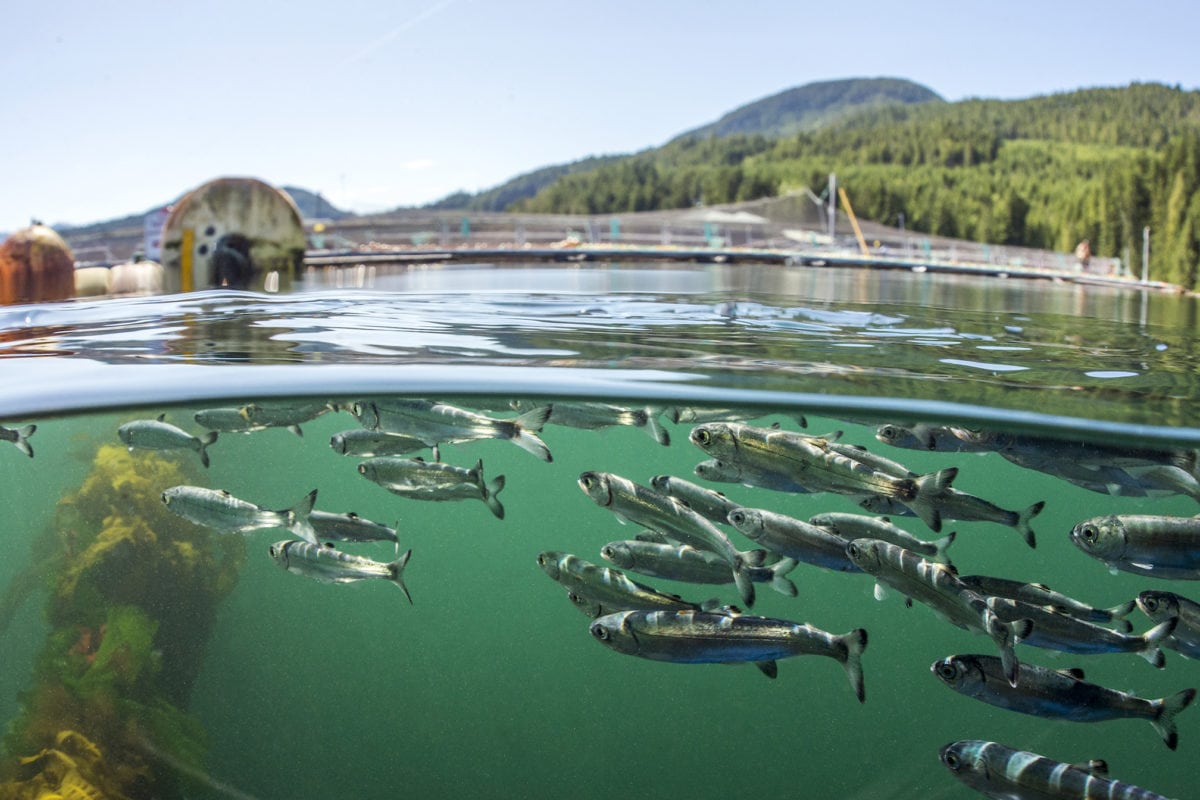
The Trudeau Liberals’ plan to ban marine salmon farms in British Columbia is set to saddle taxpayers with an astronomical $9 billion bill, states a new report that details the far-reaching economic, social, and environmental fallout of the government’s decision.
The “reckless” ban, largely aimed at appeasing the anti-fish farming lobby, will eliminate B.C.’s top agri-food export, destroy 4,560 jobs, and adversely impact over 1,000 Indigenous people directly and indirectly employed by the sector, estimates the economic analysis commissioned by the B.C. Salmon Farmers Association (BCSFA).
In addition to the devastating ripple effects that will be felt across Canada, over 1,400 vendors in the sector’s supply chain in B.C. will sustain losses of $437 million, with some having to shut down their operations.
The suffocating grip of poverty poised to reclaim remote First Nations communities in B.C., where salmon farming once broke the cycle of depression and suicides, is immeasurable, warned the report authors, RIAS Inc.
“What wasn’t included in the $9 billion bill to Canadian taxpayers announced today is the social cost to First Nations if Ottawa continues to ignore the rights, title, and self-determination of coastal Nations hosting salmon farms in their traditional territories,” said Dallas Smith, spokesman for the Coalition of First Nations for Finfish Stewardship (FNFFS).
“You cannot cut a cheque for the damage that will occur to impacted Indigenous communities if our salmon farming partners are forced to leave B.C. This includes increased suicides, overdoses, poverty, and the loss of our rights,” said Smith in a statement released alongside the report at a press conference in Ottawa today.
The economic impact analysis follows the federal Liberal government’s decision to disregard its own scientific experts and a wealth of peer-reviewed research demonstrating that salmon farming in British Columbia has negligible impact on wild stocks.
Instead, yielding to activist pressures, the Trudeau government is advancing a transition plan for ocean-based salmon farms in B.C., which includes a proposed ban on the sector beginning in 2029.
“The proposed ban is a reckless decision by the Trudeau government that ignores both science and economic reality,” said Brian Kingzett, Executive Director of the BCSFA.
“B.C. salmon farming companies, suppliers, and First Nations within whose territories we operate have communicated to the federal government that transition cannot be a ban on marine net-pen salmon farms in less than five years and maintain a viable farmed salmon sector,” he said.
“Unfortunately, these decisions made by the Trudeau government seem to have been co-opted by well-funded, anti-salmon farming activists, who have spent years pushing the false narrative that salmon farms significantly threaten wild Pacific salmon when peer-reviewed science says it does not.”
In recent weeks, anti-fish farming activist groups have been regurgitating the myth that “when salmon farms are removed, wild salmon population numbers rise.”
But years of continuous data collection on wild stocks near salmon farms show this isn’t true.
“Wild salmon populations went up and down before salmon farming began, they went up and down in the presence of salmon farms, and I am confident that wild salmon populations will continue to go up and down if salmon farms are removed,” said Dr. Gary Marty, a world-renowned veteran fish pathologist who, for the past two decades, worked with the Animal Health Centre of B.C.’s Ministry of Agriculture.
“However, we have good evidence that salmon runs have not declined in B.C. just because of salmon farms,” he said, adding, “I interpret this data as evidence that salmon farms and wild salmon can co-exist.”
At the press conference today, Smith from the FNFFS, who was joined by David Kiemele, Managing Director of Cermaq Canada, representing the salmon farming sector, emphasized that 100 percent of B.C.’s farmed salmon is produced in agreement with Rights Holder First Nations.
“Canada can avoid these unnecessary social and economic costs if they let Rights Holder First Nations lead the transition of salmon farming in their territories,” said Smith.
B.C.’s salmon farmers and their First Nations partners have consistently maintained that they are committed to continuous innovation, blending modern scientific advancements with the wisdom of traditional knowledge to ensure sustainable and progressive aquaculture practices.
But mandating the sector to transition to unproven technologies in a short time frame ignores the willingness of the sector to administer alternative innovations that can achieve the same outcome, they said.
“Innovative solutions need to be tailored to unique coastal characteristics and aligned with the goals of the Rights Holder First Nations who host salmon farms in their territories.”
The BCSFA and the FNFFS are urging Prime Minister Justin Trudeau to consider a more realistic, no-cost-to-taxpayers alternative to transition that would achieve the same outcome as a ban without imposing devastating impacts on the sector, on First Nations’ rights, and on coastal communities in B.C.
“Given the trade and economic crisis that this country continues to face, there’s an opportunity for the government to pivot to a positive direction on the future of salmon farming in B.C.,” said Smith, adding “We are part of the solution.”
By the Numbers
Financial Burden on Taxpayers:
Today’s report estimates that the total cost to Canadian taxpayers for compensating existing salmon farmers, suppliers, and First Nations, as well as subsidizing unproven new closed containment technology, would exceed $9 billion. This includes:
- $1.9 billion in financial losses for salmon farming companies.
- $1.9 billion in future lost profits for suppliers.
- Over $1 billion in financial losses for First Nations over the next 10 years.
Environmental and Market Impacts:
The ban will also lead to increased imports of farmed salmon from countries like Chile and Norway, resulting in higher carbon emissions and increased prices for Canadian consumers. The Canadian Aquaculture Industry Alliance (CAIA) estimates that the climate impact of air freight imports of salmon could equal the carbon footprint of adding about 84,000 cars to Canadian roads.
Socio-economic Ripple Effects:
The report predicts potential closure of businesses in fish processing, feed manufacturing, and high-tech equipment supply. Rural and coastal communities, particularly on Vancouver Island, would be hit hardest, losing meaningful career opportunities and the ability to attract and retain youth.
- The ban is projected to result in a loss of $1.17 billion in annual economic activity, $435 million in GDP, and 4,560 well-paid full-time jobs, with a combined annual payroll loss of approximately $259 million.
- Over 1,400 vendors across B.C. would lose $437 million in annual spending.
- The elimination of 50,000 tonnes of farmed salmon production would severely impact the province’s top agri-food export.
- Indigenous communities, which have benefited from $134 million in annual economic benefits and employment for over 1,000 Indigenous people, would face significant setbacks in economic development and reconciliation efforts.
Source - https://seawestnews.com