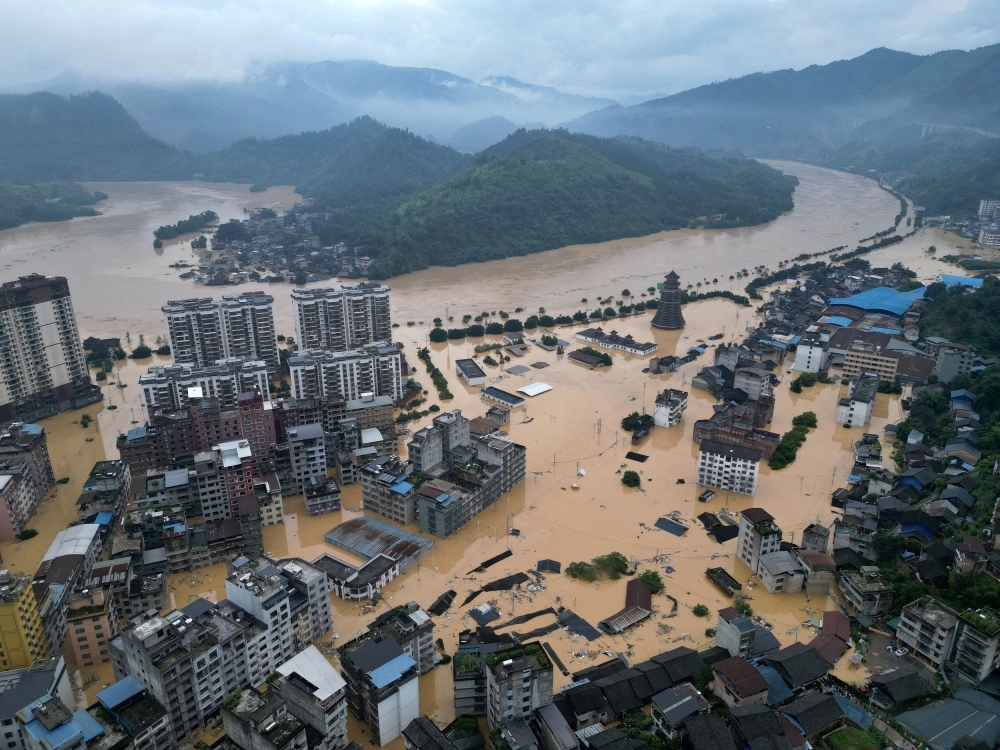
In May 2026, southern and central China experienced exceptionally heavy rainfall, which triggered widespread flooding, and caused multiple fatalities and displacement of tens of thousands of people. Several provinces also grappled with significant disruption to infrastructure, agriculture and supply chains.
The floods, which also occurred before the peak of the East Asia monsoon season, highlighted the growing challenge of what JBA Risk Management called “increasingly intense and unpredictable rainfall in one of the world’s most economically and operationally critical regions”, in an article on the event.
“A rapid accumulation of rain”
The impacts of the flooding intensified between 19 and 21 May, as extreme rainfall fell across already saturated catchments.
“The rapid accumulation of rain resulted in flash floods, overflowing rivers and landslides, prompting weather warnings, evacuations and the release of emergency response funds,” said the article.
“Flooding has mainly impacted communities around the Yangtze and Pearl river basins where some regions have received more than twice the typical rainfall for this time of the year.”
The article also stated: “NASA Global Precipitation Measurement (GPM) satellite estimates indicate that more than 400mm of rain fell across parts of Guangxi and Guangdong provinces over seven days, while Shimen county in Hunan province recorded 339.2mm in 24 hours from 16 to 17 May.”
Impacts of the severe flooding
According to JBA Risk Management, “large parts of Duyun city were impacted when the Jianjiang River burst its banks in southwest Guizhou Province, triggering a Level III emergency flood response”.
State-run media platform Xinhua noted that China has a four-tier emergency response system, with Level I being the most severe.
In another article, Xinhua also revealed that the Chinese government allocated yet another CNY160m ($23.6m) in in central natural disaster-relief funds on 26 May to support five provincial-level regions in southern China, on top of the CNY120m previously distributed.
Lastly, as the floods also coincided with China’s planting and harvesting season for wheat, agricultural operations in several areas were also impacted. To this end, China Life Property & Casualty Insurance received more than 360,000 agricultural insurance claims so far in 2026, the state-run media platform stated.
The insurer has also completed damage assessments worth nearly CNY3bn, and paid out about CNY2.9bn in compensation.
But according to JBA Risk Management, “the full impact on the 2026 wheat harvest remains uncertain, as 58% of the crop was still to be harvested later in the year”.
Climate risk and changing flood patterns
“Flood risk in China is influenced by large-scale climate patterns that affect rainfall across East Asia,” said JBA Risk Management’s article.
“Changes in ocean temperatures can alter atmospheric circulation, influencing the timing, intensity and duration of rainfall during the monsoon season.”
One climate system that influences the East Asian summer monsoon is the El Niño-Southern Oscillation (ENSO), with the other being the Indian Ocean Dipole (IOD).
El Niño, the warm ENSO phase, is “often associated with enhanced rainfall across the Yangtze River basin and parts of northern China”, said the article. On the other hand, “a positive IOD, warming in the western Indian Ocean, can increase rainfall across several major river catchments, including the Yangtze, Huaihe and Yellow rivers”.
El Niño conditions are forecast to develop during 2026, with the National Oceanic and Atmospheric Administration (NOAA) estimating an 82% chance of El Niño by July. The World Meteorological Organization has also forecast the potential development of a positive IOD later in the year.
Put together, these climate patterns may influence rainfall across China during the second half of 2026 and into 2027.
A protection gap
“Despite the scale and recurrence of flood losses, insurance penetration for flood risk in China remains limited,” said the article. It also noted that during the July 2023 heavy rainfall event in the Haihe River basin, direct economic losses reached CNY166bn. Of these losses, only 7.6% were insured.
As exposure rises in major economic regions, the scale of this gap highlights the growing need for robust risk quantification and reinsurance support, JBA Risk Management noted.
“Although catastrophe insurance products have gradually emerged in the Chinese market, coverage remains constrained,” the article stated.
“In July 2024, insurers reportedly received at least 95,000 catastrophe-related claims, with total losses estimated at CNY3.2bn and insurance payouts of approximately CNY1.1bn.”
And although China’s non-life insurance sector is performing well, the reinsurance cession ratio for catastrophe risk has been noted to remain low at around 10%.
“This limits the sector’s ability to efficiently transfer peak flood risk and scale affordable coverage,” said the article.
Other limiting factors include an unwillingness among insurance companies to offer flood insurance, the article noted, as well as low willingness to purchase flood protection among the public.
Despite these challenges, China has reduced flood damage through sustained investments in protection, with JBA Risk Management noting that “major disaster events, fiscal capacity and policy shifts playing a key role in shaping long-term resilience spending”.
Source - https://www.asiainsurancereview.com