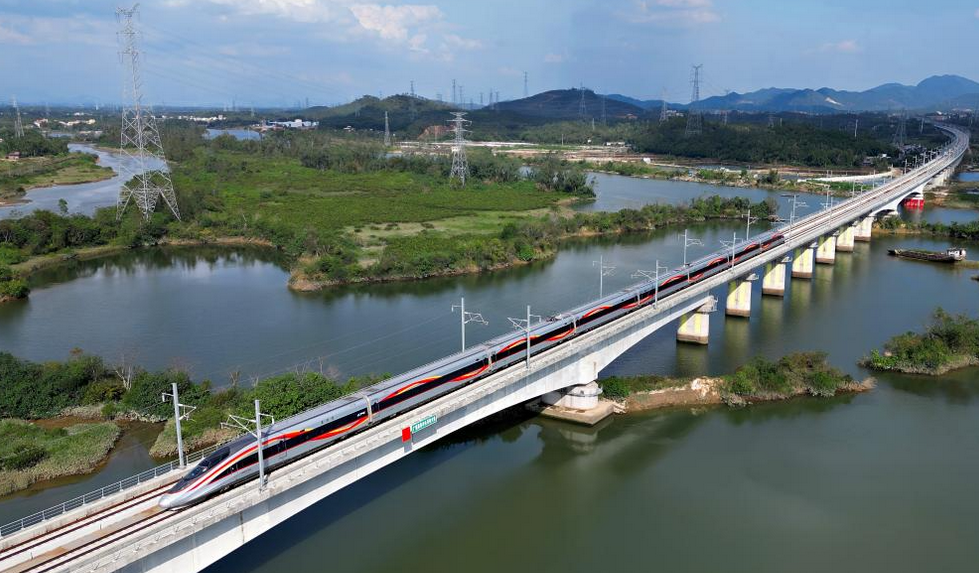
Train number G9785 was ready to depart Guangzhou Baiyun Railway Station at 10:30 am on Monday for Zhanjiang in western Guangdong province, marking the official commencement of the newly built Guangzhou-Zhanjiang high-speed railway.
At nearly the same time, train G9787 departed Shantou in eastern Guangdong for Guangzhou as the section between Shantou and Shantou South railway stations along the Shantou-Shanwei high-speed railway also began operations.
The 19.8-kilometer section connects both sides of Shantou Bay. The project brings the main urban area of Shantou into the era of 350-km-per-hour high-speed rail while creating an east-west synergy with the simultaneously opened Guangzhou-Zhanjiang line.
The operation of the two new lines helps connect Zhanjiang and Shantou — two major sub-center cities in western and eastern Guangdong, respectively — to a two-hour transportation circle within the Guangdong-Hong Kong-Macao Greater Bay Area, according to railway operators.
The Guangzhou-Zhanjiang line, which has a design speed of 350 km/h, passes through cities including Foshan, Zhaoqing, Yunfu, Yangjiang and Maoming.
Construction on the line began early in 2019. The railway significantly reduces travel time between western Guangdong and the core area of the Pearl River Delta region to less than two hours.
The railway spans approximately 401 km, with bridges and tunnels accounting for 76.7 percent of the route in western Guangdong.
The 9,640-meter Zhanjiang Bay undersea tunnel, a key engineering feature of the line, set a record for the longest single-head tunneling distance for a large-diameter undersea tunnel in China.
"During the construction process, we faced world-class challenges such as complex undersea geology and high-water pressure," said Zheng Wei, an engineer from the Guangdong Guangzhou-Zhanjiang Railway Co.
The project team adopted several new technologies, including intelligent tunneling, to overcome difficulties during construction, according to Zheng, who participated in the maiden journey on Monday.
The opening of the high-speed rail between Guangzhou and Zhanjiang has provided a boost to modern agriculture in western Guangdong. In the Genzi township of Maoming, famously known as the hometown of lychees, a major farmer surnamed Long was busy inspecting a brand-new packaging production line.
"We are making thorough preparations for next year's lychee season," Long said.
With the opening of the rail line, more people are expected to visit the township.
"Our channels for selling high-quality lychees externally to the Greater Bay Area and beyond will further expand," he said.
Meanwhile, the Shantou-Shanwei railway, also with a design speed of 350 km/h, connects eight districts and counties across the cities of Shantou, Jieyang and Shanwei. It serves as a corridor linking eastern Guangdong with the Greater Bay Area.
The travel time reduction is expected to empower the industrial development of Shantou, a traditional manufacturing and trade base for toys, gifts and garments.
In the Chenghai toy creative industry park in Shantou, a buyer from Shenzhen surnamed Chen was negotiating business in the sample showroom of Alpha Group Co.
"In the past, I had to allocate two days for business trips to Shantou, and it took an additional hour to reach Chenghai district from Shantou South Railway Station," Chen said.
With the opening of the high-speed railway, Chen was able to quickly reach the manufacturing and trade base.
"Now I can select products in the morning, sign deals in the afternoon and return to Shenzhen in the evening," Chen said.
The operation of the two new lines has helped facilitate the construction of a more efficient transportation network in Guangdong during the 14th Five-Year Plan period (2021-25), according to China Railway Guangzhou Group.
Total railway operating mileage in the province has reached 6,433 km. High-speed railways operating at speeds of 200 km/h or more account for 3,411 km, according to the railway company.
Source - https://info.newsgd.com