Farmers in Xinjiang Uygur Autonomous Region, an inland region in northwest China, have been busy harvesting salmon, lobsters and hairy crabs – and now pearls.
They are confident that people will soon be buying jewelry made with aquatic products grown in the deserts of their landlocked home.
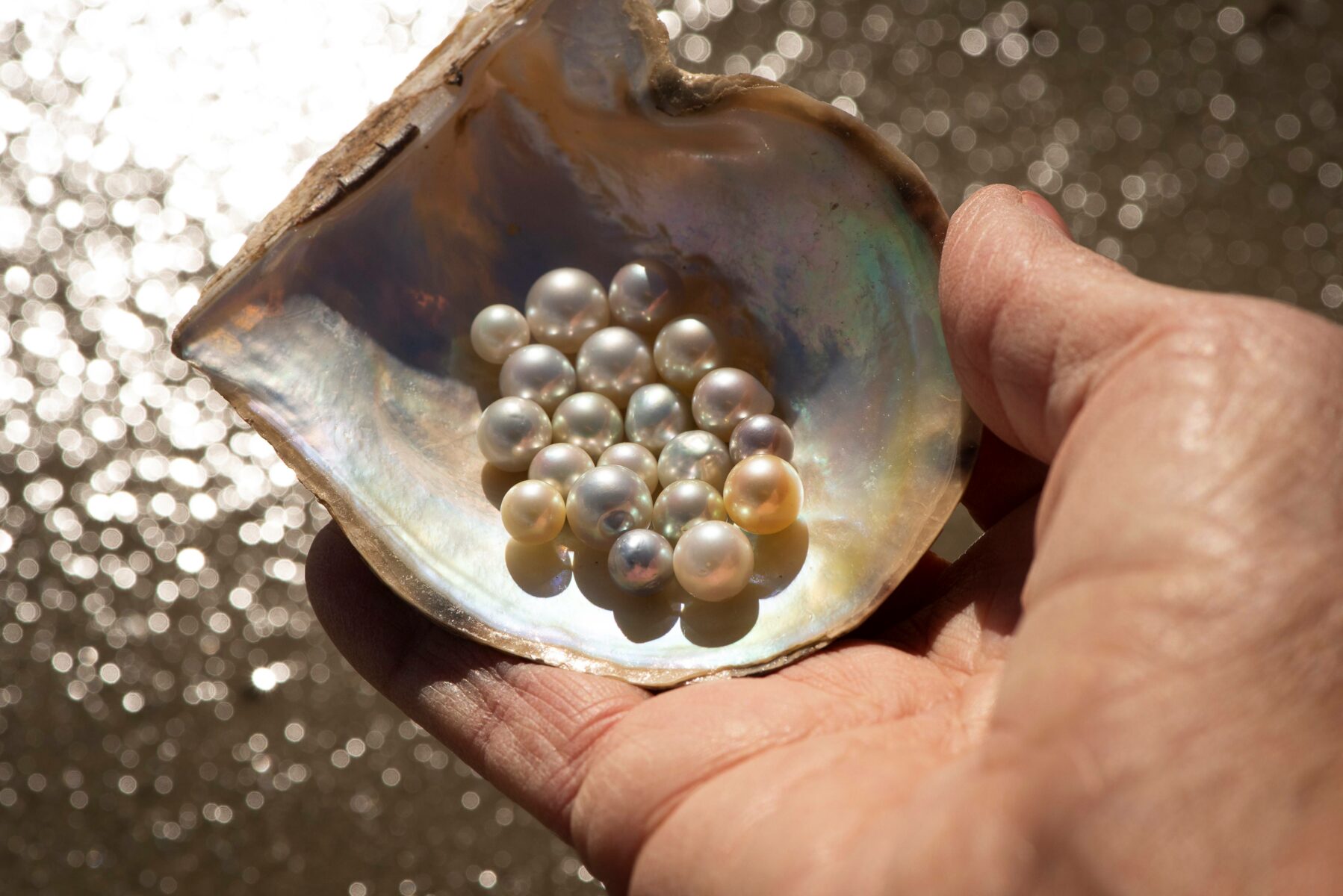
A video of a local farmer showcasing a handful of pearls has been circulating on Chinese media in recent weeks.
The pearls were harvested from oysters cultivated on a seafood breeding base in Qiemo County, which is situated at the heart of the Taklimakan Desert in Xinjiang.
Local agriculture technicians say that trial breeding has been successful, and they anticipate the market launch of the Xinjiang pearls next year.
Pearls are the latest endeavor of Xinjiang’s aquaculture sector.
Locals say that the sparsely populated hinterland – located far from industrial pollution – provides an ideal environment for the cultivation of premium aquatic products, and that innovative local breeding techniques can enhance the desert aquaculture industry.
Hailing from south China, Chen Jiazhen is an aquaculturist with over 20 years of experience and is currently the chief technical consultant of the seafood breeding base.
During a trip to Xinjiang in 2021, he was intrigued by the natural environment and thought of establishing an aquaculture business there.
Xinjiang is home to numerous rivers, lakes and reservoirs. However, its long hours of sunlight, dry climate and extensive saline-alkali land pose challenges for plant growth and aquaculture.
Since 2017, the Chinese government has been encouraging the exploration of saline-alkali aquaculture, and Chen saw an opportunity in this.
He and his partners from China’s southern provinces established their company, Shishixian, in Xinjiang’s Kizilsu Kirgiz Autonomous Prefecture in July 2022.
After numerous experiments, they used microorganisms to create circulation systems that transform local salt lake water into seawater suitable for marine fish farming.
Their efforts to make artificial seawater have yielded numerous patented inventions and boosted the breeding of various species, including fish, shrimp, abalone and crab species.
Like Chen, many of Xinjiang’s aquaculture farmers have undertaken independent research and development, and sought scientific and technological assistance from universities and research institutions to simulate the ocean environment.
Pacific white shrimp, Australian crayfish and African tilapia are among the seafood types that must be cultivated in high-quality breeding water with strict temperature and salinity requirements – and they can be bred in many parts of Xinjiang.
The region’s aquatic industry has gradually gained popularity nationwide and become a new option to satisfy the increasing demand from China’s growing middle-income group.
Seafood labeled to show it was harvested in Xinjiang is now available in restaurants and supermarkets in Beijing and other major cities.
The success of their fishery business soon motivated Chen and his partners to enter the high-end market, and they began focusing on pearl cultivation.
Their microbial technology can transform the organic waste produced by fish into essential substances such as amino acids and nitrates, according to Chen.
These compounds are crucial for the growth and health of aquatic plants, providing nutrient-rich food for pearl oysters.
“No chemical additives are used in the farming cycle,” Chen noted.
“According to local environmental regulations, we are required to achieve zero emissions and zero pollution.
“We cannot simply add the missing elements to the water, as this would result in more sediment in the ponds,” he added.
Chen’s thriving business has also been supported by the continuous improvement of local infrastructure.
Thanks to rapid progress in high-speed rail networks, civil aviation transport, power supply, and cold chain logistics, aquatic products from Xinjiang can now be delivered to coastal provinces such as Jiangsu and Zhejiang within a single day, making these destinations as convenient as almost anywhere else in China.
Inland aquaculture is satisfying Chinese people’s appetite for diverse aquatic products, and it is also contributing to local prosperity.
According to local agriculture authorities, Xinjiang produced 184,000 tonnes of aquatic products in 2023, generating an output value of 3.86 billion yuan (about US$537 million) and providing jobs for 13,600 people.
They predict that by 2025, Xinjiang’s entire fishery industrial chain will generate an approximate output value of 20 billion yuan.
Gong Yonghong, chairman of the Qiemo-based company behind the pearl cultivation, attributes the transparency and superior quality of the pearls in part to the significant temperature difference between day and night in Xinjiang and to the region’s long sunlight hours.
Although Xinjiang’s pearl farming is still in its infancy, the delicate products that have resulted from trial breeding have already captured the interest of buyers in various regions of China, including the Hong Kong Special Administrative Region.
If the quality of his company’s pearls remains high in subsequent experiments, Gong says that he plans to invite jewelry companies to open branches in Xinjiang, where they can develop a comprehensive industrial chain that would contribute significantly to local economic growth.
Source - https://www.theborneopost.com