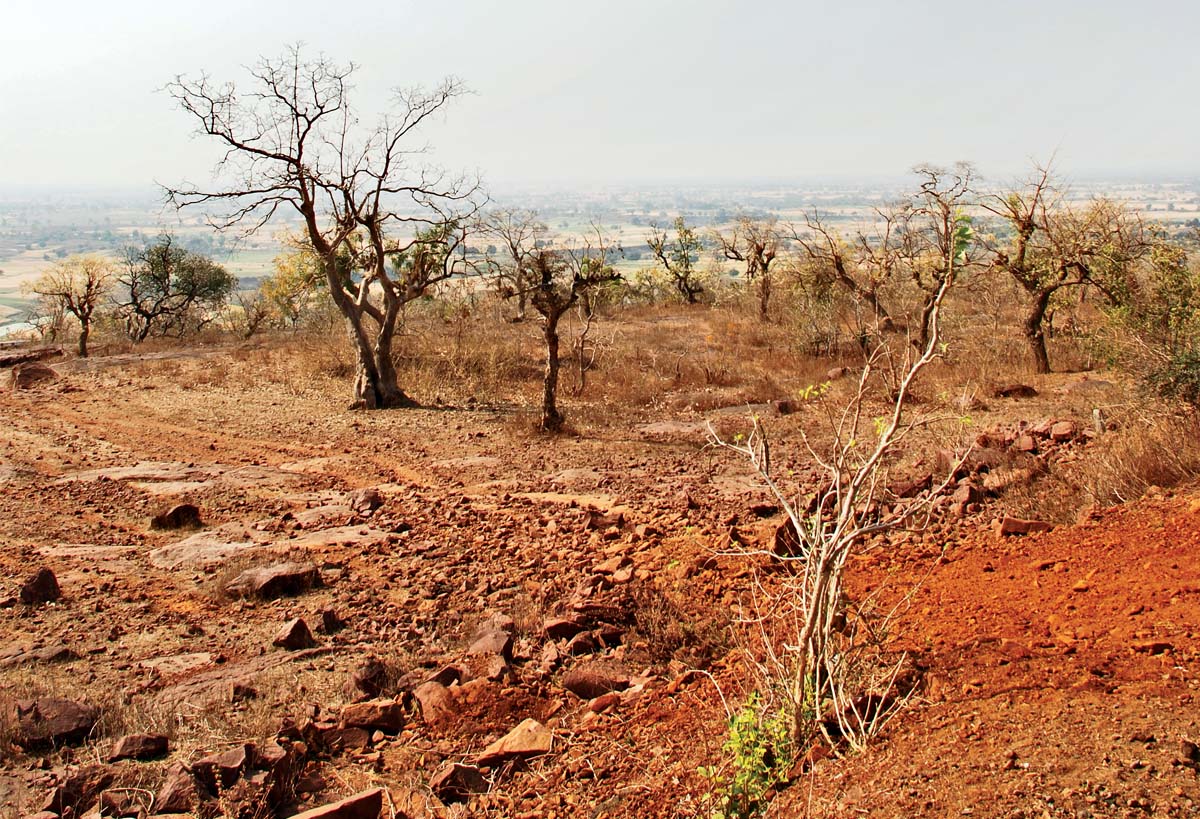
Up to 40 percent of our planet’s land is degraded, directly affecting half of humanity and threatening about 50 percent of global GDP. By 2050, if we don’t change our trajectory, an additional area almost the size of South America will become degraded, with dire repercussions for climate, biodiversity, and human life.
That was the stark warning issued by the United Nations Convention to Combat Desertification (UNCCD) in its second Global Land Outlook report (GLO2). The report was released on 27 April 2022, in the lead-up to the UNCCD’s 15th session of the Conference of the Parties (COP15) to be held in Abidjan, Côte d’Ivoire, from 9 to 20 May. It is the most comprehensive report on land and land degradation ever written and was developed over five years with 21 partner organizations and over a thousand scientific references.
The GLO2 explores the planetary consequences of three scenarios for the upcoming decades to 2050: business-as-usual, restoration of 5 billion hectares (35 percent of the global land area), and restoration plus conservation of natural areas that serve particularly important ecosystem functions.
Under business-as-usual, land degradation would claim large swathes of the planet; agricultural productivity would decline in many areas, particularly sub-Saharan Africa; and an additional 69 gigatons of carbon would be emitted. Under the restoration scenario, crop yields would increase by 5 to 10 percent in most developing countries, limiting food price increases, while carbon stocks would rise by a net 17 gigatons; however, biodiversity would still continue to decline. In the restoration-and-protection scenario, a third of baseline biodiversity loss would be prevented, and 83 gigatons of carbon would be stored compared to baseline.
“Conserving, restoring, and using our land resources sustainably is a global imperative, one that requires action on a crisis footing,” noted the report’s authors. “Business as usual is not a viable pathway for our continued survival and prosperity.”
To meet countries’ current combined pledge to restore a billion hectares by 2030, it’s estimated that USD 1.6 trillion will be required in total. For comparison, USD 700 billion are currently injected every year into harmful fossil fuel and agricultural subsidies.
“Investing in large-scale land restoration is a powerful, cost-effective tool to combat desertification, soil erosion, and loss of agricultural production,” said Ibrahim Thiaw, UNCCD’s executive secretary, in a press release. “As a finite resource and our most valuable natural asset, we cannot afford to continue taking land for granted.”
Thiaw emphasized the importance of transforming the ways we produce food. “Modern agriculture has altered the face of the planet more than any other human activity,” he said. “We need to urgently rethink our global food systems, which are responsible for 80 percent of deforestation, 70 percent of freshwater use, and the single greatest cause of terrestrial biodiversity loss.”
The report shared hundreds of ‘snapshots’ of successful land restoration practices across the globe, such as regenerative agriculture and rewilding, and integrated regional initiatives like Africa’s Great Green Wall. “The case studies from around the world showcased in GLO2 make clear that land restoration can be implemented in almost all settings and at many spatial scales, suggesting that every country can design and implement a tailored land restoration agenda to meet their development needs,” said Thiaw.
“The findings really are very clear,” said UNCCD’s managing director, Louise Baker. “With our management and misuse of land resources, we have already done a lot of harm. Now we are at a crossroads; if we follow the wrong path, the future is very bleak.
“But there is an alternative path – to my mind the only right path. We can put right what we have damaged and destroyed and stop the loss of land resources,” she added. “It could be a game-changer for humanity.”
Source - https://news.globallandscapesforum.org