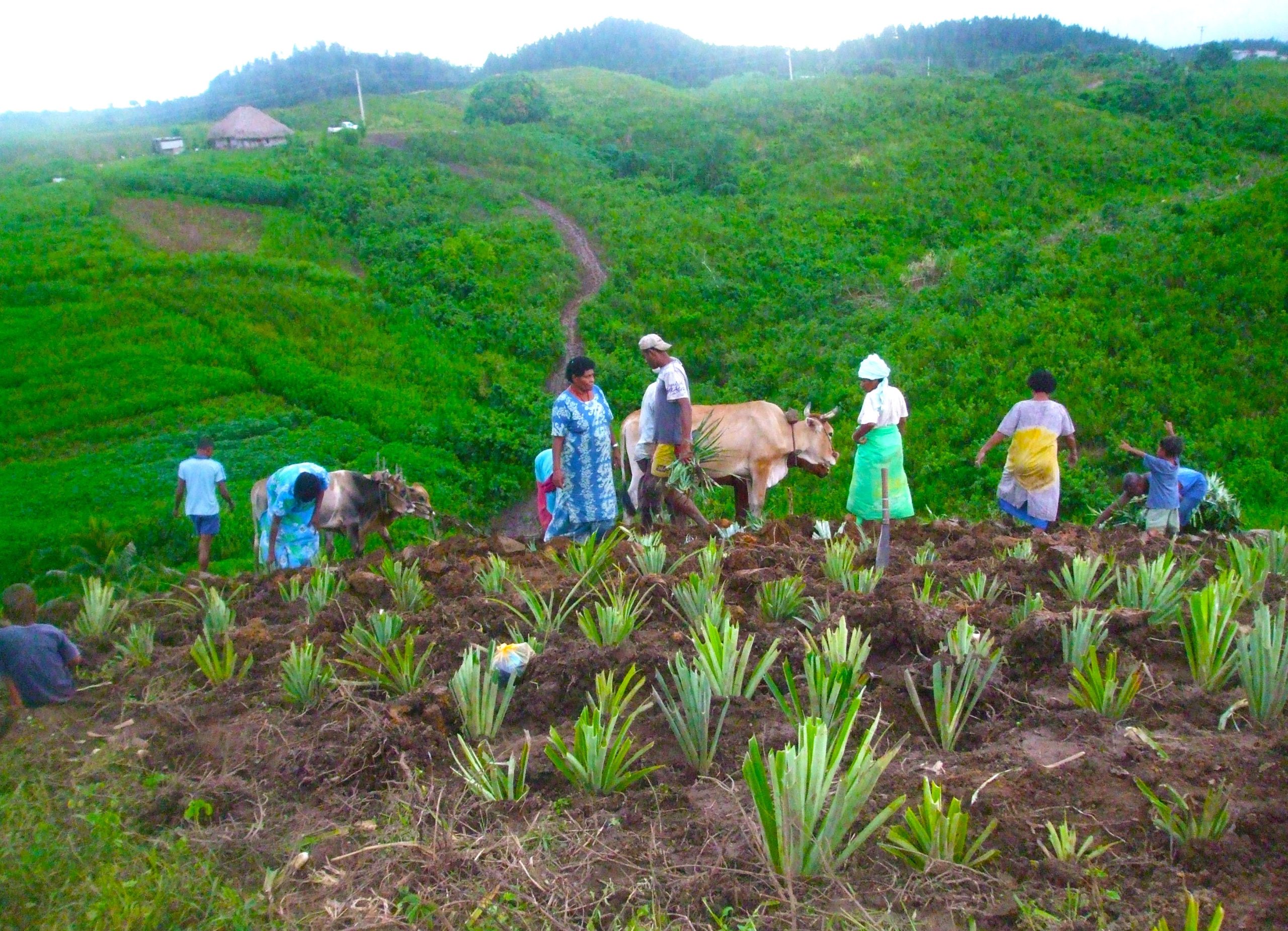
Over the past 10 years, natural disasters have wreaked havoc through farmlands costing Government more than $700million.
This is why the introduction of a crop insurance cover is being pushed by Government to assist farmers across the country recover quickly from damages left behind by a tropical cyclone.
Explaining this new initiative during the recent Parliament sitting, Minister for Agriculture and Sugar Industry Tomasi Tunabuna said this was a strategic shift in the country’s national policy moving towards crop insurance as a primary mechanism for rehabilitation and recovery.
Government cost
Mr Tunabuna highlighted since 2016, Government had racked up a bill of more than half a billion dollars most of which was sustained during Tropical Cyclone Winston.
“When TC Winston tore through our islands in 2016, it broke the economic spine of thousands of our families,” he said.
“It cost an estimate of $F542million in damage, affecting roughly 20 per cent of our commercial farmers.
“TC Yasa inflicted $F147million in losses, impacting 15 per cent of our commercial sector.”
The minister revealed an even worse trend recorded over the last four years.
“From TC Cody in 2022, TC Mel in 2023, devastating flood in 2024, and to the most recent TC Vaianu in 2026, we have seen a pattern, where even lower intensity events cause cumulative debilitating losses.”
Farming and insurance
“The structure of our farming communities is that 83.6 per cent of farming households are small scale. These are families living on the margins, where a single flood can mean the difference between sending a child to university or falling into a cycle of debt,” said Mr Tunabuna.
“Only 16.4 per cent of farming households operate a medium-to-large commercial scale.
“An intervention we design must be inclusive, accessible as the small-scale dalo farm in Taveuni as it is to the large-scale commercial poultry or sugarcane produced in Labasa.”
He said through local providers such as Sun Insurance, Fiji Care and Capital Insurance, in partnership with international development agencies, the country has seen the introduction of parametric micro-insurance and bundled products.
“This has been particularly vital in our sugar sector, which has long served as a testing ground for risk sharing mechanisms.
“The sugar industry has taught us that insurance works best when it is integrated with financing and farmer support program.
“It has shown us that while insurance can provide partial income protection and improve sustainability, penetration remains limited without two things – awareness and incentive.”
He said the ministry was now looking beyond traditional models.
“We are actively exploring the expansion of the parametric insurance to the public, and to those unfamiliar with the term, traditional insurance models often require an insurance agent to physically visit a farm, assess crop damage, and argue over the value of the losses.
“This process is long, and in many cases, by the time the compensation is disbursed, the planting season has already passed, leaving farmers unable to recover and sustain production.”
Parametric insurance
Mr Tunabuna insisted this form of insurance was different.
“It is triggered automatically based on pre-defined data – wind speed, millimetres of rainfall, or the track of the cyclone.
“The wind hits a certain speed the payout is triggered.
“The rain exceeds a certain level the payout is also triggered.”
He said the advantages were clear.
“Speed payouts can reach farmers in days, not months, allowing them to replant immediately.
“The transparency, there is no dispute over the value of damage, and the data speaks for itself.
“When we talk about efficiency, it reduces the massive administration cost of sending assessors to every remote farm in our maritime provinces.
“For a small island development state like Fiji, where a timely response is the difference between food security and food imports, parametric insurance is the most logical path forward.”
Mr Tunabuna believes the reason for the ministry’s intention to move rested on several reasons.
“Firstly, it enhances farmers’ confidence.
“When a farmer knows they have a safety net, they are more likely to take the leap from subsistence to commercial agriculture. They are more likely to invest in better seeds, better machinery and better technology.
“Secondly, it reduces the fiscal burden on the Government.
“Every dollar that the insurance company pays out is a dollar that the government does not have to divert from health, education and infrastructure for post-disaster support.
“We are moving from a model of government-funded disaster relief to a model of market-led disaster recovery.”
The task ahead
He added this vision was not a stand-alone project.
“It is a core pillar for Horizon 2030 – Fiji’s pathway to a safe, resilient and innovative food system.
“Under this framework, we are planning to develop a national crop insurance program that will establish a public-private partnership to bring global insurance expertise to Fiji, introduce a targeted premium subsidy to ensure that our most vulnerable and most productive commercial farmers can afford coverage and invest in high-tech climate data system and digital tool to ensure our insurance triggers are accurate and fair.
“We will link insurance with concession findings so that an insured farmer is also a bankable farmer.”
Mr Tunabuna, however, says while the new insurance cover could pave the way for better agricultural recovery and rehabilitation, ensuring there were no loopholes was important.
“We know the challenges and we need better weather data.
“We need to build trust with farmers who have never used insurance before.
“We need to ensure that premiums do not become a burden that outweighs the benefits. We are moving towards a more resilient, protected, and investment-ready agriculture sector.”
He concluded while a fully established nationwide scheme required careful, evidence-based design, Government was taking a deliberate step to ensure that farmers were never left alone to face the fury of the elements.
“We are shifting from uncertainty when waiting for aid to security with guaranteed recovery.
“This is how we protect our food security and this is how we protect our economy and protect our people.”
Source - https://www.fijitimes.com.fj