Crop insurance is one of the most important protections against climate-related risks for farmers. Despite being heavily subsidized, insurance take-up in France remains surprisingly low. The goal of this paper is twofold; first, we explain this paradox by analyzing the heterogeneous effects of taking up crop insurance, and second, we provide concrete welfare-enhancing policy recommendations to increase insurance take-up. Using a micro-level panel of 17,000 French farmers over 20 years, we first use a moment-based regression to identify the local average treatment effects (LATE) of insurance on expected revenues and variance. Then we investigate the factors causing the heterogeneity in these effects, both observable through interaction terms and unobservable through a marginal treatment effect (MTE) design. We conclude that insurance subsidies have very little impact on crop insurance demand, especially for those who would benefit the most. Finally, we suggest cost-efficient ways to increase insurance take-up based on administrative simplification, information and imitation.
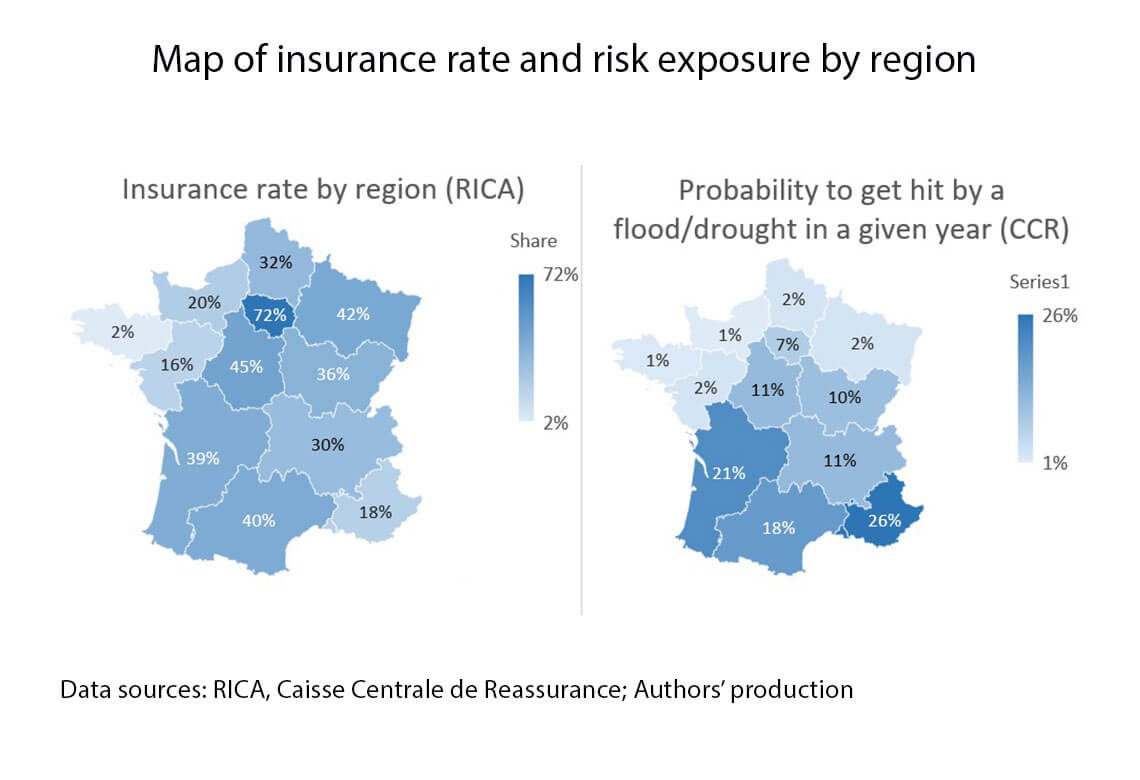
The penetration rate of crop insurance is low in France. Only 13.3% of farms were insured in 2020, and the numbers are stable, perhaps in slight increase, from 12% in 2016. Yet, farming is a risky activity and the climate, a driver of the yearly yield variations, is changing towards more frequent extremes. This begs the question: why is adoption so surprisingly limited? Not only is the need for protection insurance is clear, but insurance premiums are highly subsidized and insurance has a net positive impact on earnings, according to the literature. Providing insight into this paradox is the main motivation behind this paper.
First, we provide a new evaluation of the impact of crop insurance on farmers’ revenues mean and variance to determine to what extent subscription is an attractive choice. Second, we explain the low take-up through an analysis of the observable determinants of crop insurance subscription. We go beyond treatment effect by exploring the heterogeneity inasmuch as it is partly explained by observables, as expected, but also with structured unobservables. Third, we perform counterfactual analyses of policies to explore their efficiency in both increasing the take-up rate and yielding high benefits for farmers.
We combine a variety of econometric methods, including the most flexible and adequate selection model to analyze, jointly and distinctly, choice and expected benefits: the Marginal Treatment Effect (MTE) framework à la Heckman & Vytlacil. The MTE approach has, to our knowledge, never been used in the context of crop insurance. It allows counterfactual analyses and provides key insights regarding the right policies to maximize insurance take-up and social welfare.
Thanks to our methodology and data, our results are therefore more precise, realistic and actionable than those of previous studies. Our results are generally in line with the previous literature as far as averages are concerned (i.e. insurance take-up is generally beneficial to farmers), yet the details are extremely interesting and they have been overlooked thus far. First, we show that, in France, not everyone benefits from insurance. Larger farms and those engaged in other protection behaviors notably draw much smaller, if not negative, benefits from their subscriptions. Second, we find a "contrarian" selection where, in most cases, farmers who would benefit the most from insurance tend to insure the least. This is true both across and within observable characteristics, i.e., even when conditioning on observables, the contrarian selection still occurs, meaning that there are unobservable barriers to subscriptions (beliefs, non-financial barriers, etc.). Third, we show that the level of insurance subsidies is not the issue causing the low insurance subscription, as increasing insurance subsidies would not cause a large increase in take-up, and those newly insured farmers would actually derive little benefit from their contracts. Instead, overcoming the non-financial barriers to insurance (i.e. information, paperwork) by directly targeting the propensity score (probability to insure) appears to be the optimal way of tackling this issue. Pursuing a goal of 100% of insured farmers might not be a feasible nor a desirable outcome, and smaller, more specialized farms should be targeted instead.
To perform this large-scale analysis across mainland France over a 20-year period, we produce a unique and highly granular dataset composed from individual data on farmers. This dataset combines several sources; it includes agronomic and financial variables coming from the French “Réseau d’Information Comptable Agricole” (part of the European Farm Accountancy Data Network), weather data at a 0.1°×0.1° resolution (from Copernicus) and administrative data for climate disasters (from the French public reinsurer, Caisse Centrale de Réassurance).
Source - www.banque-france.fr