India - Giant African snails trigger fresh alarm in Goa; agriculture dept begins state-wide checks

16.11.2025 517 views

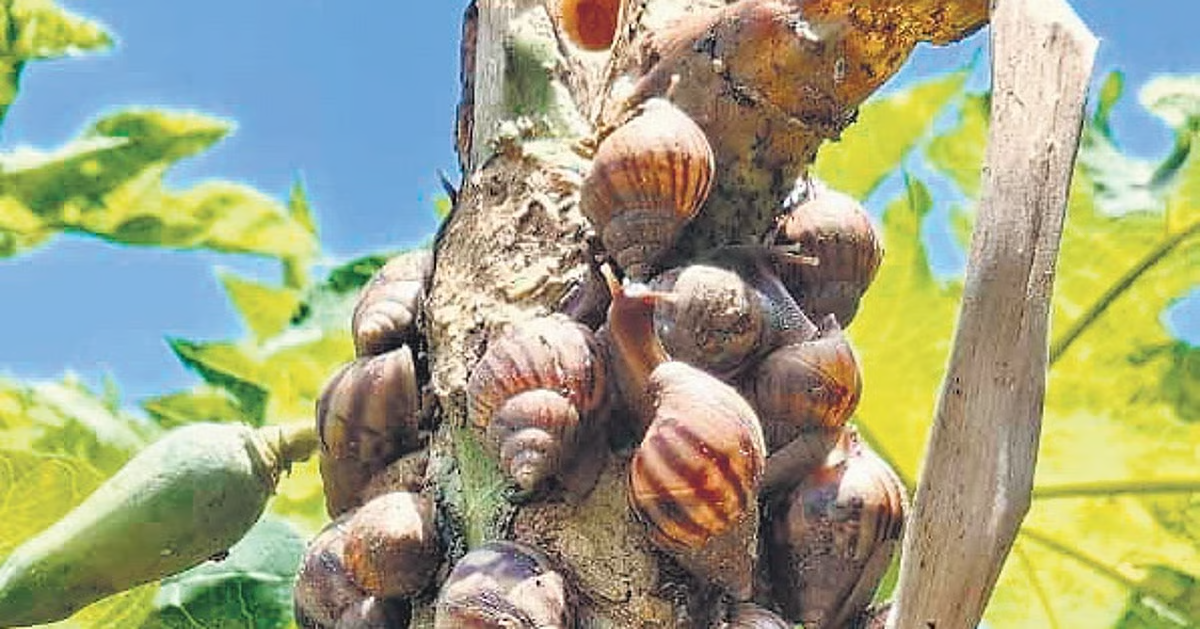
Alarming reports of Giant African Land Snails (GALS) — an invasive species known to wreak havoc on agriculture — have prompted Goa’s agriculture department to launch a state-wide inspection drive. Officials have been directed to collect field-level data on the presence of the pest, following concerns raised by the Goa State Biodiversity Board (GSBB) over its rapid spread.

In recent weeks, social media has been flooded with photos and videos showing clusters of the giant snails in Goa’s coastal talukas, sparking public concern.

“We have requested our zonal agricultural officers (ZAOs) to carry out an exercise of checking their areas for their presence,” agriculture director Sandeep Faldessai told reporters.

Though the snails are infamous for their voracious appetite and rapid destruction of crops, the department has not yet received formal complaints of crop damage.

The species was first reported in Goa in 2015, when a specimen was spotted on the Goa University campus. Ecologists believe the snails may have been accidentally introduced through vehicles or soil transported from infested regions. A decade later, the random sightings across the state point toward established local populations.

Residents in several areas are reporting clusters of the large snails.

“We find lots of them in our compound and nearby at Gogol, Margao. The other day, I picked 30 to 40 with gloves,” said resident Deepa Kerkar. She also recalled a plucker who developed a skin reaction after handling one of the snails.

According to locals, the snails have an unsettling ability to crawl up trees and cling tightly to any surface.

“It takes some effort to pull them as they use vacuum to hold on,” Kerkar added.

Authorities are expected to take further action once the ZAOs submit field reports, as Goa braces for the potential agricultural and ecological impact of one of the world’s most invasive gastropods.


Source - https://daijiworld.com

23.08.2026

USA - Pennsylvania Opens $10M Aid Program for Freeze-Hit Growers

Pennsylvania will open a $10 million disaster-relief program Aug. 24 for fruit growers facing an estimated $150 million to $200 million in losses from a spring freeze, Gov. Josh Shapiro reported Thursday during a visit to an Adams County orchard.

23.08.2026

A year of change in Polish agriculture

Minister Krajewski highlights support for farmers and stronger agricultural resilience.

23.08.2026

Nepal - Hunting permits issued to protect crops from wildlife in Arghakhanchi

Amid growing damage to crops and increasing human-wildlife conflict, a system allowing the legal hunting of certain wild animals has been introduced in Arghakhanchi.

23.08.2026

Spain - Barrachina highlights 35.3 million in agricultural insurance for 21,000 professionals in the field

The Generalitat allocates 35.3 million to agricultural insurance in the Valencian Community to support 21,000 farmers and ranchers against increasing risks.

23.08.2026

India - Sodiem locals seek FIR against WRD over paddy crop damage

The Siolim-Sodiem gram sabha on Sunday resolved to initiate criminal action against the Water Resources Department (WRD) over damage to ready-to-harvest paddy crops allegedly caused by leakage and seepage from the Tillari canal.

23.08.2026

India - Bhilwara farmers face crop loss as yellow mosaic virus hits pulses

Farmers in Bhilwara district are in distress due to an outbreak of yellow mosaic, commonly known as yellow disease, affecting their pulse crops. 

20.08.2026

Philippines - Farm damage from ‘habagat’ and serial storms hits ₱1.7B

The agricultural damage caused by the recent typhoons has soared to more than P1.7 billion, affecting over 50,000 farmers and fisherfolk, according to the Department of Agriculture (DA).

20.08.2026

India - Tech Guard For Farms: MIT Muzaffarpur Students Develop AI Device To Protect Crops From Nilgai

For years, farmers in Bihar have relied on scarecrows, fencing and constant vigilance to protect their crops from nilgai, wild animals and birds. But these measures often lose their effectiveness as animals gradually learn to ignore them.