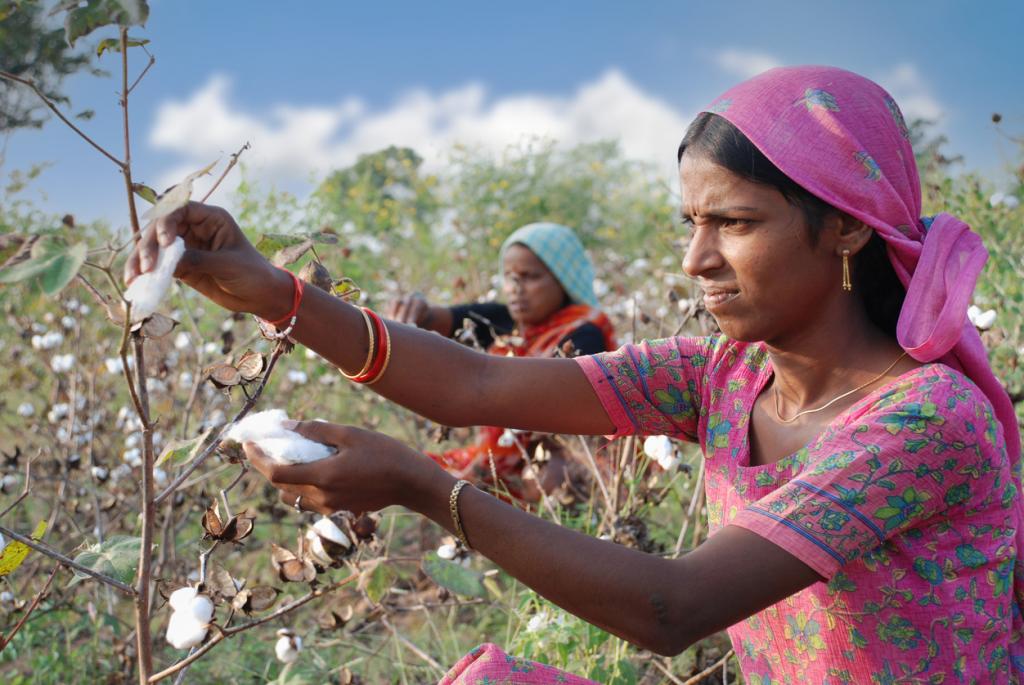
Indian farmers have faced consistent losses of Bt cotton crops due to pink bollworm attacks since the mid-2000s, when scientists found that the insect had become resistant to the genetically modified variety of cotton.
Bt cotton was introduced to India in 2002 after its success in the United States and Australia in 1996, said Govind Gujar, entomologist and former head of division at department of entomology, Indian Agricultural Research Institute (IARI).
Before that, the American bollworm had become the biggest threat to cotton crops as it had developed resistance to synthetic pyrethroids, organophosphorus and carbamates (group of insecticides). From 1985-2002, it caused heavy economic losses to farmers in all 11 cotton-growing states of India.
Gujar said:
Bacillus thuringiensis (Bt) cotton, or Bollgard-I, was introduced to protect the crop against all three species of bollworms (American, spotted and pink bollworms) as it was encoded with Cry1Ac toxin.
In 2005, he added, scientists with the Indian Agricultural Research Institute started monitoring if pests were growing resistant to Bt cotton. A year later, Bt cotton was encoded with Cry2Ab gene for improved resistance against the American bollworm.
“But in 2008, for the first time, our team found unusual survival of pink bollworm in Amreli district of Gujarat, indicative of the pest’s resistance to Bt cotton,” the expert said. “Through our scientific study, in 2009-10, we confirmed pink bollworm’s resistance to Cry1Ac gene in four districts of Gujarat.”
YG Prasad, director, Central Institute for Cotton Research (CICR), Nagpur, said that in 2014, scientists found pink bollworm population resistant to Cry2Ab gene as well.
A year later, Gujarat first reported the outbreak of pink bollworm infestation, while Punjab reported an outbreak of Whitefly, according to Prasad. “The pink bollworm had still not reached the northern regions.”
In 2017-18, widespread pink bollworm infestation was reported in Maharashtra and the southern states, Prasad noted. By 2018-19, the insect was reported to be resistant to Bollard-II from Haryana’s Central Institute for Cotton Research regional station in Sirsa, Haryana, he added.
Then in 2021-22, a pink bollworm outbreak was reported in Punjab and Haryana, the expert shared. “By 2023, resistant populations of pink bollworm to Bt cotton were established in the North Zone including north Rajasthan districts.”
Seeshpal, a farmer from Chhapianwali village in Malout of Punjab said that he has been aware of pink bollworm since 2021. “It has become resistant to Bt cotton as I learned about its infestation starting from Mansa in Bhatinda. But it has grown to become worse than the American bollworm,” he said.
Explaining further he added that unlike the latter, which used to feed on the crop from outside, the pink bollworm infests the crop from inside the bolls. “It remains elusive in the initial stages and is seen in harvest stages when the damage is already done. As it feeds from inside the bolls, no amount of pesticides help control them,” he said.
Seeshpal said that controlling American bollworm could still save 40 per cent of the total produce covering investment cost. “As pink bollworm damages the entire crop, the damage is more than 100 per cent of the investment cost. It is because the cost of labour to remove the plantation and prepare the land for next sowing adds an additional Rs 8,000 to Rs 10,000 per acre cost,” he said.
He said that it is the highest loss since 2002 since the Bt-cotton was introduced. “We have been thrown 20 years back where we stood staring at crops damaged by American bollworm,” he added.
Source - https://www.downtoearth.org.in