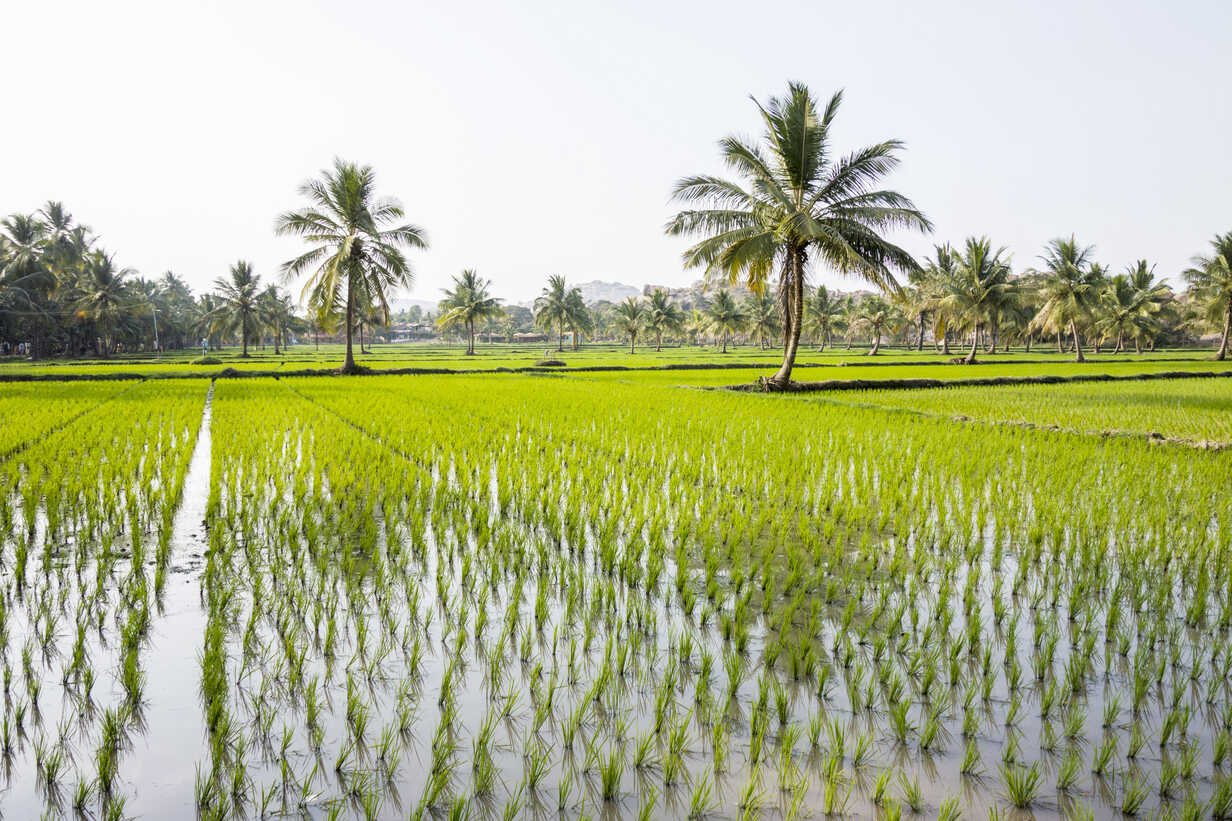
A plant virus disease first identified in China has been detected in north Indian paddy fields causing fears of reduced crop yields at a time when extreme weather events have already hampered grain production.
Rice plants infected with the Southern Rice Black-Streaked Dwarf Virus (SRBSDV) exhibit dwarfism, stiffness, and darkening of leaves.
The virus—transmitted by the white-backed planthopper (Sogatella furcifera) when it sucks on the sap of young plants—interferes with root development and plant growth.
Detected in Guangdong Province in 2001, the disease was confined to China for the next few years before spreading to other countries such as Vietnam and Japan. A research paper shows that it can cause a 30% to 50% reduction in rice yields.
The real fear
The Indian government fears that the outbreak might add to losses caused by erratic southwest monsoon rainfalls. The area under paddy cultivation has been 6% lower this August compared to the same period last year. Rice accounts for 40% of India’s total food grain basket.
“Laboratory analysis showed the presence of virus in both the infected young plants and the body of the vector after the RNA was isolated,” said Rajbir Singh, director, Agricultural Technology Application Research Institute, Ludhiana, Punjab.
However, the virus was not found in the infected plant’s seeds and grains, said Singh, who heads an eight-member committee of experts formed Aug. 22 by the Ministry of Agriculture and Farmers’ Welfare to assess the extent and severity of the disease. The team visited the 24 fields located in the three worst affected states of Punjab, Haryana and Uttarakhand.
Punjab has 2.7 million hectares under paddy, Haryana has more than 1.5 million hectares and Uttarakhand has around 2.8 million hectares. Punjab and Haryana alone contribute around 16 per cent of India’s total rice production.
Collected samples sequenced in the laboratory showed the virus’s association with stunting symptoms. The team found that between two and ten per cent of rice plants were affected although in some fields the rate of infection was as high as 50 per cent.
The action plan
The team observed that most infected plants were those grown in waterlogged conditions where hybrid seed crops were planted early. “The incidence was mostly reported from crops planted in June while crops planted in July didn’t show signs of infection,” said Singh. “We also observed that the disease mostly affected hybrid seed crops.”
Farmers have been advised not to flood their paddies with water and to monitor the plants for the presence of the vector on a weekly basis. They have also been asked to remove weeds and avoid the indiscriminate use of pesticides and fertilisers.
When large numbers of the insect pests are spotted, pesticides such as triflumezopyrim, dinotefuran or pymetrozine may be sprayed at the base of affected rice stalks, officials say.
The virus was found to be affecting both basmati (aromatic) and non-basmati varieties of rice. Investigations are underway to discover how the virus arrived in India and how it works against rice plants.
“Currently, we assume that the vector is ‘long-range migratory’ in nature, which would probably come through human routes,” said Gopala Krishanan, principal scientist at the Indian Agriculture Research Institute, India’s premier agriculture research institution. “We are trying to decode the whole mechanism of the spread of the virus.”
Damage control
While it is known that infected paddy plants die, hitting crop production, neither officials nor scientists are ready to estimate the extent of possible loss.
“Loss is certain, but we have no figures yet — it is still under monitoring and assessment,” said a scientist and member of the investigating committee, asking not to be named.
Rice traders, however, expect that the virus could substantially cut crop production in Punjab and Haryana, often called the rice granaries of India. “Our assessment shows that the production of rice can be reduced by as much as seven per cent,” said Ashok Kumar Gupta, vice-president of the Haryana Rice Millers Association.
Source - https://qz.com