Ireland - A wrong decision for the sake of just getting crop in the fields could end up a very costly mistake

15.04.2024 441 views

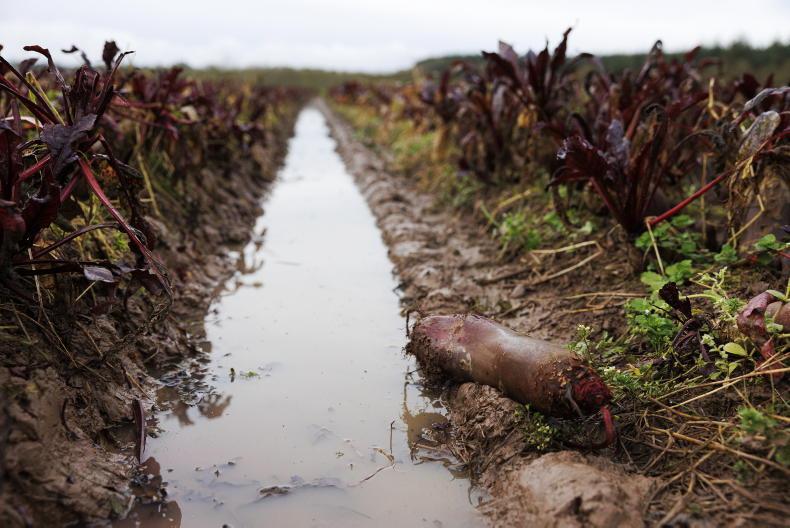
Ireland has seen one of the wettest periods in recent history, with record rainfall every month since the beginning of the year. 47mm has already fallen this month, and the monthly average for April is 50mm. Growers should be planting by now, but the rain keeps falling, and the fields are waterlogged.

"We are hoping to get some planting done in the next few days," said Stephen McCormack from McCormack Family Farms, based in County Meath. "We are around a month behind schedule, but that said, last year was also wet, and we didn't start planting till April 17."

Stephen is hoping that it stays dry for the few days as the plants are ready, and he will have half a million lettuce, Pakchoi, and herb plants arriving this week, already a week behind schedule, "Our propagator can't hold onto them any longer, the same again the following week and they need to be in the ground quickly. We are looking at plowing the lay ground in the hope that it is drier than other fields that were planned for the early crops.

"The ground is in bad condition after all the rain, and it makes it more challenging and costly to plant. There is the danger that we won't get yields we are expecting or even worse that the quality will be down. We are keen to get going but we must be very careful and make the right decisions, a wrong decision for the sake of just getting crop in the fields could end up a very costly mistake."

On a positive note, McCormack imports through the winter to supply their customers and demand has especially strong this year.

"In the next few weeks, the Spanish and Italian seasons will end, and the gap to our season will be much longer than normal, which will see prices for imported produce hit the roof. Or not be available at all, as the UK and northern Europe are also behind.

Source - https://www.freshplaza.com

19.01.2026

FAO issues new guidance on food safety risks linked to climate mitigation chemicals in agriculture

As governments and agribusinesses race to curb greenhouse gas emissions while feeding a growing global population, the UN’s Food and Agriculture Organization (FAO) has released new guidance to help policymakers and industry assess food safety risks linked to emerging climate-mitigation chemicals used in agriculture.

19.01.2026

Indonesia pushes agricultural downstreaming to boost farmers’ income

Agriculture Minister Andi Amran Sulaiman has called on regional governments to accelerate downstreaming of local agricultural commodities - particularly coconuts, cashew nuts, and cocoa - to increase added value and raise farmers’ incomes. 

19.01.2026

Japan struggles to weed out plant threatening agriculture, ecosystems

The seemingly innocuous alligator weed, or Alternanthera philoxeroides, poses a real problem, especially to rice farmers.

19.01.2026

Canada - Kamsack-based Nytro promotes Green Lightning technology

The Green Lightning system uses electricity to convert water into nitrogen-rich fertilizer, with larger units designed to meet the needs of farm operations.

19.01.2026

Ireland - Almost €2.9m issued in farm scheme payments last week

Just under €3 million was issued in various farm scheme payments last week by the Department of Agriculture, Food and the Marine (DAFM).

19.01.2026

India - Horticulture Director gave his suggestions in the National Conference of Crop Insurance Scheme

A two-day National Review Conference was held in Bengaluru under the Pradhan Mantri Fasal Bima Yojana. 

18.01.2026

India - Bihar Launches Online Crop Loss Compensation Scheme: Farmers Can Claim ₹7,500–₹10,000 per Hectare

The Bihar government has announced financial assistance for farmers affected by crop losses under the Bihar State Crop Assistance Scheme. 

18.01.2026

Afghanistan - $30m new cold storage facility opens in Kabul to boost agriculture

The Ministry of Agriculture, Irrigation and Livestock (MoAIL) has inaugurated a new cold storage facility in Kabul, saying it will help reduce agricultural waste, cut imports, and strengthen the economy.