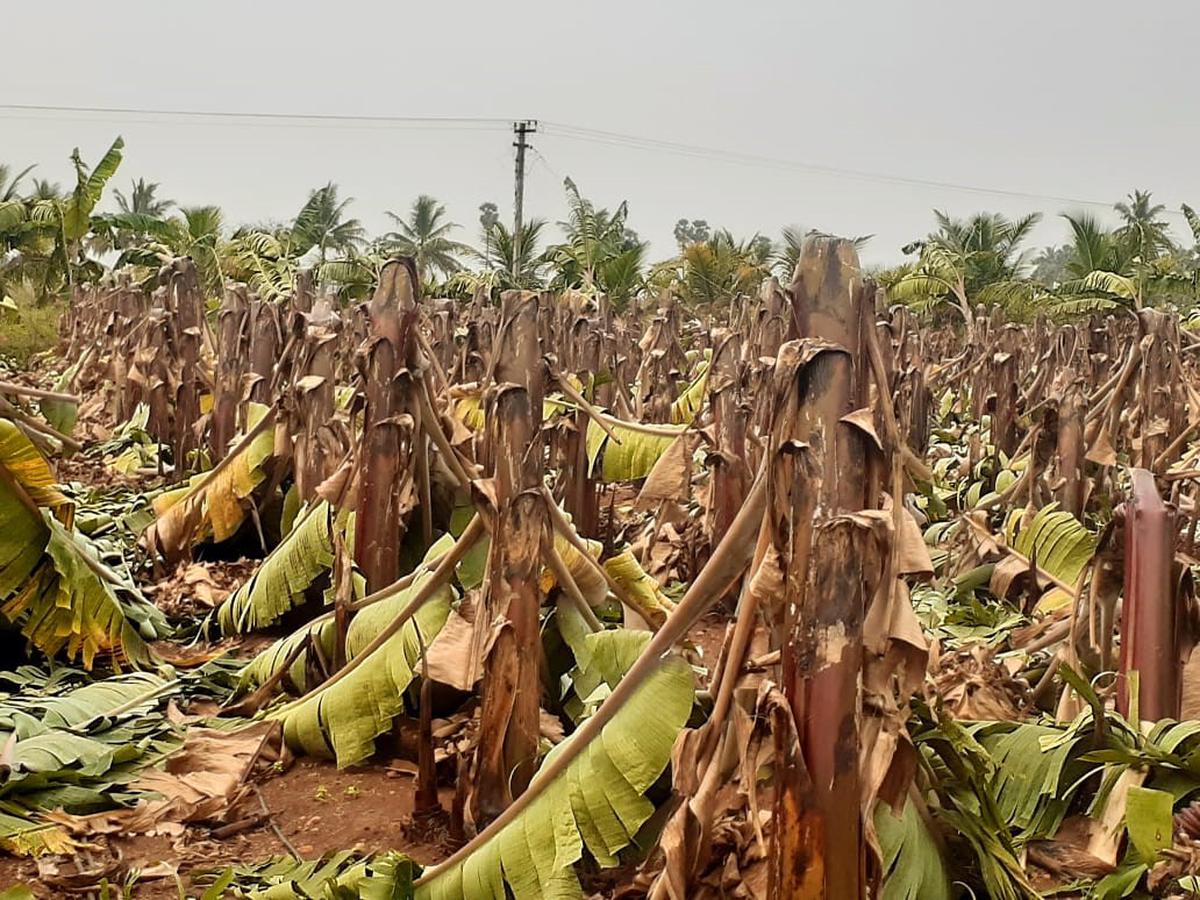
Banana farmer Sadhuram Kharel of Nijgadh 9 lost most of his plants to a violent storm in April. A devastated Kharel, who has been growing the fleshy fruit for 10 years, isn't interested anymore in casting his ballot on Friday.
Many farmers in nine wards of Nijgadh have been ruined by the storm that destroyed huge swathes of banana crops.
On April 29, a heavy storm smashed down on the banana fields and felled the rows of plants that the farmers had been nurturing for a long time. Most of the bananas were ready to be harvested and shipped to market.
Luckily for Kharel, he has crop insurance. But he has no idea how to file a claim.
"The estimated losses may be at around Rs200,000," Kharel said. “The storm came and blew everything down. I am not excited by the election at all.”
Kharel had grown 700 malbhog varieties of banana on his 10-kattha farm. “All the plants bore fruit. The storm destroyed everything overnight.”
He is distressed that no leaders have come to see their damaged crops and listen to their woes.
Nara Bahadur Lama of the same village is also distraught. More than 75 percent of his banana plants on 3 bighas have been damaged.
The storm has impoverished 200 families in Nijgadh. They lost their crops just when the market price of bananas has hit a historic high.
The Kalimati Fruits and Vegetable Market Development Committee in Kathmandu has fixed the price of banana at Rs150 per dozen. Last week, the retail price had reached as high as Rs170 per dozen before dipping slightly this week.
Fruit traders say that the price will remain on the high side for a few weeks because of the damage to the banana crops in several Tarai districts.
Kharel, a former agro technician, says hundreds of families in Nijgadh have been cultivating banana for the last two decades, and the fruit has become their key cash crop.
Farmers had planted banana on 1,200 bighas, and the storm wiped out crops on 150 bighas. According to Kharel, preliminary reports show that the high winds and rain destroyed bananas worth Rs50 million.
"We have lost the matured fruits," Lama said.
Nijgadh has a high banana productivity. According to farmers, they produce bananas worth Rs500,000 on a bigha per season.
Many farmers have lately switched to growing bananas after cash crops like sugarcane and tobacco stopped giving good returns.
"The storm has ruined us," said Rupa Kafle, a technician at the agriculture office under Nijgadh Municipality. “We have been collecting data from all wards. A relief package should be provided to farmers who do not have crop insurance.”
The banana varieties mainly produced in Nijgadh are local malbhog, Jhapali malbhog and other hybrid types.
"Farmers get to save barely Rs200,000 annually by growing sugarcane," Kharel said. “Banana crops give us an income of Rs600,000 per year,” he said.
"Selling sugarcane and tobacco was not easy either," Kharel said. “But bananas are in high demand. Traders come to our farms and pay us in advance.”
Even beekeepers are giving up their business and switching to growing bananas because of the market demand.
At least 50 youths who have returned from foreign employment have started cultivating bananas on a commercial scale.
Banana farmer Ashok Subedi says banana farming is easy, pays well and requires little labour. “Due to the high demand, traders came to the farms to buy the crops. There is no problem about market access.”
According to Subedi, a banana farmer can make Rs20,000 per kattha by spending Rs5,000.
"Banana farmers who also rear cows, chickens and pigs benefit by using the manure as fertiliser on their farms," he said.
"While other crops require regular weeding, adequate water and fertilizer, you do not have to give so much care to banana plants,” Subedi said. “Farmers can also produce organic fertilizer from decaying banana plants after the fruits have been harvested.
Source - https://kathmandupost.com