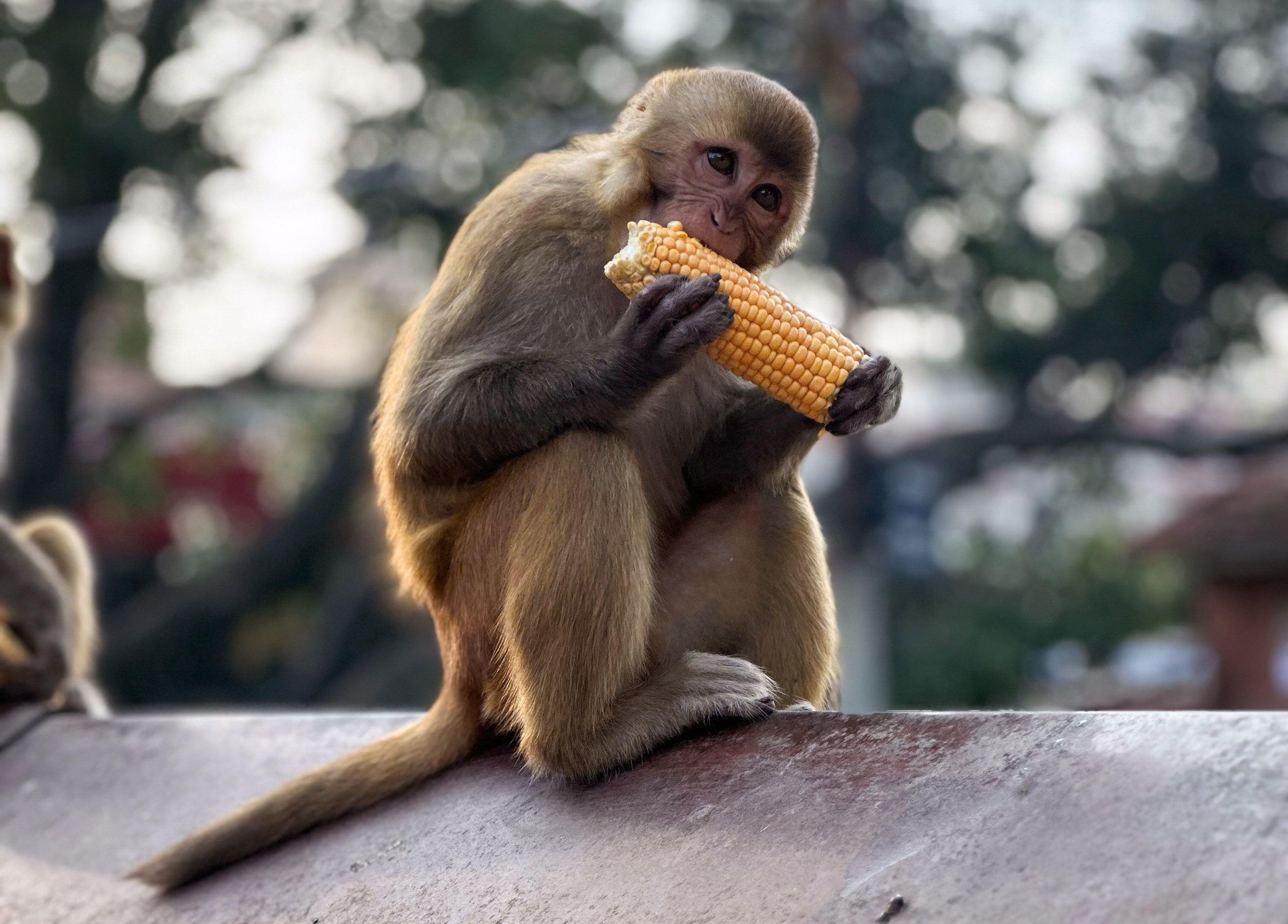
Monkeys in Nepal are giving locals and authorities sleepless nights. Newspapers are peppered with reports of monkeys raiding kitchens in villages. Meanwhile, farmers dread harvest season, fearing raids on their ripe maize. Monkeys love maize, but so do farmers, as it provides a good return on investment.
Many solutions are currently being discussed, including compensating farmers, culling monkeys or even logging trees to limit the habitat of monkeys.
Chandra Bhandari, the Member of Parliament from Gumli, raised the issue in parliament, stating on June 2, 2024 that, “farmers are planning to send monkeys as gifts to the parliament as a response to our [turning a] deaf ear to the problems they have been facing.”
Nepal has three species of monkeys; the rhesus macaque, Assamese macaque, and Hanuman langur. But reports of conflict are largely linked with the rhesus macaque. This species is well-known for being able to adapt to humans.
“Debates are being done in such a way that [all nuance is lost], and all monkeys are demons,” said Sabina Koirala, who researches primate behaviour. She has researched crop-raiding behaviour by rhesus macaques, and one paper co-authored by her found that farmers in the Panauti municipality of central Nepal’s Kavre district were suffering an annual loss of US$15 (about 5 per cent of their average annual cropping income) because of monkey raids. “For those not cultivating rice but only maize, the total damage was 10 per cent of total income,” Koirala said.
Nepal’s annual per capita GDP – an approximate measure of average income – was just over US$1,300 in 2023, so losses like this are hard to bear for poorer communities.
At the same time, Nepal currently lacks robust data on its monkey population. It is hard, therefore, to estimate how widespread the real problem is, even if the heated discussion around it seems to suggest a widespread problem.
Our forests are diverse, and we have planted plenty of species including several fruit [trees] across the country. Government and other agencies failed to avert this crisis and now they are pointing fingers at us.
Thakur Bhandari, chairperson, Federation of Community Forest Users
Lessons from India?
Across the border from Nepal, in the Indian Himalayan state of Himachal Pradesh responded to a similar problem by neutering 160,000 monkeys between 2006 and 2018. In February this year, a team of Nepalese parliamentarians along with foresters and veterinarians visited the Indian state to understand if this had worked, and if so, what were the challenges.
“It is just an option being discussed, but castration is very expensive as it’s quite hard to catch monkeys and keep them in the enclosure until the surgery wound is healed. I don’t think we can afford it,” said Bed Prasad Dhakal, spokesperson at Nepal’s wildlife department.
According to a 2020 report by Himachal Pradesh’s forest department, the rhesus macaque population is now 136,443, which is around 33 per cent lower than 2004 when the sterilisation programme began.
This apparent success, though, has a dark side. The Animal Welfare Board of India (AWBI), which operates under the Ministry of Environment and Forests, criticised the programme after a team found that captured monkeys often suffered injuries, starvation, prolonged captivity and other abuses during the sterilisation process.
Himachal Pradesh also undertook a culling programme from 2016 to 2020, after permission from the Union government, which has the authority to categorise animals as protected or not.
The move to classify monkeys as pests in 2016 triggered a war of words in the Indian cabinet at the time. Maneka Gandhi, then the Minister of Women and Child Development, criticised the environment minister, saying that his ministry is “frivolously granting permission to kill innocent animals.”
The data on how many animals were culled has not been made public.
In 2023 Nepal was also seriously contemplating a similar move according to Hari Bhadra Acharya, senior planning officer at the Department of National Parks and Wildlife Conservation.
He told Dialogue Earth that both the wild boar and the rhesus macaque were scheduled to be labelled as pests, clearing the way for their culling, but while boars were classified as pests, monkeys were not. “Both animals were on the draft proposal, but some top-notch officials feared it would bring trouble due to religious values, so we had to take [monkeys] off the list,” added Acharya.
Monkeys are considered sacred by some members of the Hindu community, but this has not stopped officials from contemplating culling.
“Culling is part of wildlife management and it has been done in other countries. We should do it, if need be,” said Phanindra Kharel, former director general of Nepal’s wildlife department.
Foresting fails led to monkey raids
Nepal’s community forestry programme may have contributed to the current rhesus macaque-human conflict, according to another paper co-authored by Koirala. The forestry programme helped reduce the deforestation rates from 1.31 per cent in 1975 to 0.01 per cent in 2013, but it also promoted monoculture timber plantations.
There has been a net loss of 48.6 per cent of native forests between 1930 to 2014, whereas the number of small forest patches between 1.01 km2 and 2.02 km2 has increased from 6,925 in 1930 to 42,961 in 2014. The trees chosen for the forestry programme had high economic value as timber, but did not restore the natural biodiversity, argues the paper.
“[As a result], several food-providing species declined and new monoculture forests heavily focused on commercial value which forced monkeys to invade cropland,” said Koirala, explaining that monkeys could no longer find enough food within the forests.
These community forests are mainly in the mid-hills of Nepal, where the human-monkey conflict has been escalating. But the chairperson of the Federation of Community Forest Users’, Thakur Bhandari, pushed back against this explanation.
“Our forests are diverse, and we have planted plenty of species including several fruit [trees] across the country. Government and other agencies failed to avert this crisis and now they are pointing fingers at us,” he said.
He added: “If you can’t solve the problem, give us the authority to deal with it. We will solve it within a few months by killing them on a selective basis to control their population. Communities have been suffering but experts, bureaucrats and politicians are just talking.”
Male migration out of villages leaves them undefended
Another complicating factor is Nepal’s high out-migration since the 1990s, with people travelling overseas for jobs. 2019 data from the International Organization for Migration suggested that more than 90 per cent of the migrants moving overseas were men, and over 75 per cent were in the age group of 15-34 years.
“The monkey-human conflict was there in the past too, but there was a human force to deter them or guard fields,” explained Koirala. Now the people managing fields are largely women, children and the elderly.
Koirala adds that the farm-based diet has also changed monkey behaviour. “As they feed on more protein-based crops in the field which don’t require them to burn much energy, they spend their energy in reproduction,” she said, inevitably increasing the monkey population.
A senior official at the Ministry of Forest and Environment, speaking on condition of anonymity, said that a committee to study the problem and recommend solutions had been formed in the ministry. He was, however, dismissive of any serious action.
“If there had been an intention to solve this problem, then it should have been a high-level committee with a political mandate under the prime minister and parliamentarians on board. A committee like this formed by the ministry will just be a ritual as many recommendations from several committees on other issues have been gathering dust.”
Source - https://www.eco-business.com