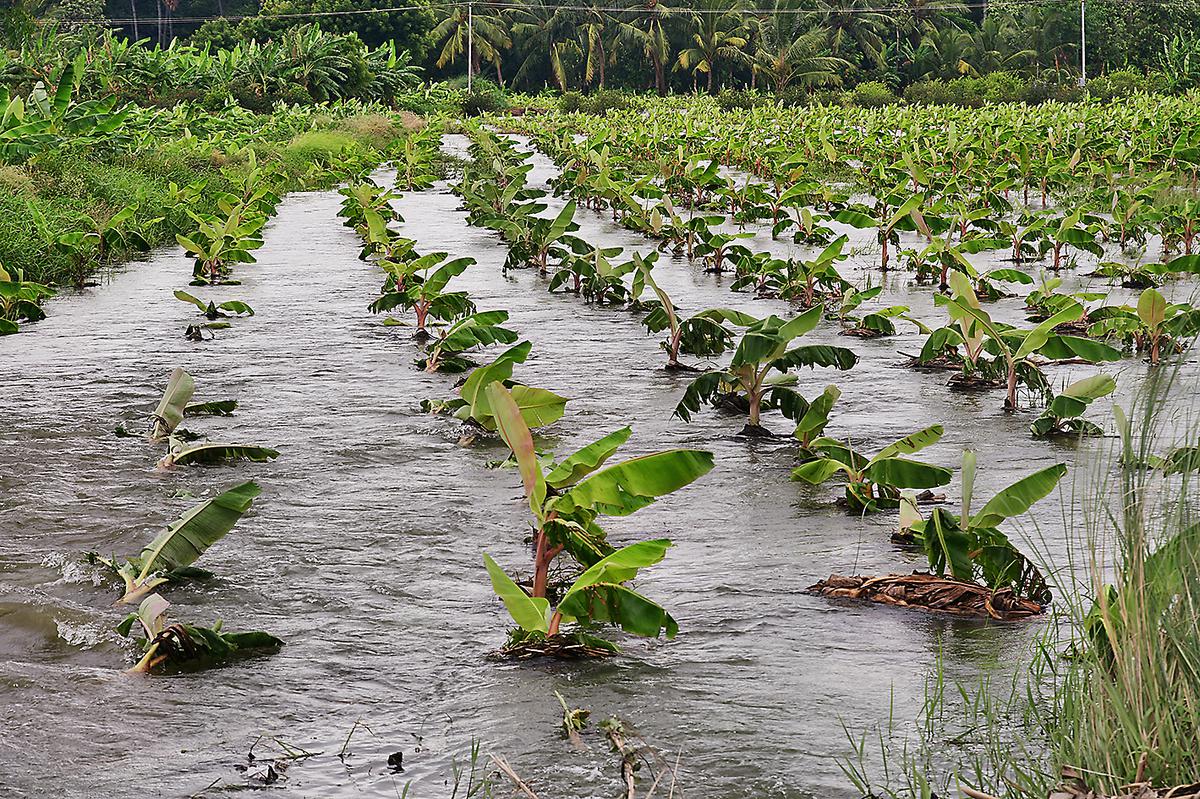
The impact of the 2022 floods on agriculture and food production has been devastating and has resulted in the loss of crops, livestock, and other essential agricultural infrastructures.
Sadly, the unprecedented losses have taken a toll on the federal government’s efforts toward ensuring food security and a setback to the country’s desire to drive goal 2 of the Sustainable Development Goals towards ending hunger by 2030.
Similarly, farmers and investors have suffered huge losses as floods have destroyed thousands of hectares of farmlands and food crops across the country.
According to a report obtained from the National Emergency Management Agency, (NEMA), 33 of 36 states in Nigeria have so far experienced the 2022 floods with many of the affected states relying heavily on food production as means of livelihood.
In Jigawa, the flood ravaged 138,442.36 hectares of farmlands and displaced 1,554 farming communities across 22 local government areas of the state.
While in Nasarawa, 45,000 hectares of Olam Rice farm located in Rukubi Doma local government area was washed away, amounting to over $15 million lost, in addition to farmlands belonging to smallholders being submerged.
Similarly, a preliminary report by the State Emergency Agency (SEMA) said in Yobe communities including Jakusko, Bade, Gulani, Mutai, and Geidam show that over 196 communities across the 17 LGAs have lost hundreds of hectares of land due to the flood.
Farmers in each of the states affected by floods have a bitter story to tell about their losses.
There is no doubt that flood hazards directly lead to a fall in food availability, food consumption, and the welfare of vulnerable rural households.
Even though early warnings in the country’s food outlook for 2022 as released by the Nigeria Hydrological Services Agency, (NIHSA) predicted severe flooding in 2022 but many stakeholders blamed government in-actions and lack of adequate preparation for the flood currently experienced.
The economic and agricultural losses arising from flooding are very severe and will continue to dare the government’s moves to achieve food and nutrition security unlike the 2012 floods which accounted for more than N2. 6 trillion in losses including agricultural produce, the 2022 flooding is yet to reach its final stage but farmers are already counting billions of naira being lost as predictions indicate that the flood will last even until the end of October.
National president of All Farmers Association of Nigeria (AFAN), Arc Kabir Ibrahim who spoke with LEADERSHIP Weekend expressed concerns over this year’s havoc wreaked by the flood as he described it as a monumental loss to the agricultural sector.
He said the devastation of the flood has affected the means of livelihoods of many Nigerian farmers across the federation.
He said, “Quite a number of our farmers have lost their means of livelihood to the floods as the entire livestock holdings and plantations are lost in some cases spread across the country, the flooding is monumental and the devastation it has brought on all facets of the economy is invaluable.
There will be food shortages as a result of this shock occurring back to back with others such as cost of production particularly from high cost of fertilizers and other inputs”.
Unfortunately, this potent that the more the flood severity, the more the food security challenge and by implications, leading to poor yields of the remnant crops, job losses, revenue depletion, increase in food prices, and the inability of average Nigerians to afford food.
This negative development remains unhealthy for Nigeria’s food security drives, especially at a time when insecurity, the Russia-Ukraine war, and high exchange rate continue to exacerbate the situation and create additional burdens on Nigeria’s economy and household income.
In a telephone interview with LEADERSHIP, a rice farmer and chairman of Odeke Youth Farmers Forum in the flood-ravaged Ibaji local government area of Kogi State, Williams Egwuda said more than 1000 farmers have lost an estimated 2 billion naira to the flood in the community.
He said over 3000 people live there and are heavily dependent on cassava, rice, yam, and others farming for livelihoods.
“Our entire farms were submerged by the flood and so far we have not received any form of assistance from the local, state, and federal government, they only made promises but this is the time we need help from them, we are more than 1000 farmers here.
So we are appealing to the government at all levels, even non-governmental organisations, private individuals to come to our aid, as we will find it difficult to get inputs to plant new ones next Planting season,” Egwuda said.
Similarly, a crop farmer, Adamu Musa who lives in Gashua community, Bade local government area of Yobe State lost his farm to the flood.
Musa who farms sorghum, millet, and beans told LEADERSHIP Weekend in an interview that he spent over N300,000 to complete his farm but all lost to the flood.
He said, “My farm is completely flooded. I have spent about N300,000 already, I can’t lie, many farmers in Bade have been affected. The flood affected our farm and the government did not help us, they did not even give us a single kobo, I can’t even count the number of people that lost their farms, we are many. So my appeal to the government is to come and help us to recover from all the losses that we have made”.
In Cross River State, the story is the same where rice, cassava, yam, maize, and sugarcane farms were destroyed by the flood.
Another rice farmer and vice president, Ogurude community, Obubura local government area of Cross River State, Enangha Anthony said the flood has affected 528 farmers badly in his community.
He said, “As I talk to you now, it’s only God that knows how we are feeding, everything we farm were lost in the water and we have not seen any level of government response to support us but we are expecting to see.
“We are 528 farmers both male and female whose farms were affected and we estimated a loss of over N50 million.”
A Twitter user with the verified handle @GidiDanAuta similarly registered his frustration, saying the flood has wreaked havoc on his seven hectares farm.
Confirming the development, @GidiDanAuta whose real name is Gideon John in Adamawa State said, “All hope lost! After two years of successfully farming rice on three hectares of land after my NYSC, this year I decided to expand to seven hectares and a lot of money was invested, unfortunately, floods ravaged our farms. God, we are in your hands.”
According to the United Nations, Nigeria office, 2022 floods have impacted more than 2.5 million people with 600 people losing their lives and 1.3 million people being displaced, including more than 200,000 houses being partially or fully damaged.
In a similar vein, the national president of Maize Association of Nigeria (MAAN) Dr Bello Abubakar expressed concerns over the devastating effects of floods as he called for government intervention to enable farmers to embark on dry-season farming to augment the losses.
Dr Abubakar who spoke through Kabir Salihu the Kaduna State chapter of MAAN, said, “I will also like to use this opportunity to express our profound concern on the recent flood that affected various states of the Federation which negated the farming activities in the country.
‘’We also call on government at all levels to assist the farmers by paying them some compensation and repairing irrigated lands for the farmers to immediately embark into dry season farming to augment the losses incurred during the current rainy season”.
Source - https://leadership.ng