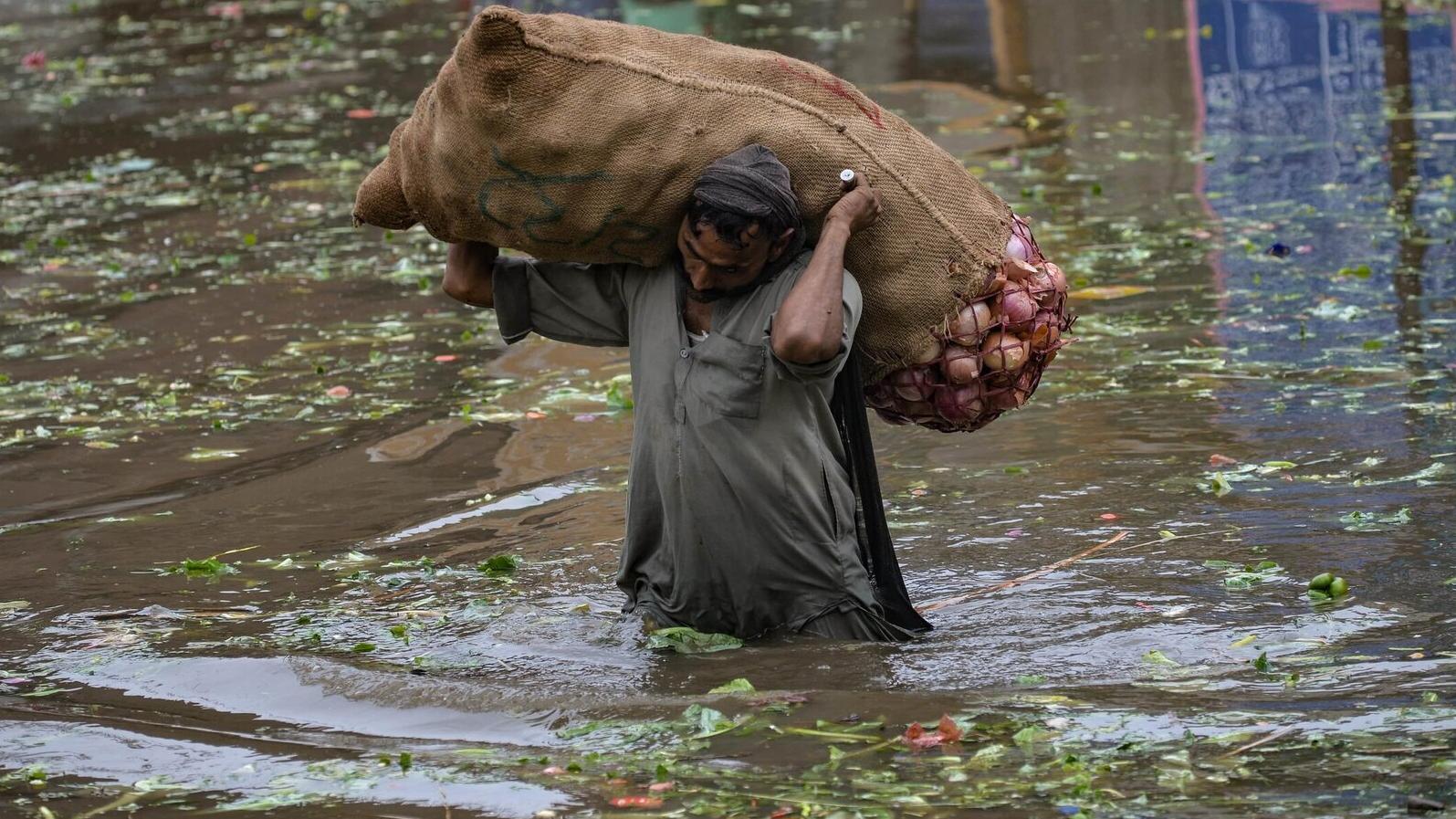
Pakistan's farmers and policymakers are beginning to count the agricultural costs of the floods that have wreaked destruction across the country, bracing themselves for an unprecedented food crisis.
Officials estimate that more than 800,000 hectares of farmland have been wiped out by the flooding, which followed unusually heavy summer downpours. For many, this raises the risk of starvation in a nation of 225 million people that is already grappling with record 27.3% inflation. It also looks likely to upend the government's budget goals and further strain its shaky foreign reserves.
The damage has been particularly heavy in south Punjab and the provinces of Sindh and Balochistan. One major worry is the fate of the rice crop due to be harvested next month.
Haji Amir Bux, president of the Sindh Abadgar Board -- a provincial farmers' cooperative committee -- told Nikkei Asia that more than 80% of his rice is damaged. His crop is planted over 150 acres (60 hectares) of land in the Shikarpur district of Sindh. "The water in the fields is still standing," he said. "Our animals are getting sick and their feed is rotting in the water."
This could have implications both inside and outside Pakistan. Since wheat, not rice, is the country's primary staple, more than half of locally grown rice is exported. This makes Pakistan the world's fourth-largest supplier even though it ranks ninth as a producer. Much of the rice grown in Sindh is sent to China, Southeast Asia, East Africa and the Persian Gulf states.
Experts foresee a limited impact on domestic rice prices for now, thanks to surviving crops in Punjab. "At this point, the rice crop in Punjab remains intact, so fears of a major price shock for rice may not materialize," said Uzair Younus, head of the Pakistan Initiative at the Washington-based think tank Atlantic Council, who has conducted a comprehensive assessment of the economic losses incurred by the floods. Nevertheless, the damage will put a dent in much-needed export revenues from what had been expected to be a record rice crop.
It also threatens to interrupt the sowing season for wheat to be planted in the fields in November, after the rice is harvested.
Owing to the slow response of the local government, Bux believes the water will not be drained in time to plant the wheat. Plus, a portion of the 3 million rupees ($13,000) he typically earns in a rice season goes toward buying wheat seed, fertilizer and diesel. "We have no money left to invest for the wheat crop," he said.
This, in turn, is likely to exacerbate pressures in a wheat market that was already affected by declining production over the past few years. Irfan Jatoi, a landowner in Sindh, explained that thin margins and low yields had prompted many farmers to switch to vegetables and sugar cane -- a cash crop in high demand in the export market. Yet domestic demand for wheat has been growing due to inflation on nonstaple foods and population growth. The result is that Pakistan, once a net exporter of wheat, is now an importer.
Meanwhile, the inundation has hit a range of fresh produce, especially onions, tomatoes and dates. Prices in local markets have shot up, prompting Islamabad to seek additional imports of vegetables from Afghanistan in an attempt to ease the pain for consumers.
Yet another concern is massive damage to the cotton crop, also due for harvest next month. This could have severe ripple effects in ways that are not immediately obvious.
Tassawar Hussain Malik, director of agricultural research at the Pakistan Central Cotton Committee, estimates that around 45% of the country's cotton plantations have been wiped out. He said this would have serious repercussions for the food supply chain.
Cottonseed oil makes up 70% of the vegetable oil consumed by rural residents and low-income populations. The leftover cottonseed cake is used to make animal feed. Malik warned that the impact on the cotton crop could reduce fodder production by 35%. This would add to the woes of dairy and meat farmers who have already seen more than 750,000 animals perish due to disease and drowning, according to official estimates.
Pakistan is the world's No. 4 milk producer, and approximately 80% is produced in rural areas, according to the Islamabad-based Pakistan Institute of Development Economics. The Pakistan Dairy Association is already reporting a milk supply shortfall of up to 30%.
All told, "The economic fallout of the floods is going to be close to 10% of GDP, which is a major economic shock for any economy," said Younus of the Atlantic Council. He estimates the value of crop losses at $2.8 billion, with livestock losses amounting to $188 million.
This means the government is likely to miss its target of reducing the $17.4 billion current-account deficit recorded in the previous fiscal year, which ended on June 30. The damage and reconstruction costs will also strain Pakistan's $14.5 billion foreign reserves, which just received a boost from the International Monetary Fund. Food imports are expected to increase, while rice and cotton exports worth over $2 billion will take a hit.
Meanwhile, the floods continue to disrupt the south of the country. High water levels in the Indus River system are threatening to breach defenses in lower Sindh, including the bunds at Manchar Lake -- one of the largest natural freshwater lakes in Asia.
Authorities are making calculated moves to release pressure in river structures to save bigger cities from flooding, but water continues to rise in several cities of the province.
Since mid-June, 1,396 people have died due to the floods, the National Disaster Management Authority reported late last week.
Source - https://asia.nikkei.com