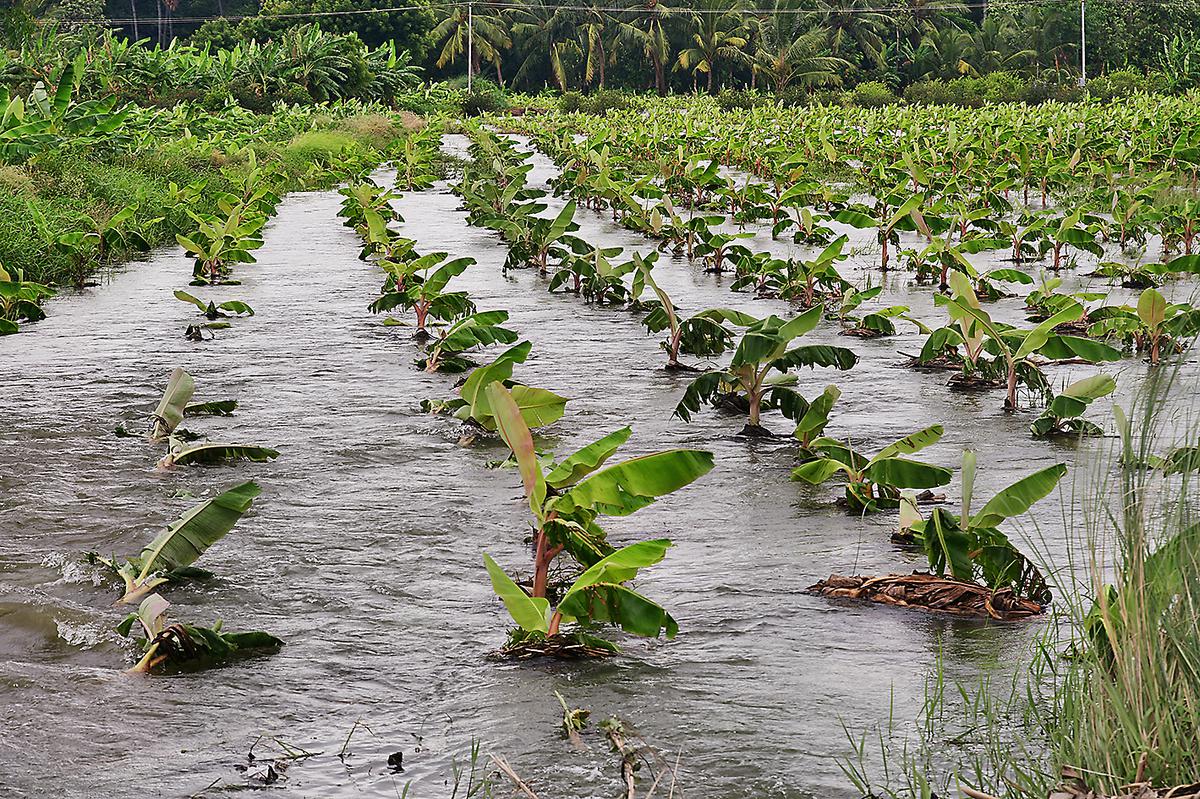
A recent by the International Centre for Integrated Mountains Development (ICIMOD) and Pakistan Agricultural Research Council (PARC) has revealed that the recent massive torrential rains had inundated the cropland of Southeastern province of Sindh that devastated commercial crops on large scale and incurred a combined loss of $1.7 billion.
The study titled "The 2022 Pakistan floods: Assessment of crop losses in Sindh Province using satellite data" by the ICIMOD and PARC used satellite imagery to assess potential crop production losses for major crops at the sub district-level to support the government's rehabilitation and compensation planning processes in Sindh Province.
The Sindh province at the national level comprised of 42% of the rice, 23% of the cotton, and 31% of the sugarcane production.
"The 2022 Pakistan floods caused unprecedented damage to agriculture crops, livestock, and infrastructure, including storage facilities with millions of tonnes of grain, posing the risk of an unprecedented food security crisis in the country. The floods struck before the harvesting stage of key crops, including cotton, rice, and sugarcane." The study showed that as per the flood extent mapping using Sentinel-1 satellite images acquired during August 22-28, floodwaters directly inundated about 2.5 million hectares of land (over 18% of Sindh's total area), which resulted in obstructed access and mobility in around three-fourths of the province area.
The most affected areas included northwestern districts of Jacobabad, Larkana, Shikarpur, and Kashmore. The satellite data of September 3 revealed that the expansion of flood waterwas continuing through the water coming from the western mountain region of Balochistanand was increasing river discharge at Guddu barrage, resulting in additional flooding in the Indus River.
"The total agricultural area of Sindh is about 4.9 million hectares. In summer (kharif) season, most of the area is cultivated under three commercial crops: rice, cotton, and sugarcane. The flood inundation is highest in the rice crop zone, which has resulted in an overall estimated loss of 1.9 million tons of rice, or an 80% loss of the expected total rice production in Sindh. Sugarcane is predominantly grown in the northeastern districts, where flood inundation remained relatively lower. Damage amounted to 10.5 million tons, or a 61% loss of the expected production of sugarcane. Like the sugarcane zone, the cotton zone also received relatively lesser inundation." An ICIMOD official told APP that however, this zone received several exceptionally high daily rainfall spells, which almost completely devastated cottoncrops at maturity (with cracked cotton balls).
"We expect a loss of about 88% of the total expected cotton production (3.1 million bales) as a result of the flood inundation and exceptionally high rainfall in the cotton-growing areas of Sindh." The research analysed that these three crops faced a direct loss of $1.3 billion (rice: $543 million, cotton: $485 million, sugarcane: $273 million). "In addition, three key vegetable crops tomato, onion, and chilli face losses totalling $374 million in the affected districts, with the highest losses in Thatta, Badin, and Mirpur." The research also studied the livestock losses and estimated that the floods had killed 42,273 livestock, including sheep, goats, camels, cows, buffaloes, and donkeys, causing a direct loss of around $13 million to livestock in the province.
"The economic losses in agriculture are much beyond the estimated direct losses to crop production and livestock. Direct damages and losses to agriculture tools and machinery, infrastructure in farms and rural areas, and trees are likely to compound the economic losses," it said.
The government's rehabilitation and compensation support were likely to have deeper and long-term impacts on Pakistan's agriculture due to the indirect costs involved in draining and land rehabilitation, losses in successive crop cycles due to water logging and delays in sowing.
"This rapid assessment does not cover other agricultural losses such as loss of agricultureinfrastructure and equipment and disruption in agriculture services." The total agricultural area is about 4.9 million hectares in Sindh ; food crops and cash crops are grown in 60% and 25% of the total cultivated land, respectively. The major crops in Sindh rice; sugarcane; cotton; beans; vegetables (tomato, chilli, onion, okra, and cucurbitaceous vegetables); and fruits (mango, banana, and papaya) are grown during the summer (kharif) season. Three cereal and industrial crops Rice production (metric tons) Sugarcane production (metric tons) Cottonproduction (bales) rice, cotton, and sugarcane dominate the total cultivated area (Figure 8), while horticultural crops account for only 7%. Nationally, the province accounts for 16% of the wheat production, 42% of the rice production, 23% of the cotton production, and 31% of the sugarcane production.
The impact of the 2022 floods on Pakistan's rural communities and agriculture was devastating, resulting in the loss of crops, livestock, and essential infrastructure. The country is now facing an unprecedented food security crisis.
Source - https://www.urdupoint.com