In a province slowly being overtaken by industrialization and urbanization, the Southeast Asian Regional Center for Graduate Study and Research in Agriculture (SEARCA) still believes feeding the people should remain a top priority.
And in an effort to promote agriculture in Laguna province, SEARCA has tapped on schoolteachers who in turn - or so the institute hopes - will pass on their skills and knowledge to a new generation.
Through the “In-Country Training on Urban Farming for Sustainable Cultivation to Support Biodiversity Conservation, Education, and Food Security in the Philippines,” program, SEARCA seeks to empower educators to establish science-based, environmentally sound urban farming systems within their schools and localities.
“This training is designed to empower educators, the frontliners in shaping mindsets, with updated tools and knowledge to implement ecologically sound urban farming systems that serve as living laboratories for sustainability,”SEARCA Center Director Mercedita Sombilla told local media.
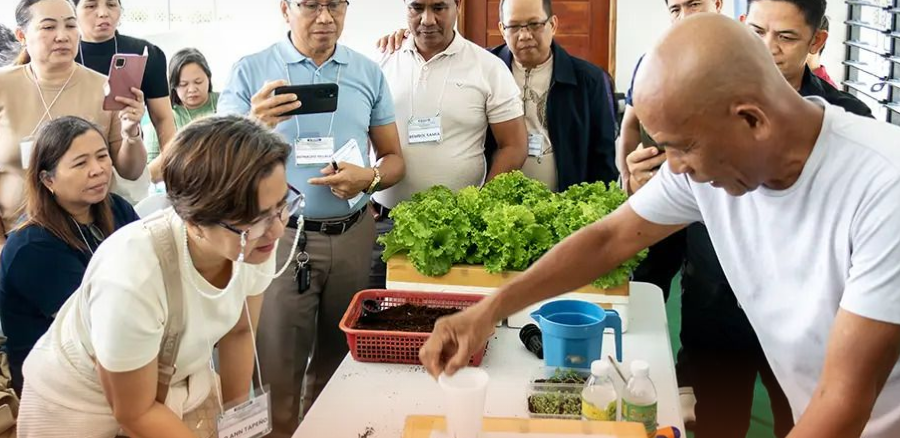
Recently, 30 educators from ten public elementary and secondary schools, along with representatives from the DepEd Laguna division committee, participated in training programs sponsored by SEARCA.
The training featured two core modules: hydroponics cultivation and urban agroforestry systems.
On day one, participants were introduced to urban agriculture by Dr. Doni Yusri of SEAMEO BIOTROP, followed by a session on hydroponics and its role in biodiversity conservation led by Dr. Eureka Teresa Ocampo of the University of the Philippines - Los Baños campus (UPLB).
Attendees also visited UPLB’s advanced smart greenhouses, which feature automated irrigation systems and data-driven crop monitoring technologies.
Day two focused on urban agroforestry. At the UPLB Makiling Botanic Gardens, Forester Cary Maynard Olivar conducted a forest therapy session, followed by a visit to the Learning Laboratory for Agroforestry. Dr. Lorena Sabino and her team discussed integrating trees and crops, along with models for developing school-based edible landscapes.
Representing DepEd Laguna Schools Division Superintendent Dr. Editha Atendido, Assistant Schools Division Superintendent Jaypee Lopo reaffirmed the division’s commitment to cascade the program’s lessons to more schools, emphasizing the goal of scaling local innovations into broader, globally aligned solutions.
SEARCA's program comes amid reports of agriculture's declining share in the Calabarzon region's economic mix, which has become dominated by the industries and services sectors in past years.
Data from the Philippine Statistics Authority (PSA) showed that the agriculture, forestry and fishing sector contributed a paltry 4.2 percent to Calabarzon's gross domestic product (GDP) in 2024, compared to to 49 percent from the industries sector and 46.8 percent from the services sector.
The Gross Value Added (GVA) of the region's agriculture, forestry and fishing sector also declined by 0.7 percent, from P137.32 billion in 2023 to P136.37 billion in 2024.
Source - https://opinyon.net