Ensuring food security and agricultural resilience in the face of environmental challenges depends on preserving and utilizing crop diversity, according to the Crop Trust. Genebanks serve as the ultimate guardians of this diversity. However, they are susceptible to various risks that could jeopardize their invaluable collections.
There is an urgent requirement for systematic risk assessment and management in genebanks. In a study conducted by Jan Engels and Theresa Herbold is an agricultural economist, graduate from the University of Hohenheim, Germany, they examined 80 genebanks worldwide, identifying threats such as natural hazards, political instability, and financial challenges. The genebanks we analyzed collectively safeguard at least 4.78 million accessions, representing approximately 65% of the reported total of ex situ conserved accessions worldwide.
One striking revelation they found is the regional variation in risk exposure.
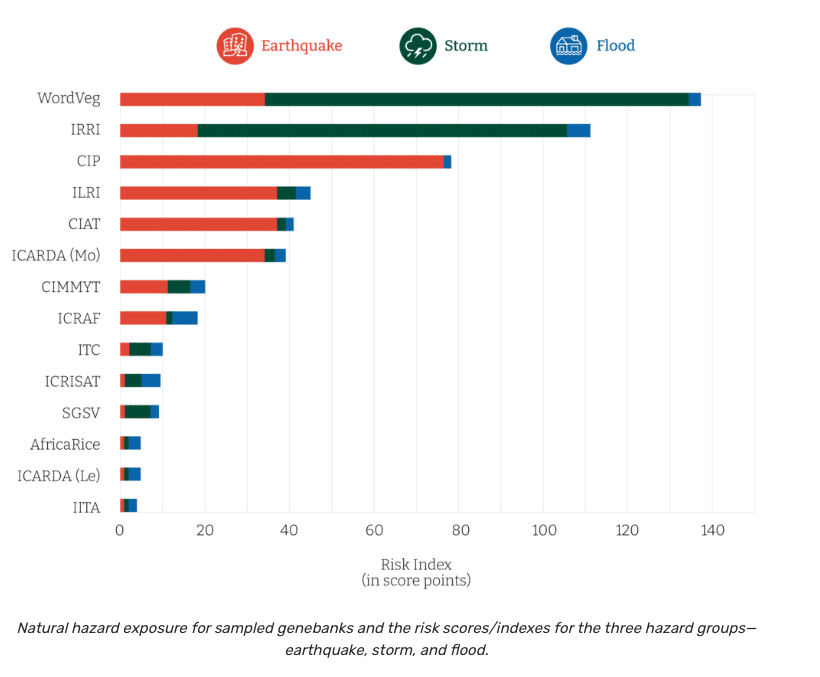
Source: The Crop Trust
Genebanks in the Asia-Pacific region are especially vulnerable to natural disasters, while those in Africa and certain parts of Asia encounter increased political risks.
Given these challenges, how can genebanks manage these risks and guarantee the preservation of crop diversity for future generations?
The article states that the first line of defense is preventing or mitigating risk. Strengthening infrastructure and maintaining safety duplicates of accessions are essential. The Svalbard Global Seed Vault serves as a critical safety net in case of catastrophic loss.
However, Herbold says not all risks can be prevented or mitigated.
“This is where risk transfer solutions come into play. Mechanisms like insurance schemes and funds offer a means to transfer risks to third parties, providing a safety net in times of crisis, and the certainty of funds being available for recovery. While currently underutilized, these solutions hold immense potential for minimizing collection loss and ensuring swift recovery post-disaster. An example of this is the Emergency Reserve Fund.
“Despite some progress in risk management, challenges remain. Looking at the contents of genebanks for insurance purposes is complicated; we need new valuation methods. Plus, greater integration of risk transfer solutions at both national and international levels is imperative to boost resilience in genebank operations.
Looking forward, the importance of genebank risk management cannot be emphasized enough. With the acceleration of climate change and increasing geopolitical tensions, the threats facing genebanks are becoming more severe. Adequate resources, political support, and a focused effort to prioritize risk management are crucial for effectively safeguarding crop diversity.
Genebanks act as crucial defenses against the loss of crop diversity, but their effectiveness depends on strong risk management practices. By proactively assessing and addressing vulnerabilities, we can ensure the resilience of genebank operations and preserve the genetic foundation of our food supply for future generations.
Source - https://www.seedworld.com