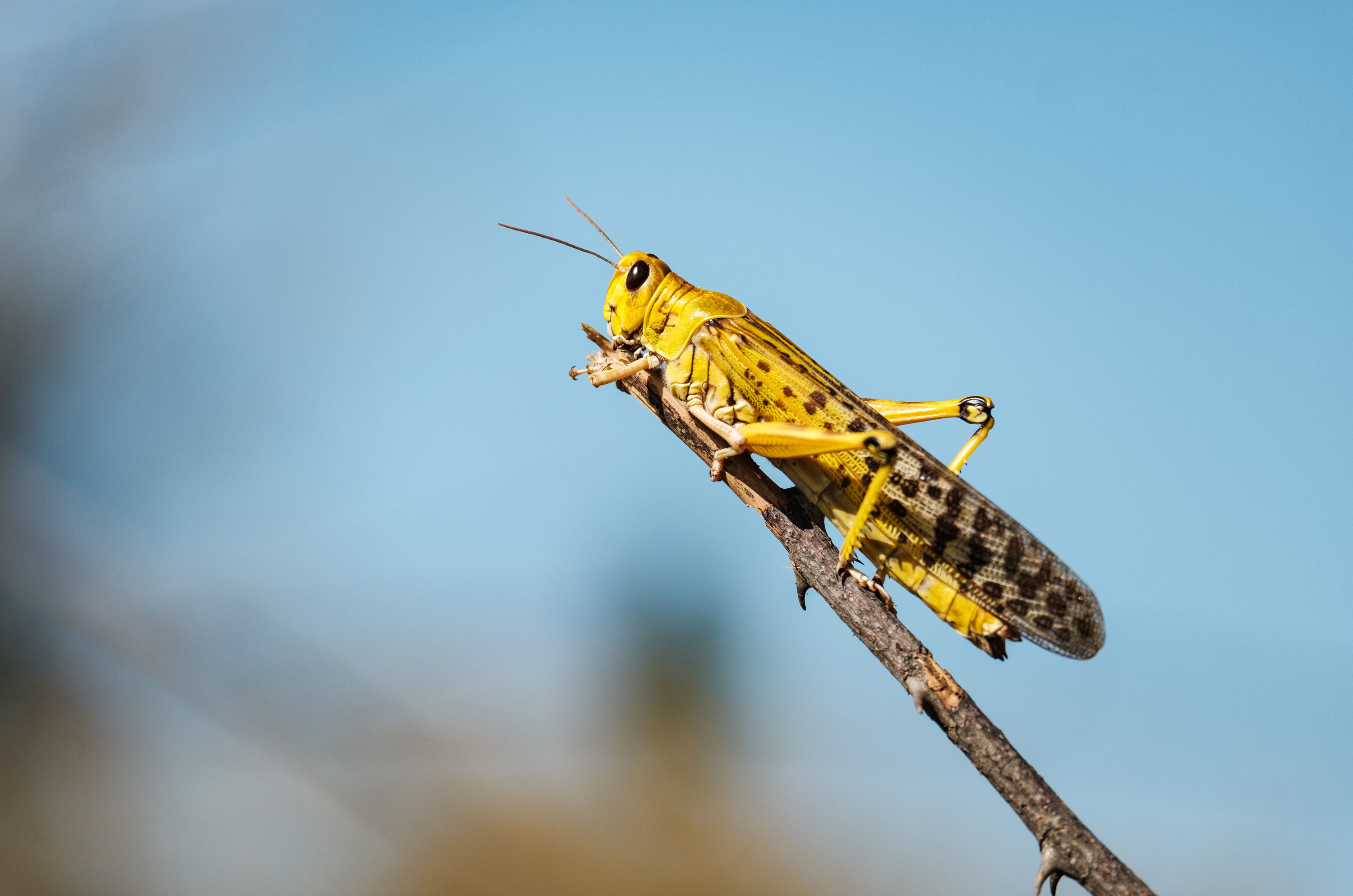
The Brown Locust outbreaks in Southern Africa have not captured headlines in the same way as the desert locust in the Horn of Africa, and the Arabian peninsula has done. However, the pest remains a daunting challenge in regions in southern Namibia as well as in South Africa.
The Ministry of Agriculture, Water and Land Reform (MAWLR) estimate that around 1.2 million hectares of cultivated fields have been infested by Brown Locusts in Namibia's Karas region alone, which has already spilt over into the neighbouring Hardap region to the north of Karas. Both regions are just emerging from a six-year harsh drought period that ended recently in 2019, and the outbreak of the locust is heavily affecting livelihoods and agricultural production.
In South Africa, the Eastern Cape government is helping farmers who are under siege from swarms of locusts that are devastating their crops. The first migration of the brown locust in the Eastern Cape was first detected late in 2021 and the Department of Rural Development and Agrarian Reform subsequently raised the alarm.
Alice, Hogsback and Kieskammahoek, which fall under the Amathole District Municipality, have been the latest areas on which the destructive insects have descended. The department is using aerial and ground spraying to control the swarms.
Rural Development and Agrarian Reform MEC Nonkqubela Pieters said the department was collaborating with the national Department of Agriculture to conduct awareness campaigns about brown locust containment and management in the affected farms and communities.
In April, Agriculture Minister Thoko Didiza said the locust outbreak was due to high rainfall, which caused the outbreaks to escalate and new generations to develop.
The wind is also pushing the swarms to areas where they have never been so prolific, such as the Garden Route in the Western Cape and citrus farms in Kirkwood and Patensie, the Eastern Cape.
Up to 1 200 controllers were appointed, and two helicopters are spraying mostly inaccessible areas where there are huge locust outbreaks
Namibia: Worrying impact on the ground
Karas and Hardap regions’ main source of livelihood is livestock farming, with about 70-80% of inhabitants raising small stock such as goats and sheep for their consumption and income.
Johannes Muhenje – a farmer from Aus – says he has never witnessed such large swarms of locusts in the 30 years that he has lived and reared animals in the Karas region.
“The locusts have started feasting on the grass and trees near our cattle outposts and very soon if they are not brought under control nothing will be left for our livestock,” Johannes said expressing uncertainty about the future.
Eddy Kooper, a small-scale farmer in Constansia, a livestock outpost, expressed fear of what lies ahead if the locusts are not controlled.
“It’s a dire situation, we hope that the government can bring it under control and salvage the remaining grass so that our livestock do not starve during the winter period,” he said.
Brown Locust masses on roads have also made roads in the region very slippery and dangerous. Locust related accidents have become frequent and several people have lost their lives in these accidents.
Scaling up monitoring and surveillance
To avert a crisis, the Food and Agriculture Organization of the United Nations (FAO) has been at the forefront of supporting the Namibian Government through MAWLR in its monitoring and surveillance activities to boost the Ministry’s locust control efforts on the ground. This current support builds on prior support targeting similar outbreaks of African Migratory Locust and Red Locust in the northern part of the country.
With funding from the USAID’s Bureau for Humanitarian Assistance (BHA), FAO through the project “African Migratory Locust Response to Mitigate Impacts on Food Security and Livelihoods” is servicing 22 vehicles carrying out monitoring and control efforts. This support enables personnel on the ground to survey large tracts of land infested by locusts and to carry out locust control interventions.
Recently, FAO through partial funding from USAID-BHA donated 56 smartphones and 40 tablets to MAWLR to enable the Ministry to intensify surveillance, monitoring and the timely reporting and sharing of information on the locust outbreak.
So far, the Ministry has managed to survey 2.119 million hectares across the country.
Despite the challenges encountered in the field by monitoring and controlling personnel, including the rocky and sometimes inaccessible terrain in certain areas, the monitoring and control teams remain resolute in their mission to safeguard livelihoods.
“Surveillance and control can be a challenge in such a large region such as Karas but we are trying our very best each day,” said Llewellyn Muenjo, MAWLR’s Chief Agricultural Technician in //Karas, who is leading a surveillance and control team on the ground. “We are hopeful that with strong stakeholder collaboration, such as that with FAO, we can overcome this threat and be able to avert a full-blown disaster,” he added.
Source - https://www.freshplaza.com