South Korean hail damages 802 hectares of crops in South Jeolla

08.04.2026 136 views

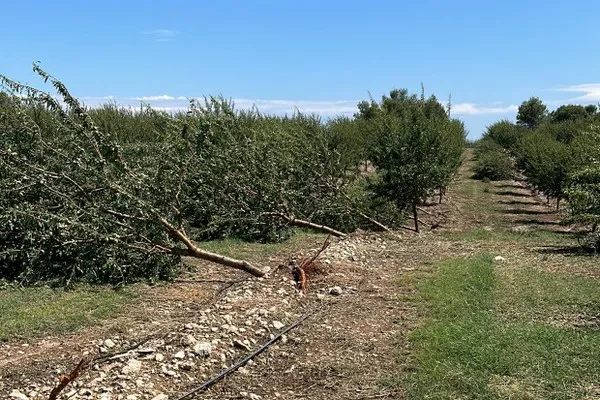
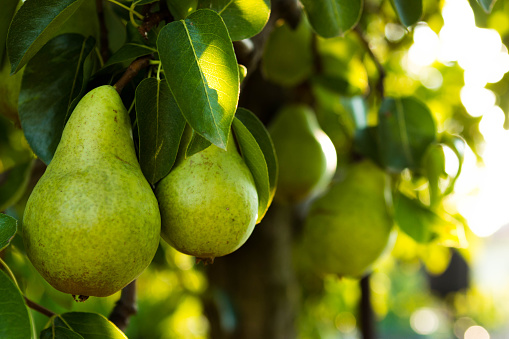
In South Jeolla Province, a hailstorm caused damage to more than 800 hectares of crops, with the impact concentrated in Naju, the country's main pear production area. This has raised concerns about the 2026 harvest.

According to South Jeolla Province, on April 7, total crop damage has been provisionally estimated at 802 hectares. Naju accounted for 742 hectares, followed by Muan County with 50 hectares and Hampyeong County with 10 hectares.

Damage levels were higher in Naju as the hail coincided with the flowering stage of pear trees. The event resulted in a flower drop across orchards. Naju City estimates that around 20 per cent of the total pear cultivation area in the region has been affected.

Pollination is a key stage for determining yield and fruit quality. The loss of blossoms may lead to reduced output over the season.

The weather event occurred on April 6 and affected six areas, including Naju, Damyang, Gokseong, Hwasun, Hampyeong, and Muan. The hail lasted between 5 and 10 minutes, with stones reaching up to 26.5 mm.

On the day of the event, Acting Mayor Kang Sanggu visited affected farms in Geumdong-ri, Noan-myeon. He stated, "We will make every effort for swift recovery and provide administrative and financial support to minimize the damage suffered by farmers."

South Jeolla Province is compiling damage reports and conducting field inspections across the affected areas. Authorities plan to provide technical support for crop recovery, including pesticide application, and to complete a detailed assessment within ten days.

An official from South Jeolla Province stated, "We will focus on delivering rapid support to the areas most severely affected by hail and concentrate on minimizing the damage to local farms."


Source - https://www.freshplaza.com

20.04.2026

Pakistani mango crop declines on heat, cold, and hail damage

Mango production in Pakistan is expected to remain below normal this season due to weather-related impacts affecting flowering and fruit set in Punjab.

19.04.2026

India - Fruit growers press for crop insurance, MIS revival

Responding to the concerns, Minister Javid Ahmad Dar, who chaired the meeting, assured the delegation that all issues would be examined and addressed in a phased and time-bound manner.

19.04.2026

Canada - How Saskatchewan’s satellite forage insurance program is going to work

Saskatchewan Crop Insurance Company shared some of the in-depth details ahead of the program’s inaugral year during the Sask. Stock Grower Association’s semi-annual meeting.

19.04.2026

Farmers in Nepal Face Repeated Losses as Government Compensation Remains Unfulfilled

In late Ashoj and early Kartik of 2078 BS, unseasonal rainfall across Nepal, including Jhapa, caused massive damage to ripening paddy crops. 

19.04.2026

Egypt - Agriculture Minister approves EGP 154m in new funding for National Veal Project

The National Veal Project, chaired by Alaa Farouk, Minister of Agriculture and Land Reclamation, has approved new financing worth EGP 154m for 110 beneficiaries, including small-scale breeders and young graduates, to support the rearing of 2,200 head of livestock. 

19.04.2026

Advocacy workshop on strengthening climate risk financing, isurance for coastal Bangladesh held

An advocacy workshop titled “Strengthening Climate Risk Financing and Insurance for Coastal Bangladesh” was held on Thursday  at Conference Hall of Hotel Western Inn, Khulna. 

19.04.2026

USA - Congress allocated $53M for CT farmers in 2024. USDA secretary claims it’s ‘at the finish line’

It’s been nearly a year and a half since Congress passed disaster relief for small and midsized farmers, and the long-awaited federal block grant is “at the finish line for Connecticut,” according to Agriculture Secretary Brooke Rollins.

16.04.2026

USA - Forecast Performance of RMA Expected Yields: Comparison of Yield Projection Methods

Building upon the analyses discussed in the Farmdoc Daily articles of Jan. 27, 2026 and April 1, 2026, this study finds that the current method used by USDA’s Risk Management Agency (RMA) provided the least accurate projection of actual RMA county yields across the five crops and four projection methods examined in this study.