Following the intense weather events that affected several countries in the Southern Hemisphere, the World Apple and Pear Association (WAPA) has released an update of the Southern Hemisphere apple and pear crop forecast that was originally presented during the Association’s latest Annual General Meeting in Berlin’s Fruit Logistica.
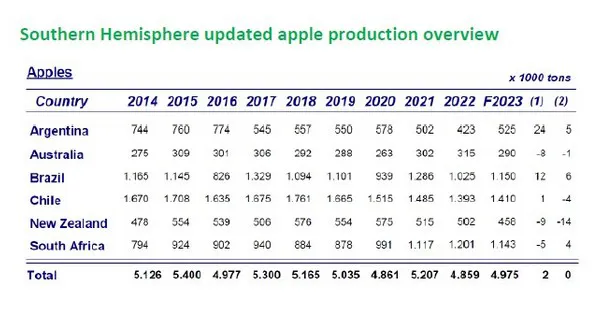
According to the revised forecast, which consolidates the data from Argentina, Australia, Brazil, Chile, New Zealand, and South Africa, apple production is set to increase by 2,38% to reach 4.974.990 T, while pear production is expected to decrease by 1,25% to a total of 1.319.601 T.
During its latest Annual General Meeting in Berlin’s Fruit Logistica, the World Apple and Pear Association (WAPA) presented the Southern Hemisphere apple and pear crop forecast for the upcoming season.
The yearly report is compiled with the support of ASOEX (Chile), CAFI (Argentina), ABPM (Brazil), Hortgro (South Africa), APAL (Australia), and New Zealand Apples and Pears, and therefore provides consolidated data from the six leading Southern Hemisphere countries.
The initial forecast for the 2023 season, which estimated a 6% and 1% increase for apples and pears respectively compared to 2022, has been revised in light of the intense weather events that affected several countries in the Southern Hemisphere. New Zealand’s and South Africa’s apple crop forecasts have been revised downward by 77.902 T and 77.276 T respectively. New Zealand’s pear crop estimates have also been slightly decreased compared to the initial forecast (-323 T), as well as South Africa’s (-28.726 T).
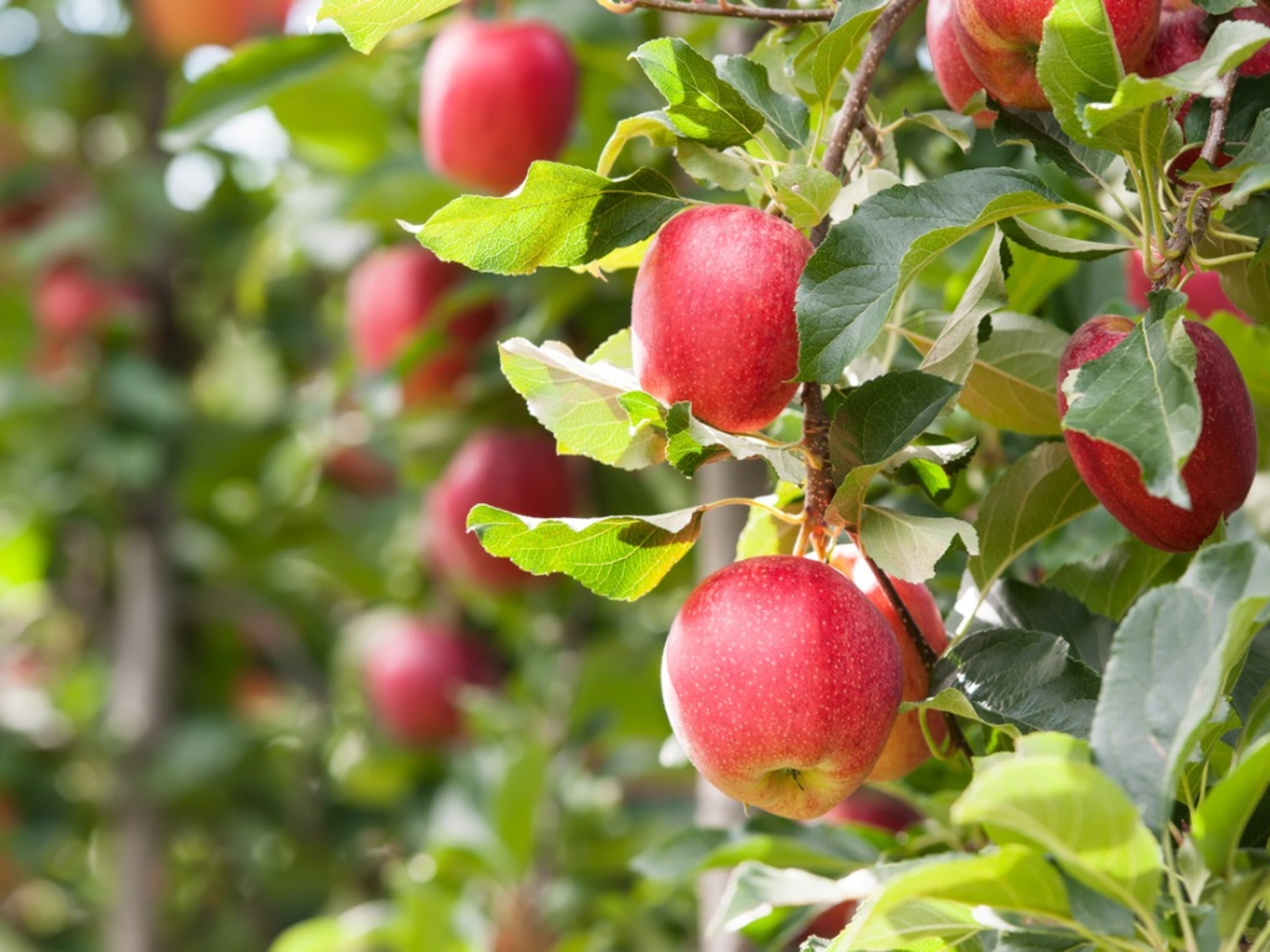
Regarding apples, the updated Southern Hemisphere 2023 crop forecast suggests an increase of 2% to a total of 4.974.990 T compared to last year (4.859.026 T). A smaller apple crop is expected in New Zealand, (457.675 T, -9% compared to 2022), Australia (-8% compared to 2022, to a total of 290.000 T), and South Africa (1.142.880 T, down 5%). Chile remains the largest producer (1.409.633 T, in line with 2022), now followed by Brazil (1.150.000 T, +12%). Argentina’s apple production should reach 525.000 T (+24% compared to 2022).
Apple exports are also expected to decrease (-3% compared to 2022) to a total of 1.556.668 T. Chile remains the largest exporter (604.000 T) followed by South Africa (509.158 T), whose exports are forecasted to decrease by 10%. Exports from New Zealand (286.823 T) and Australia (2.687 T) are also expected to decrease by 15% and 1% respectively. Brazil’s (70.000 T) and Argentina’s exports (84.000 T), on the other hand, are expected to recover from the low 2022 figures.
With 1.843.130 T, Gala remains by far the most popular variety, with its production expected to increase by 4% compared to 2022.
Pears
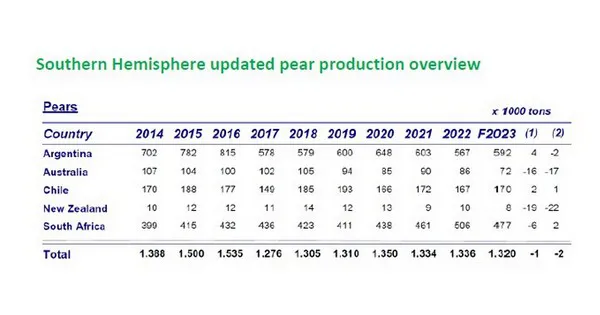
Regarding pears, the Southern Hemisphere growers predict a slight decrease of the crop (-1%), which will drop to 1.319.601 T. While Argentina and Chile are expected to increase their production by 4% and 2% respectively, South Africa’s (-6%), Australia’s (-16%), and New Zealand’s (-19%) production levels are all expected to decrease.
Argentina remains the largest pear producer in the Southern Hemisphere (592.000 T), followed by South Africa (477.419 T), Chile (170.000 T), Australia (72.016 T), and New Zealand (8.120 T).
Packham’s Triumph remains the most produced variety (481.049 T, in line with 2022), followed by Williams' bon chrétien pears (332.447 T). Export figures are expected to be stable (670.054 T), with a 12% increase in Argentinian exports and a 13% decrease in exports from South Africa.
Source - https://www.freshplaza.com