Although the rains of recent days have brought some relief, drought and the depletion of water reserves in the Axarquia and the Costa Tropical de Granada have been causing great difficulties to the tropical sector, as "there appear to be no viable short term solutions," says producer Francisco Garcia.
"All the measures being proposed come too late and involve infrastructures that are currently unfinished," says producer Francisco Garcia. "Now a very considerable amount of tropical acreage could be lost due to long-term bad water policies, for which all administrations are partly responsible: local, regional and national. Warnings have been issued for a long time, so there should have been more investment to prepare us to deal with the problem we have now."
It is true that the weather conditions, which are the cause of the stress suffered by the tropical industry, are an absolutely uncontrollable and external factor, although we must not forget that climate change is undeniably considered to be anthropogenic. The sector has spent years calling for infrastructural improvements, as tropical agriculture is an important source of direct and indirect employment and an engine for the economy of the region. In the latest campaign, despite the drought already taking a toll, the value of the production came close to 148 million Euro in the case of avocados, 29 million in the case of mangoes and almost 43 million Euro in the case of cherimoyas.
"In the upper tropical area of Granada, the only solution that we have been proposed, and which the Administration is planning to implement, are the pipelines of Béznar Rules, which have remained undeveloped for 20 years. They have announced that, with some luck, the works could begin in late 2023 or early 2024; but the water would reach the fields by 2026. In the Axarquia, reclaimed water options are being offered, although these can only account for a percentage of the water needed. So what solution do these measures bring us?" says Francisco.
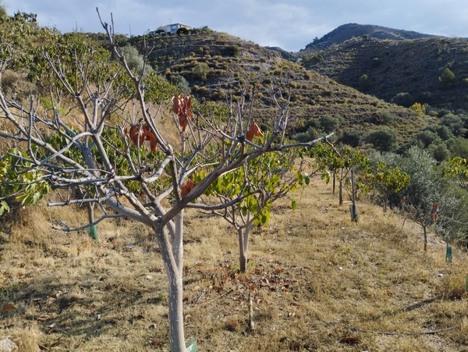
At the moment, the situation is such that producers like Francisco have had no choice but to prune the most affected plants as much as possible, and paint them to avoid their direct exposure to the sun to ensure their survival, sacrificing not only next year's harvest, but also that of the next 3-4 years, which is what the trees would need to become productive again; almost as if they were new trees."
"In the area of La Herradura, everything is burned to a greater or lesser extent; in the lower part of Almuñécar, the plantations are strongly affected by the high levels of water salinity, but in the upper part, despite the water shortages and dry wells, plantations could still be saved because the chloride levels are not yet so high."
"Here in Granada, the area of Motril is the one with the least problems, but we were told that several months ago, at elevation 200, there were some issues with water salinity, and we do not know how the situation will be now. In Malaga, Axarquia is more affected because a large part of the region is irrigated with water from the reservoir of La Viñuela, which is at 10% of its capacity."
"In my case, unfortunately, I must consider my field as lost. In fact, our mango plantation is already nothing but dry trees."
"Not only are they not going to help us in time, but we are gonna end up in debt"
The clouds that have covered the Andalusian sky these days have brought a little short term relief. "With 30-40 liters falling for 10 days, we would have a solution, as long as we also had the necessary infrastructure, including desalination plants. One more thing needs to be taken into account," says Francisco. "Here, in Granada, when it comes to infrastructure, the State will cover 80% of the cost, with support from European funds, but 10% will fall on the commonwealth of municipalities; that is, on all ordinary citizens, and the other 10% on the irrigation communities. In the case of other types of infrastructures, such as tertiary infrastructures, the communities are paying 20%; that is to say: of a 10 million Euro infrastructure, 2 million would be paid out of our own pockets by all community members. So not only are they not going to help us in time, but they are also going to put us in debt."
"With this type of management, all Administrations at all levels have failed us, agricultural producers."
Source - https://www.freshplaza.com