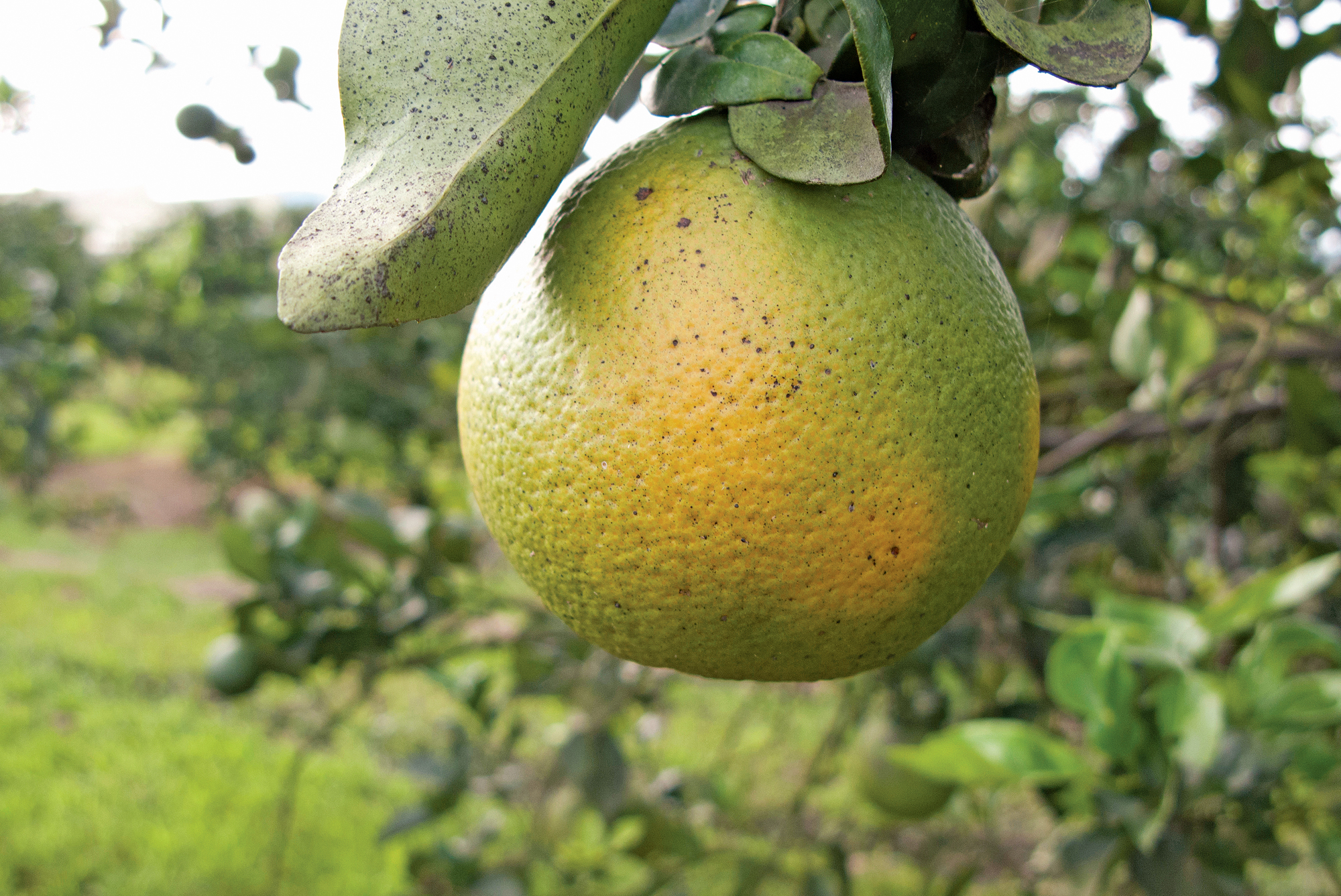
Huanglongbing (HLB), or yellow dragon disease, is a deadly bacterial disease for citrus fruit. Already present in almost all producing regions, HLB is now threatening the Mediterranean basin with the arrival of the psyllid, its insect vector. Given the impact on production and the resulting increase in prices, Cirad is developing integrated pest management strategies, together with its partners as part of several projects, including Tropicsafe, a project funded by the Horizon 2020 program of the European Union, which has just been completed.
Originally from Southeast Asia, HLB spread rapidly to the Caribbean and South America in the 2000s. As the main production area for small citrus fruits, oranges and lemons, the Mediterranean basin is also fearful of this bacteria because, although the disease has not been detected yet in the region, the psyllid - insect vector of HLB - is already present (see the areas where the disease and/or the psyllid are present).
Guadeloupe at the forefront of varietal solutions
Estimated at about 6,000 tons in 2005, Guadeloupe’s production of citrus fruit has dropped by 60% in just a few years, after HLB was detected on the island. The rapid spread of the disease, its aggressive nature and the lack of means to fight it have forced several producers to leave the citrus sector in favor of other fruit species. As a result, citrus imports to Guadeloupe between 2010 and 2020 have been multiplied by six.
More than 400 analyses have been carried out on the island since 2012 as part of the Tropicsafe project, revealing that 60% of the trees tested were infected by HLB. According to Raphaël Morillon, molecular physiologist in charge of the Cirad project, containing the disease is no longer enough. “Today, the only truly effective method consists in removing the sick trees, replacing them with certified healthy plants, and treating them with insecticides to prevent the psyllid from returning. This method has been used in Brazil but it has a high ecological footprint and is not sustainable at all. In Guadeloupe, Cirad has turned to other solutions, by combining new varieties that are more tolerant to the disease with new agro-ecological cropping systems.”
Varieties replanted in sustainable or organic agriculture
Together with its partners and as part of different projects*, Cirad has analyzed rootstocks and new varieties of lime, mandarin, pomelo and orange trees in the field in Guadeloupe, in order to assess their tolerance to the disease. “With these varieties, we are testing different types of technical itineraries,” explains Raphaël Morillon. One in sustainable agriculture, which is without pesticides and more economical in terms of inputs, and the other in organic agriculture**. Our results show that combining this innovative plant material with adapted cultivation practices helps keep the trees alive and produce fruit for a period of at least seven years.”
Approximately 10% of the surfaces initially used for the cultivation of citrus fruit in Guadeloupe is now being replanted with certified healthy plant material. Larger-scale testing is underway with several farmers. “But a lot of work remains to be done to support the farmers in growing these varieties, especially regarding irrigation and fertilization, in order to regain a satisfactory level of production.”
Towards new resistant varieties thanks to the caviar lemon?
The next step is to develop resistant varieties. One of the hopes scientists have lies in the use of some citrus species from Oceania, such as the caviar lemon which is strictly resistant to the disease. “We are trying to create varieties and rootstocks that are completely resistant to HLB, by hybridizing these resistant citrus trees with traditional rootstocks or cultivars, such as orange, mandarin, lemon and grapefruit. In order to identify those resistance genes on the parents of these future varieties, we explore the great genetic diversity of citrus fruits,” explains Patrick Ollitrault, geneticist in charge of the Horizon 2020 Pre-HLB project of Cirad. In the long-term, Pre-HLB aims to develop this type of varietal solutions to manage the disease, while limiting the risks of introducing and spreading the disease in the European citrus orchards. Surveillance is being heightened.
Source - https://www.freshplaza.com