USA - $2.5M grant will support nature-based study of pathogen resistance in perennial crop systems

07.01.2025 375 views

 Plant pathogens — microorganisms and other disease-causing agents — can wreak havoc on agricultural and forest crop plantings, as well as rangeland.

Managing annual monoculture crops to resist disease means using specific products or practices to disrupt the pathogen population.  

But researchers think an altogether different strategy could work in an alternate system: perennial polyculture. 

University of Kansas scientists and their collaborators believe, based on their previous research, that this approach could lead to more durable resistance in perennial crops: mimicking nature and using mixed strategies — including breeding for resistance and planting in multispecies polycultures. 

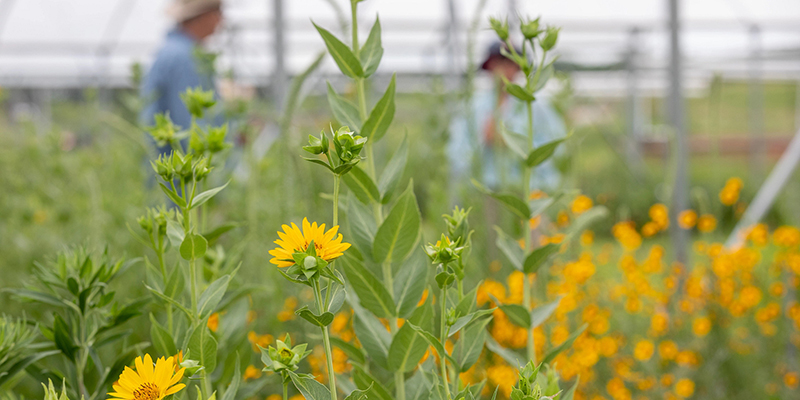
A new five-year, $2.5 million grant will support a KU-led project exploring this approach in a potential perennial oilseed crop, silflower (Silphium integrifolium). The project is funded through the federal program on Ecology and Evolution of Infectious Diseases (EEID), a joint effort of the National Science Foundation, the National Institutes of Health and the U.S. Department of Agriculture.

The principal investigator is Jim Bever, KU Foundation Distinguished Professor of Ecology & Evolutionary Biology and senior scientist at the Kansas Biological Survey & Center for Ecological Research. Collaborating institutions are The Land Institute in Salina, the Danforth Plant Science Center in St. Louis and Case Western Reserve University in Cleveland.

“We already know that the impact of pathogens goes down with species diversity in plant communities,” Bever said. “This is common in prairie plant communities, and it brings significant increases in productivity. In terms of a crop, that means overproducing.”

Researchers will evaluate the drivers of foliar disease in silflower — specifically the relative importance of two factors: breeding for genetic resistance and planting in multispecies mixtures. The results could guide future breeding efforts and planting designs. 

“My hope and expectation is that planting diverse species mixes can mean more robust resistance to pathogens than you’d get only using a genetic approach,” Bever said. “Reliance only on breeding for resistance is hard because you’re only addressing one pathogen at a time, and the pathogen is always evolving.

“Diversity in planting can give plants resistance to more pathogens at once, and that can make resistance more difficult for the pathogen to overcome. So it follows that planting diverse mixes also could reduce the need to put effort into breeding for pathogen-specific resistance.”

The project runs from the beginning of 2025 through the end of 2029, with field research sites in Lawrence and Salina. 

The Kansas Biological Survey & Center for Ecological Research is a KU designated research center, housing a diverse group of programs in ecological research and remote sensing/GIS. It also manages the 3,200-acre KU Field Station, a resource for KU studies in the sciences, arts, humanities and professional schools, and for the community and other institutions.


Source - https://news.ku.edu

16.04.2026

USA - Forecast Performance of RMA Expected Yields: Comparison of Yield Projection Methods

Building upon the analyses discussed in the Farmdoc Daily articles of Jan. 27, 2026 and April 1, 2026, this study finds that the current method used by USDA’s Risk Management Agency (RMA) provided the least accurate projection of actual RMA county yields across the five crops and four projection methods examined in this study. 

16.04.2026

Philippines - DAR orients agrarian beneficiaries on crop insurance

The Department of Agrarian Reform (DAR) facilitated an orientation workshop for the agrarian reform beneficiary organizations (ARBOs) from the provinces of Surigao del Norte and Dinagat Islands to strengthen their access to crop insurance and equip them to become authorized underwriters of the Philippine Crop Insurance Corporation (PCIC). 

16.04.2026

Estonia - AgriFi Brings Agricultural Real-World Assets On-Chain with $AGF on Polygon

Agriculture remains one of the largest and most complex industries in the global economy, contributing over $3 trillion annually to global GDP and supporting the livelihoods of billions of people worldwide, according to data from the Food and Agriculture Organization and World Bank.

16.04.2026

USA - Aid Available for Nebraska Wildfire Victims

Just over one month ago, Nebraska experienced the worst series of wildfires in history, burning nearly 950,000 acres. Since then, assistance for farmers and ranchers affected has been rolling in.

16.04.2026

Thailand - Storm batters Si Sa Ket durian orchards, losses hit B39m

A summer storm caused extensive damage to durian plantations in Kantharalak district, toppling hundreds of trees and wiping out tonnes of Thailand’s economic crop just days before harvest, local officials said on Thursday.Following the storm, district chief Somkuan Singkham ordered an urgent survey in tambon Phu Ngern, where strong winds and thunderstorms hit five villages, damaging durian orchards belonging to 110 farmers.The affected fruit is a geographical indication (GI) product known as “Sisaket Volcanic Area Durian,” grown in Khun Han, Kantharalak and Si Rattana districts. Popular varieties include Monthong, Chanee and Kanyao, prized for their creamy texture, mild aroma and relatively dry flesh.

16.04.2026

Cropshader approved for organic farming in Europe

Cropshader, developed by Lumiforte, has been verified as suitable for use in organic farming under the control of Ecocert in Europe. The product complies with the requirements for inputs used in organic production in accordance with applicable European regulations.

15.04.2026

USA - Federal aid programs aim to help Southeast Texas farmers recover from losses

Southeast Texas farmers grappling with crop losses due to extreme weather are turning to federal aid.

15.04.2026

India - Landowners waive lease payments after crop damage

Farmers with large landholdings are doing their part to ease the burden on small and marginal farmers whose crops were damaged by the April 4 storm.