Sen. Jack Bailey (R-St. Mary's, Calvert), a former game warden, was not the scheduled speaker at the Deer Summit in Annapolis on May 11, but he did highlight the importance of meeting. He talked about Senate Bill 327, a unanimous bill coming out of both chambers, affecting hunters, farmers and deer.
“We understand that deer are a problem,” Bailey said. “The way we did it in that bill, requires the Department of Agriculture and Department of Natural Resources to work together and inform us in a full written policy by December first. So we can be educated to make the right decisions.”
A large crowd of hunters, farmers, and policy makers crammed into the Maryland Department of Agriculture building in the state capital to hear experts talk about controlling the white-tailed deer population.
Many solutions were bandied about, but the biggest thing was what hunters knew all along — kill more deer. Particularly female ones.
Secretary of Agriculture Kevin Atticks told the rural crowd he empathizes with his audience.
“The number one topic that I’m hearing is deer. I moved here and they are eating my Hostas, blackberries, figs ... this is personal folks,” he joked, while acknowledging the seriousness of the problem.
Brian Eyler, from the Department of Natural Resources, described the mandatory check-in system after a deer is killed. This gives DNR a picture of how many white-tails are in the woods. The system had been in place since 1927, when five bucks were reported in Allegheny County.
The system provides an accurate measure of how many deer are harvested, and how many hunters are shooting them. Combined with antler harvest metrics, and records from State Farm for total miles driven and deer collisions, DNR can predict the number of deer per year.
Eyler said that despite popular belief, their data indicates a stable deer population.
“It’s definitely too high in some areas,” he noted.
Eyler praised the hunters in the room — 80,000 deer are harvested a year, and of those hunters remove 40,000 to 50,000 female ones.
“The services hunters provide are invaluable,” he said
The fee for licenses hunters need also goes back into the economy.
“That’s $400 million to the state,” Eyler said.
“We’re throwing the kitchen sink at hunting. The season’s from early September to February. All our seasons and bag limits encourage harvest of female deer," he said. "We allow crossbows, muzzle loaders, everything to keep hunters engaged.”
Eyler’s solution lies with the hunters — allow Sunday hunting statewide and hunt in areas that have been previously unhunted.
The second speaker, Luke Macaulay, a wildlife management specialist, showed the kind of damage these “large rats,” cause. He portrayed a portion of an alfalfa field fenced in, compared to an unprotected area. The leaves in the fenced area were plump and spreading, but almost skeletal in the unprotected area.
That’s because a 150-pound deer eats 9 to 12 pounds of foliage daily. He agreed with Eyler that lethal is the best way to prevent the deer problem, but produced other methods to stave the deer off if that was not an option.
Forage soybeans and other food plot plantings are shown to draw deer away from a main crop. He said fencing helps but could be costly. Plastic mesh works for deer but not rabbits, he added. Some fencing hurt turtles too. Repellents depend on the weather, and you have to reapply after a rain.
Really, lethal is the way to go, he agreed.
Macaulay said they need to encourage high density hunting on a single day. That means getting a large group of hunters out the same day harvesting. Then hunters leave that property for a while to prevent the deer’s learning behavior of becoming nocturnal and cunning.
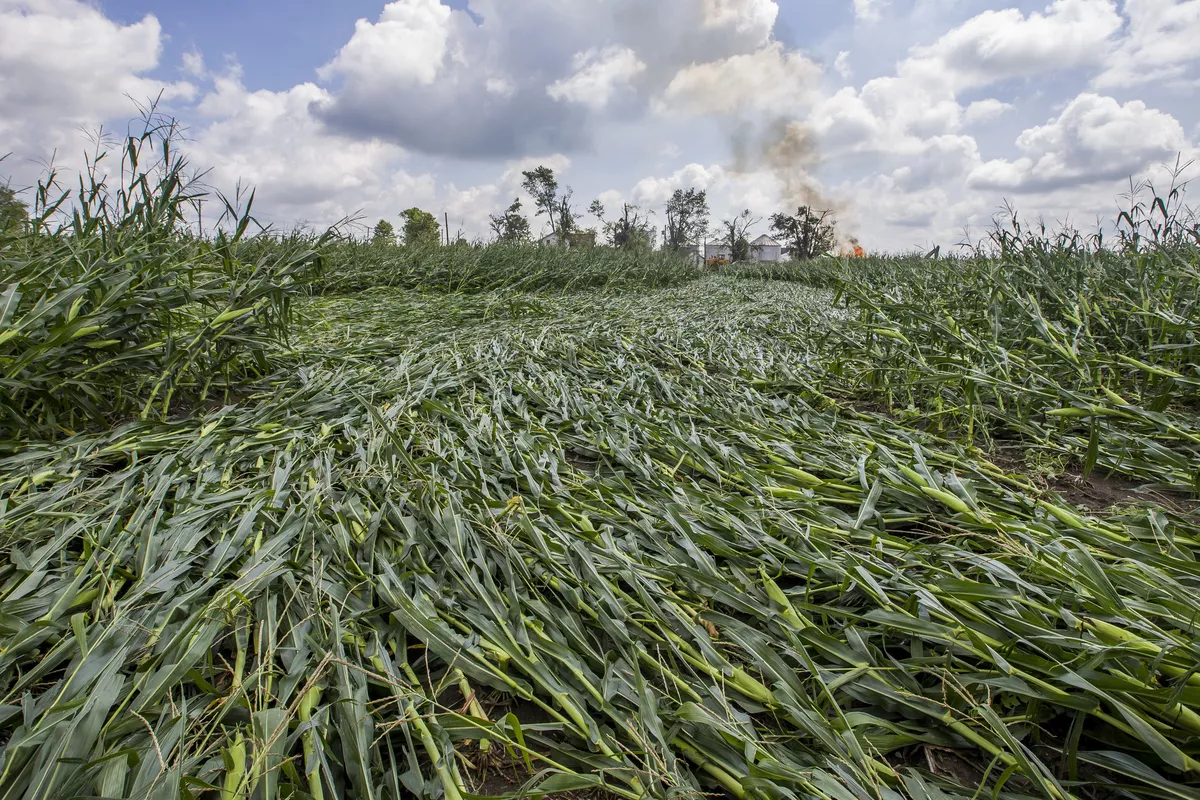
Colby Ferguson of Maryland Farm Bureau dove into the financial havoc deer cause. Based on discussions with farmers around the state, the average crop loss from deer is around $50 per acre per farm, he said. With nearly 1.1 million acres in cropland, this means about $60 million in losses a year.
There was some help coming from the state Senate, Ferguson pointed out. In the 2023 legislative session, they passed Senate Bill 327: Hunting, Wildlife Conservation, and Outdoor Recreation — Funding, Promotion, Management, Licenses, Permits and Stamps.
A portion of the funding increase goes to the creation and funding of a farmer cost–share program to provide funding for farmers to plant forage crops on private agricultural land to reduce the loss of crops.
Ferguson pointed out more funding is needed to help reduce crop damage.
“It is devastating,” he said.
Costs of deer damage escalate because of health concerns to the public, which David Crum, state public health veterinarian with MPH, and Katherine Feldman, also with MPH, addressed.
Crum talked about zoonosis, diseases which can be transmitted to humans from animals, and referred mainly to deer ticks. Deer are not affected with Lyme disease, Crum said, nor do they infect ticks.
There are no human cases of rabies in Maryland either, he pointed out.
Finally, Krum said that deer are not a threat “at this time” to spread COVID-19.
One issue was the federal control over “approved sources,” of food. Why can’t wild venison be sold commercially, one farmer asked? Dr. Clifford S. Mitchell said they need to track it for health reasons.
A landowner brought up if the state is willing to compensate for livestock loss due to coyote, and grain due to bear, why aren't they willing to compensate for deer in this region?
Many mentioned Sunday hunting should be allowed statewide. One person in the audience cautioned that approach.
One commenter said hunters and farmers are getting older, and asked what’s being done to encourage the younger generation to farm and hunt.
Atticks said, “We’re just starting the discussion. Our different departments and university will cooperate and get some recommendations based on what was discussed today.”
The report has to go to the legislature by December.
“We’ve got our work to do. This is the first of the discussions that will help inform that.” Atticks said.
The list of speakers closed on a hopeful note. Josh Wilson relayed his story of how his father came up with Farmers and Hunters Feeding the Hungry. Wilson’s father encountered a poor woman on the roadside, struggling to get a deer home and process it before it went bad.
Wilson’s father assisted her, then later had the idea to unite hunters and farmers to feed the needy.
From his father’s vision grew a nationwide effort uniting volunteers across America.
Wilson brought up the issue of processing. What good is harvesting a deer if you can’t get it processed safely? There is a shortage, and more needs to be done to encourage processing.
Source - https://www.somdnews.com