Evan Schutt plucks a Honeycrisp apple from a tree on his 50-acre farm on Plank Road in Penfield.
"You see this russeting?" Shutt asked, pointing out a discolored, gritty band around the middle. "No one's gonna want to bite into that."
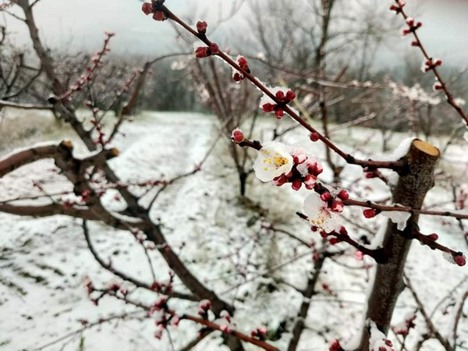
The frost ring, as it's called, is the mark left on the apple from a frost on May 18. Even though the damage is only cosmetic, Schutt won't offer blemished apples for sale in Schutt's Apple Mill, the family business he took over eight years ago.
The harvest is still underway, but it appears as though half of Schutt's crop was affected by the late spring frost. In addition to the superficial damage seen on the Honeycrisp apples, the farm's Empire apples were almost completely wiped out this year.
Some of the apples with frost damage can be sold to make cider or apple juice, but he expects to get $60 per bin (800 pounds of apples), compared to the $600 or $700 that a bin of Honeycrisp eating apples could command.
In some ways, Schutt knows he is fortunate. Some New York apple growers lost 95% of their crop. According to early estimates, the losses average 20% statewide.
"We know of many farms in Central New York, in some of the highlands around the Hudson Valley, and a little bit further south of Lake Ontario ... more inland ...where they lost all of their crop, which is absolutely terrible," said Gregory Peck, associate professor of horticulture at Cornell University.
It all comes down to location, according to Peck. Orchards close to bodies of water are protected from frost events because the cooler air means the trees blossom later in the season. Proximity to water also mitigates large swings in temperature.
"On the morning of May 18," he said, "the orchards that were close to the lake, they just didn't drop down to as cold of a temperature as those orchards that were just a few miles further south of Lake Ontario."
Peck said losses from spring frosts will be more likely in future years, too, as climate change leads to warmer winters and earlier-blooming apple trees.
One method that growers can try to mitigate damage, he said, is planting a mix of apple varieties that are programmed to bloom at different times, so a single frost event doesn't destroy everything.
Elevation is another factor.
In Penfield, less than three-and-a-half miles from Schutt's Apple Mill, the apple orchard at Wickham Farms largely escaped frost damage this spring. That's because their apple trees sit on a hill.
"What happens is, the cold air actually runs like water, right down the hill, and the warm air stays. We believe that may have spared us," said Debbie Wickham, the farm's co-owner.
On a cool September morning last week, she was preparing to welcome customers who've been waiting for the new crop of Honeycrisp apples to be ready to pick.
This customer favorite makes up half of the farm's apple crop.
"We basically have more apples than we are currently able to sell. These trees are producing like wildfire," Wickham said, pointing to a wall of trees heavy with fruit.
Back at Schutt's Apple Mill, Evan Schutt said he'll get by this year by sourcing apples from other local growers and selling other products in his retail store.
He has already diversified the business by planting strawberries and flowers and hosting summer and fall events. Two years ago, he installed an irrigation system on the farm.
But Schutt, who is a fifth-generation farmer, has seen more and more extreme weather and knows he will continue to face challenges.
He admitted that there are times when he second-guesses his decision to give up a teaching career to go into the business.
"I love what I do," Schutt said, "I'm a really fortunate person. The community has supported our family business for over 100 years. But to tell you that stress is not a major part of my life is hard."
Last month, the U.S. Department of Agriculture approved a request from New York state for a federal Agriculture Disaster Designation.
This will allow the affected farmers affected by the spring frost to apply for low-interest emergency loans.
Source - https://www.wxxinews.org