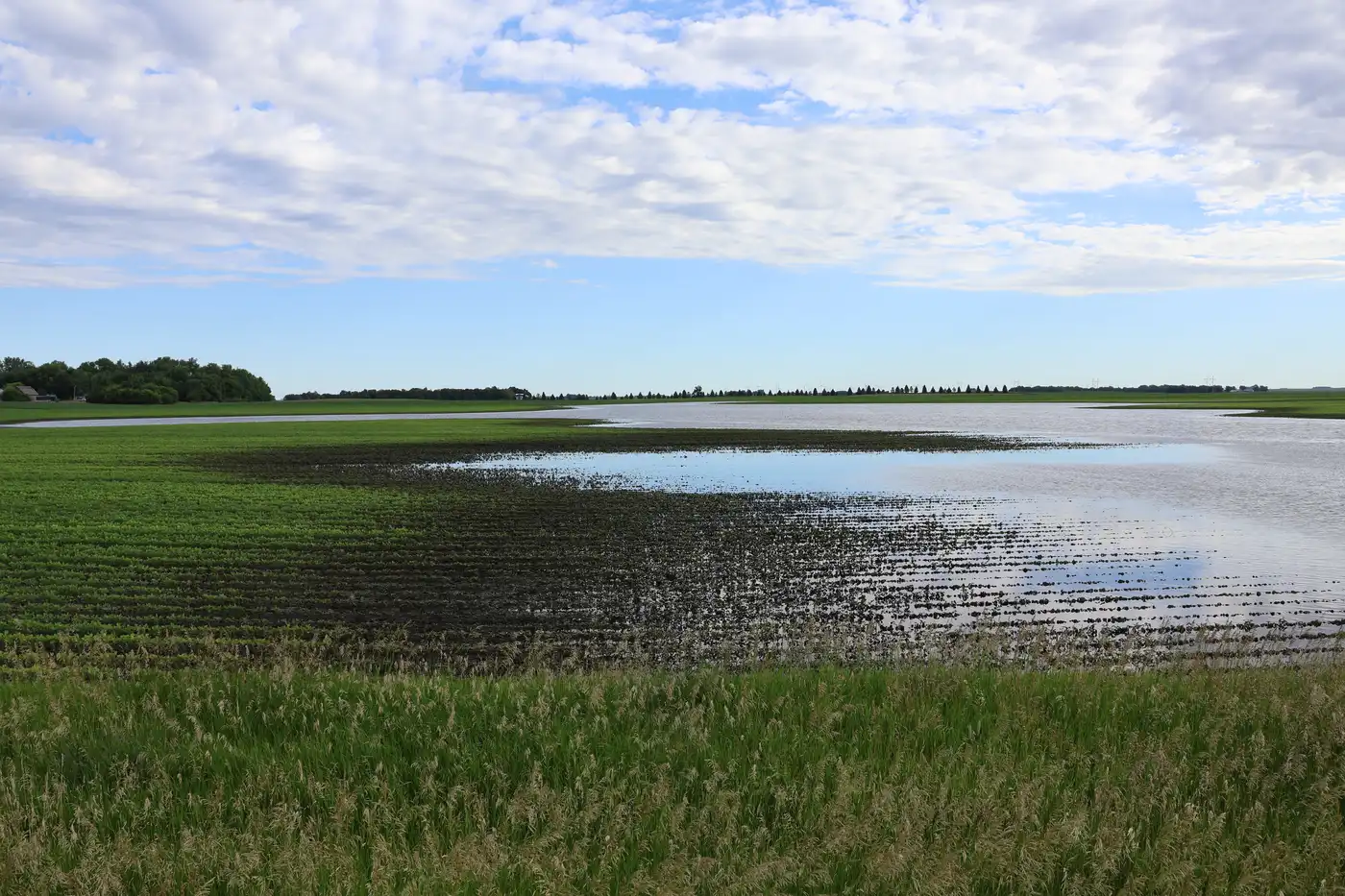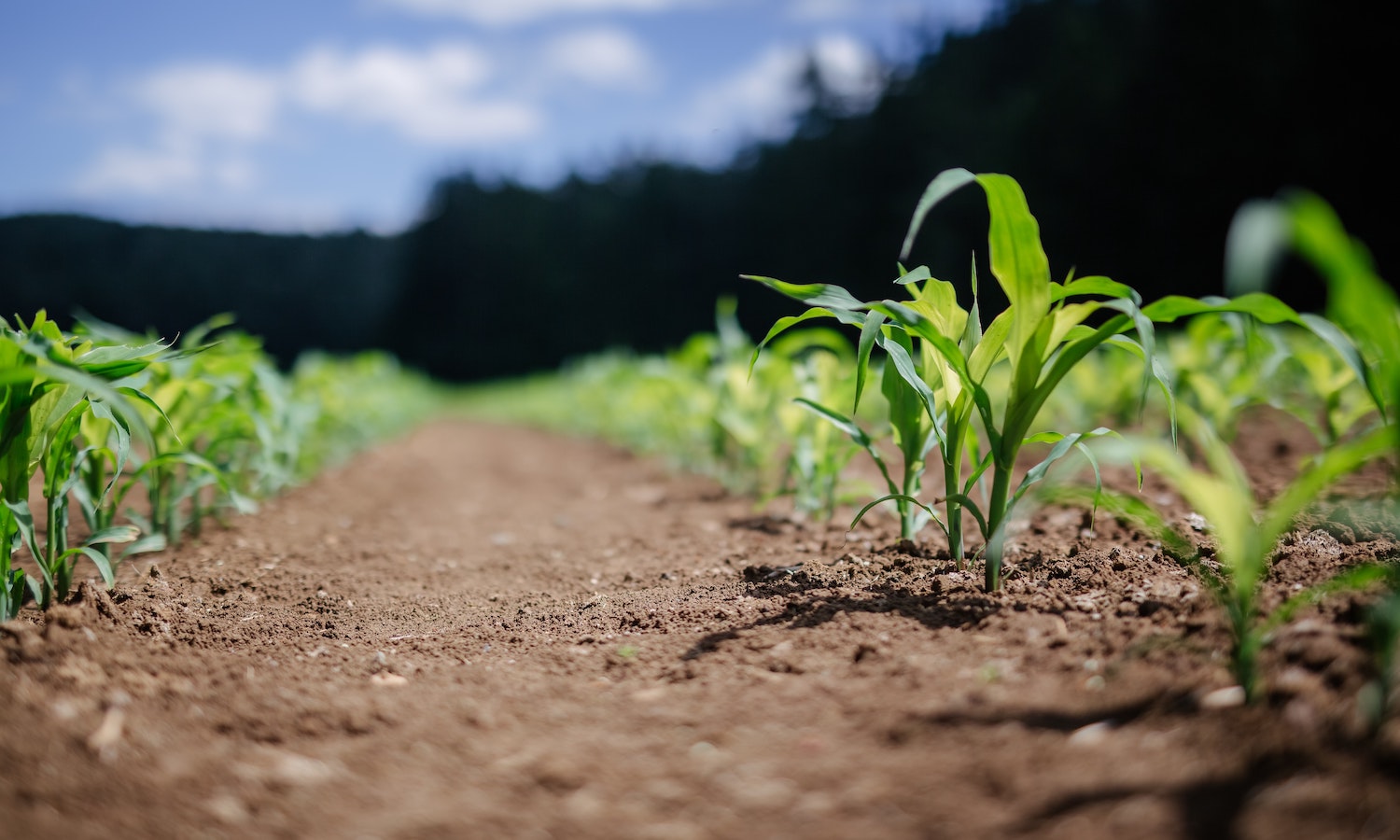
The images are familiar: gray clouds of soil billowing from crop fields in a dry, windy spring and road ditches filled with snowbanks crowned with brown.
All tell the story of soil erosion. The images, which have prevailed across decades and generations, seem an inevitable outcome of farming.
The true story behind these familiar sightings and the volume of erosion they represent is breathtaking. The historic loss of soil, when tallied across the most vulnerable topographical areas of the Midwest, may amount to 57 billion metric tons of topsoil and its carbon lost over the past 150 years of farming.
NATIVE PRAIRIE REMNANTS
The staggering measure of loss comes from research done at the University of Massachusetts (UM). Members of the research team visiting the Midwest had been intrigued by sites where remnants of native prairie butted up against farm fields. Characteristic of these sites was a sharp drop in elevation from native prairie to tilled fields, indicating the extent to which the native prairie had been eroded.
The researchers measured the differences in elevation between these two land uses at 20 sites in nine states — Illinois, Indiana, Iowa, Kansas, Minnesota, Missouri, Nebraska, North Dakota, and South Dakota. They did high-resolution topographical surveys across erosional escarpments to calculate how much soil had been eroded.
“We used an association between the measured reduction in soil thickness and topographic curvature to predict regional soil erosion occurring since the beginning of farming to the present,” says Evan Thaler, a member of the UM research team now working as a scientist at the Los Alamos National Laboratory in New Mexico.“We estimate that the rate of soil loss comes to 2 millimeters in thickness per year across the hilly areas [in the states we studied],” he says. “The soil loss amounts to 22.5 metric tons per hectare per year, or about 10 tons per acre per year.”
While the study does not measure ongoing rates of soil erosion, Thaler suggests the high rate of historical soil loss indicates that present measurements by other sources underestimate both the historical rate of erosion and the rate of erosion that continues.
Results of the study, titled “Rates of Historical Anthropogenic Soil Erosion in the Midwestern United States,” were published online in 2021 by the journal Earth’s Future.
The study was inspired by earlier UM research estimating soil erosion in the Midwest. In the earlier study, researchers used satellite imagery obtained during the dormant phase of the growing season to compare differences in soil color to estimate erosion rates. The study, “The extent of soil loss across the U.S. Corn Belt,” was published in 2021 in Volume 118 of Proceedings of the National Academy of Science.
A-HORIZON SOIL EROSION
“By developing a relation-ship between soil loss and topography, we found that A-horizon soil has been eroded from roughly one-third of the Midwestern U.S. Corn Belt,” says Thaler. “Prior estimates indicated none of the Corn Belt region has lost A-horizon soils.”
The A horizon constitutes topsoil built by the native prairie. “Prior to European settlement in the mid- to late 19th century, the vegetation was primarily tallgrass prairie with some savanna and woodlands,” says Thaler. “The native prairie vegetation fostered the accumulation of thick A-horizon soils. In the decades following European settlement, the prairie was plowed, and the landscape was rapidly and extensively converted to row crop agriculture. For example, in Iowa, Indiana, and Illinois, less than 0.1% of the original tallgrass prairie remains.”
Soils where the A-horizon layer of soil has been completely removed are commonly classified by USDA as Class 4 eroded soils, notes Thaler. Classes 1, 2, and 3 represent soils that have lost topsoil in the amounts of 25%, 25% to 75%, and greater than 75%, respectively.
“Because the A horizon has the largest fraction of soil organic carbon within the soil profile, it is a key component of water and nutrient retention and soil productivity,” says Thaler. “The loss of A-horizon soil has removed as much as 1.4 petagrams, or 1.5 billion tons, of carbon from hillslopes, reducing crop yields in the study area by around 6% and resulting in $2.8 billion in annual economic losses.
“Soil degradation diminishes soil fertility by removing organic matter and nutrients,” he says, “and without countervailing practices, such as fertilization and genetic crop enhancements, leads to reduction in crop yields. Fertilizer use, however, does not fully restore the productivity of eroded soils, and because fossil fuels are required to generate the energy needed to produce fertilizers, the use of fertilizers to increase yields in degraded soil is not sustainable.”
Much of the carbon held within the topsoil eroded from hilltops and side slopes likely remains buried in lower areas within the field, suggests Thaler. “Restoring carbon to degraded soils therefore has potential to both reestablish soil function and sequester atmospheric carbon dioxide,” he says.
OPPORTUNITY EXISTS
Because carbon is the main component of soil organic matter, increasing organic matter in the soil in degraded areas presents an opportunity for farmers, says Richard Cruse, Iowa State University agronomist. Not only does the building of the organic matter se-quester carbon, but it also boosts crop yields without increasing inputs.
Improving the soil’s ability to store water is a critical way that increasing levels of soil organic matter help crop yields. “Water is the critical thing crops need,” says Cruse. “Building soil organic matter improves soil structure, and this improves water infiltration and retention.”
The need to improve water availability in soils is becoming more critical. “Increasingly, we’re experiencing warmer and drier mid- and late-season growing conditions for crops,” says Cruse. “Our models indicate that our weather systems are going to be-come even hotter and drier, especially during grain filling. The need to maintain water in the soil is huge, and it’s going to get even bigger.”
Practicing no-till in combination with growing cover crops or other crops year-round is key to building the organic matter that will restore health to degraded soils. “It’s important to protect the soil surface at all times and grow the root biomass that will provide a smorgasbord for soil life,” he says. “Having surface cover and having biomass under-ground close to the surface are key to building healthy soil.”
CAN ERODED SOIL BE REBUILT?
While management practices may improve soil health and rebuild carbon-rich soil organic matter, these improvements cannot restore eroded soil to its original state, says Richard Cruse, Iowa State University agronomist.
His is a sobering reminder that any amount of soil erosion represents losses that cannot be retrieved.
“Soil organic matter is just one component of the topsoil,” he says. “Other components are those materials that glaciers deposited. These clay particles make up the min-eralogy of the soil, and the makeup differs by region. If we put organic matter back in the soil, it’ll be a lot better than it was with lower levels of organic matter. But it won’t be as good as it was before the erosion occurred.”
Source - https://www.agriculture.com