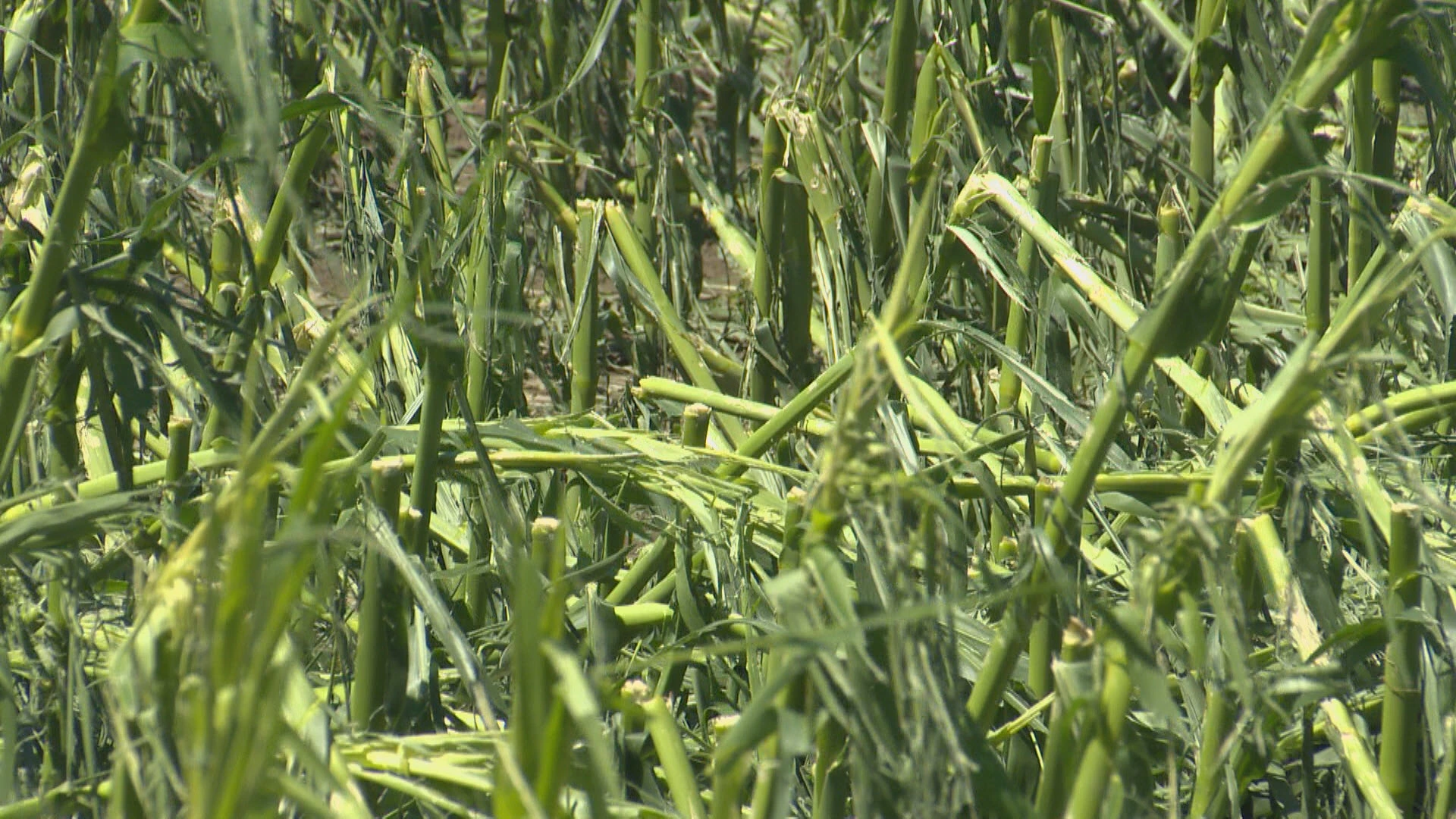
Straight line winds exceeding 60 miles per hour over Independence Day weekend flattened a good number of cornfields in the southeastern part of Pennsylvania.
With a significant amount of corn approaching pollination in the region, there is some risk of yield loss from this event.
If you have broken stalks, or green snapping, below the ear leaf, you likely will not get any yield from those plants, according to Dan Quinn, an Extension corn specialist from Purdue University. There can be up to a one-to-one percentage yield loss per percent of green-snapped corn in this circumstance.
If the stalk damage is above the ear leaf, you may still get some yield, but Quinn writes that it will be lower than desired.
If you had to choose the lesser of two evils, you would hope for root lodging, or lodging without stalk breakage. Root lodging tends to occur when high winds are paired with moist soil, so roots pull out of the ground.
I have seen evidence of both types of lodging in Lancaster County.
By the time this article is published, you should be able to see damaged corn plants starting to right themselves upward, also called goosenecking. Corn plants can reestablish roots and reorient leaves to catch maximum sunlight. However, this recovery depends on factors like soil moisture during the storm, root structure, hybrid, severity of bending, and most importantly, the growth stage of the corn at the time of injury.
If plants haven’t started to gooseneck by now, they will not yield for you. The problem is, some leaves get shaded, reducing photosynthesis. If your corn is moving into the reproductive stage, neighboring lodged plants shade or cover exposed silks, causing poor pollination.
Growth Stage Makes All the Difference
Quinn cites data from a three-year research trial in Ohio (Lindsey et al., 2021). The researchers found that up until tassel/silk, the earlier the lodging damage occurred, the lower the yield loss. This is because the larger the gap between the root lodging damage and reproductive stage, the longer the plant has to reorient itself and rebuild its roots.
Once corn reaches the milk stage, yield loss from root lodging is still significant but lower than the critical VT/R1 stage.
Hopefully most corn was still in the vegetative stage and has time to recover. I have heard incredible anecdotes about achieving top yields even after a root lodging event during the vegetative stage.
In summary, be aware of the potential for yield loss, but don’t lose hope just yet.
Source - https://www.lancasterfarming.com