It’s 10 minutes after 2 early Thursday morning and Kerry Mattics inspects a thermometer hanging on a deer fence that surrounds his family’s fruit orchard.
Twenty-seven degrees.
“It’s go time,” he says. “The bottom just fell out.”
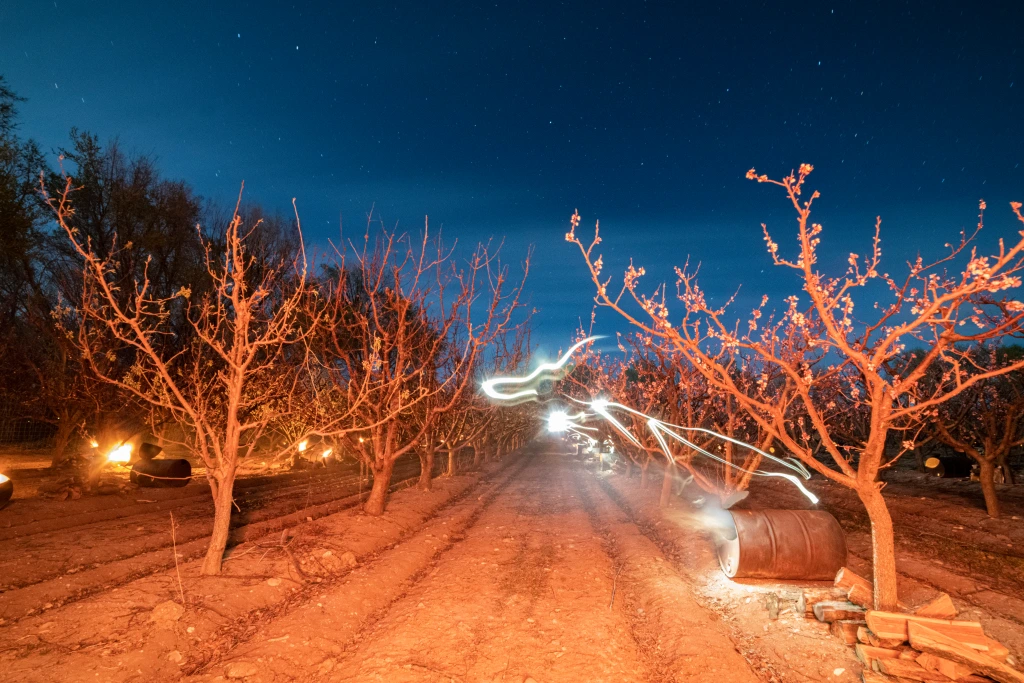
The mercury had dropped a full three degrees in just a few minutes, as a thin layer of clouds melted away. With the sudden dip in temperature, Mattics climbs aboard an ATV armed with a propane torch. In the darkness ahead of him, rows of flowering peach, apricot and plum trees now sit below the stars freezing, and each lost degree is costing him money.
After sparking the propane torch, Mattics drives down each row lighting burn barrels filled with wood that he and his laborers have been preparing since midnight. In all, Mattics thinks he’ll use about 10 cords of wood in more than 100 burn barrels trying to prevent his crop from being a complete loss. He had to put in the same effort the night before.
Fragile and frail are the blossoms of the Colorado fruit tree each April as the colorful buds await their pollinators.
While this April is no different, Colorado fruit farmers have endured sleepless nights this week as frigid spring weather has swept through the state.
In the heart of the Western Slope, where peaches, plums, apricots and apples support thousands of livelihoods from Palisade to Paonia, these annual spring dips into the danger zone are about managing risk.
In Palisade, lifelong resident Kaibab Sauvage, a fruit grower and winemaker, has had to light propane heaters in his 17-acre orchard this week to keep the air around the buds from freezing his crop to death.
“We turn on the heat for our most valuable crops, the peaches, apricots,” Sauvage says. “We’ve already seen a little bit of damage this week.”
Exactly two years ago, on April 14, 2020, a hard freeze with temperatures dipping into the mid-teens hit Western Slope farms hard. That same fall, a hard freeze hit vineyards from Mesa County all the way up the North Fork Valley.
Sauvage says each spring can bring freeze and frost warnings to Western Slope fruit growers, and the best way to mitigate the damage is to know how to use elements like air, water and heat to your advantage.
Propane works best for his orchards on these cold nights. Sometimes a wind machine that moves cold air up and warm air down to create an inversion can buy a grower a couple of degrees of insurance. Other times kicking on the sprinklers to carefully add a layer of ice over the trees can help.
“You’ve gotta work for it,” Sauvage says. Fruit growing, he says, “is a risk, it’s a gamble.”
Sauvage said his 80 acres of wine grapes will be spared in this week’s freeze, but added many winemakers are still recovering from hard freezes in 2020 and 2021.
Back in Olathe, Mattics is in a battle to keep the fires under his trees going. It takes about 45 minutes to visit each burn barrel in the orchard to add wood, and by the time he returns to the first one, it’s time to start the process all over again. Mattics says he will continue this work into the early morning, or until “the thermometer starts moving the other direction.”
Fires are burning at another orchard just down the road and smoke is filling the countryside around Olathe, a town better known for its sweet corn. Mattics says only a few fruit growers remain in the area as rising costs and other economic pressures have forced many orchards to close. His own family-run farm used to grow fruit on more than 80 acres above Olathe. Today, the multi-generational operation is down to about 8 acres.
Buds that have already fully opened are most at risk during a freeze. Mattics says by burning barrels he hopes to save the buds that are still closed or have not fully opened. Kerry admits spending all night keeping fires going is a lot of work, for potentially low return.
It’s a labor of love to endure cold, smoke-filled nights to keep his orchard from freezing. Like many Western Slope farmers, the reward of the work may be the bountiful harvests in summer.
“I really enjoy fruit farming,” Mattics says. “It’s fun and I love it, but I don’t know how much longer I can do it.”
Source - https://coloradosun.com