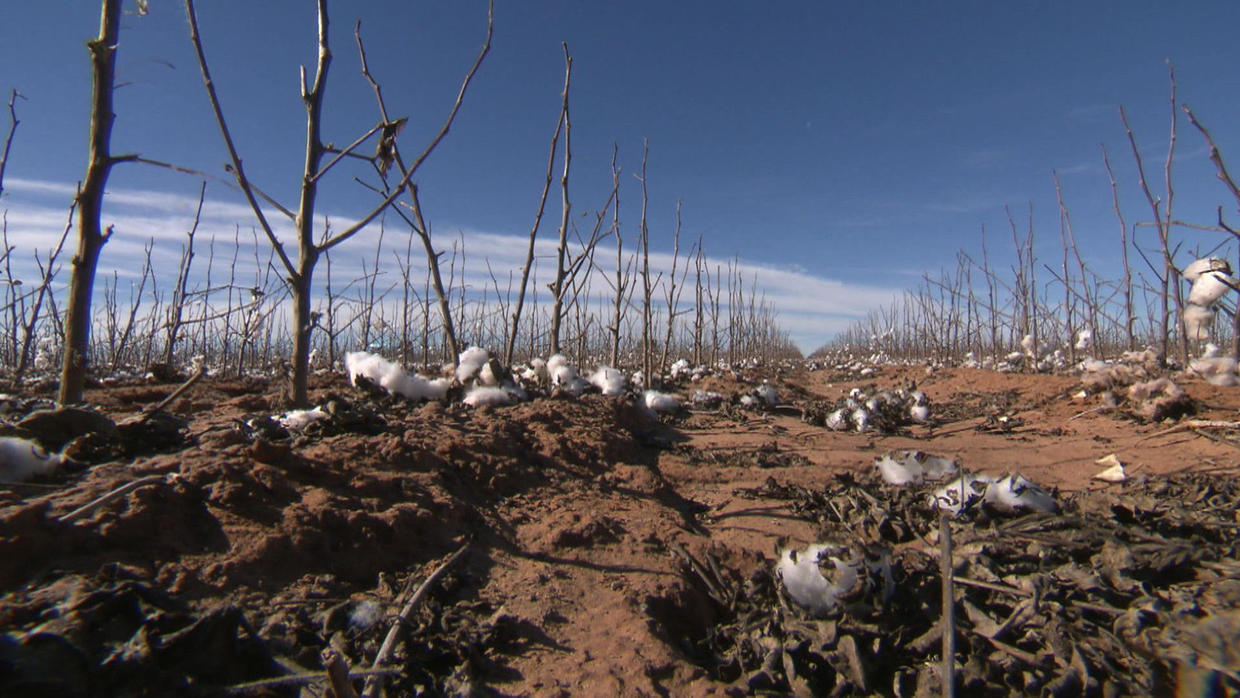
A punishing drought in West Texas is turning fields to dust in the U.S.’s top cotton-growing region, deepening a global supply-chain shock that is likely to further weigh on clothing prices.
About half of the area is experiencing what could end up being its driest year ever, threatening crop yields for producers that were already burdened by soaring costs for fertilizer and transportation. La Nina weather conditions could extend dryness through the second half of the year.
Consumers, already strained by widespread inflation, are bound to feel the consequences. Texas accounts for about half of cotton production in the U.S., which is the world’s top exporter. The U.S. ships almost twice as much as second-ranked Brazil.
Cotton futures have tripled since April 2020 and could rally further. That intensifies cost pressures for apparel brands such as Gap Inc. and Levi Strauss & Co. and makes it harder for them to keep a lid on prices without sacrificing profit.
“Without rains in West Texas there will be almost unbelievably tight U.S. supply,” said Louis Rose, a veteran market analyst. Prices “could top the highs from a decade ago.”
Non-irrigated fields in West Texas have not seen such parched conditions since at least 2011, when drought caused billions of dollars in losses to the state, including $2.2 billion in cotton. That was Texas’s driest year on record, with just 14.8 inches of total rainfall.
Cotton growers that year saw a historically high acreage abandonment of 55% of planted acres, and U.S. Drought Monitor data signals the current dryness may be worse, said Kody Bessent, chief executive officer for Plains Cotton Growers Inc., the largest producer group in the state.
The U.S. Department of Agriculture has designated hundreds of Texas counties, 35 of which are in the High Plains region, as primary disaster areas due to drought. The region includes the northern and western side of Texas from the Panhandle to the Pecos River, Bessent said.
“Farmers are doing the best they can to prevent erosion by keeping previous cotton stalks up in the fields and using cover crops,” he said. “Despite cover crop initiatives, there is a lot of dust in the air.”
There is no significant rain in the forecast at least through this week, though there’s been more sporadic rain that is typical of May, according to World Weather Inc. Plantings are picking up and will end in early June, with harvesting done in the fourth quarter. While some irrigated areas have gotten rain this season, they could suffer from dryness in coming months.
The weather risk adds to shipping woes that were already pressuring the industry.
“In recent months, our members have faced the highest rates of delayed vessel services, empty container export sailings, and total inbound containerized cargo of all time, which inundates interior logistical infrastructure,” said William “Buddy” Allen, the president of the American Cotton Shippers Association, in an email.
To be sure, U.S. cotton acreage is forecast to be 9% higher this year, which may help offset crop loss in Texas. Demand may also ease amid higher prices and slowing economies, said Jon Devine, supply-chain economist at North Carolina-based researcher Cotton Inc.
Geopolitical tensions add to the industry’s complications. Neither Russia or Ukraine is a significant producer or consumer of cotton lint. Their annual imports of cotton products like apparel are valued at roughly $3 billion and $500 million, respectively.
But Russia’s invasion of Ukraine is expected to crimp consumer demand and further exacerbate mills’ problems across the globe, which include rising costs for production, higher fuel prices, and, for yarn manufacturing, electricity costs.
Already, “at these prices and given macroeconomic pressure, yarn spinners cannot make money up here as they are experiencing inflation in every aspect of their business, as are their customers,” said Jordan Lea, trader for textile supplier Deca Global LLC.
For traders, it’s risky to hold inventory too far into the future with the price curve showing lower prices for deferred contracts through 2023, said Sid Love, a consultant in Kansas. Prices could rally further “until the crop is more certain, but acres are up.”
The situation makes for enormous uncertainty for growers.
Bessent from Plains Cotton Growers said those who end up with a poor crop will be hurt the most by staggering input costs. He said, “If farmers can make a crop and take advantage of the high prices, that would certainly be of great benefit to their bottom line.”
Source - https://www.nny360.com