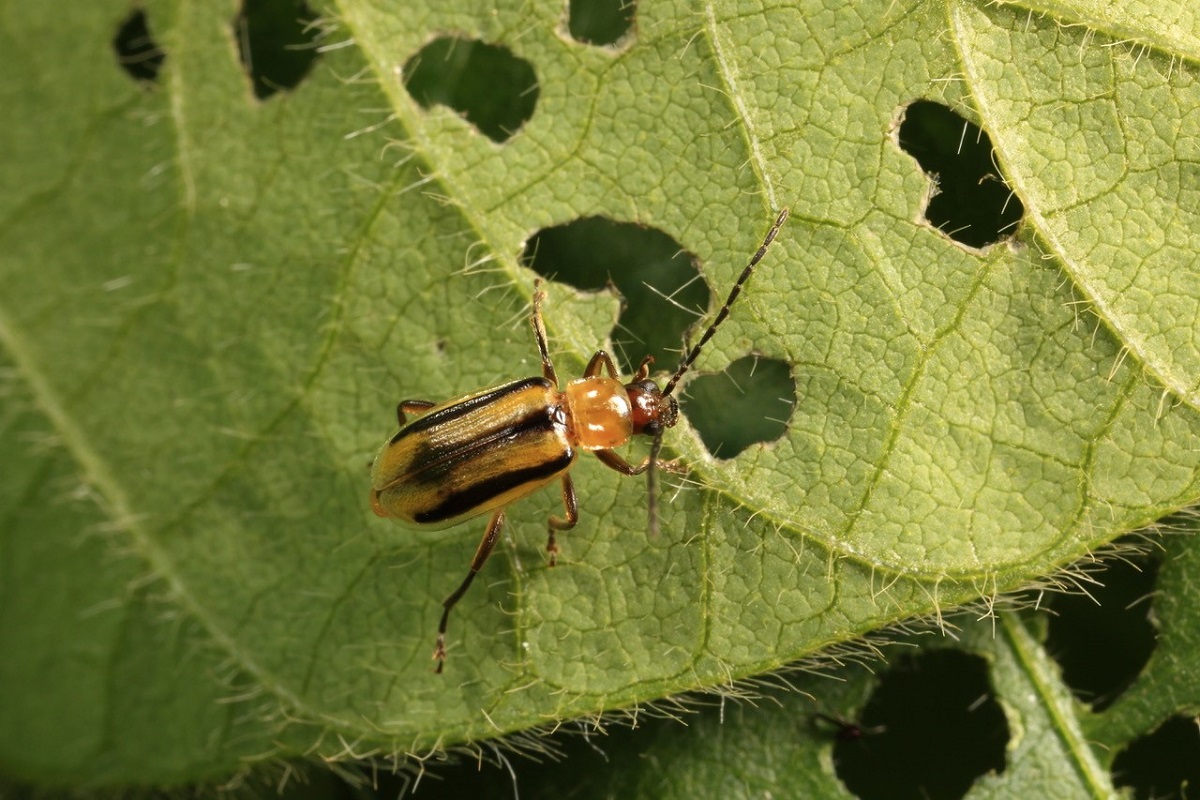
Farmers should pay close attention to potential rootworm issues this season, especially in northern Illinois.
After a drop in populations following the release of Bt corn, which contains a protein initially toxic to the pest, a growing number of corn rootworms developed resistance to the trait.
And populations of both western and northern corn rootworms have been growing in some portions of the state as a result.
“Populations of both species have resistance to all available Bt traits in some areas,” Nick Seiter, research assistant professor at the University of Illinois Department of Crop Sciences, said during a recent webinar.
Corn rootworms remain the most economically damaging insect pest of corn in Illinois. And, while much of the crop damage comes from the western species, which adapted to crop rotation by laying eggs in soybeans, northern corn rootworm populations are also a growing menace.
“Those populations where we’re seeing (corn) damage is not just western corn rootworm, but we’re also seeing a pretty healthy dose of northern corn rootworms,” Seiter said. “In most problem fields, we see a mix of those two populations. That’s very different from what we were seeing five, 10 or even 15 years ago.”
A portion of the rootworm population built up resistance to four single Bt toxins over the years, three of which (Cry3Bb1, mCry3A and eCry3.1AB) share the same mode of action. The other Bt toxin is Cry34/35Ab1.
“One of the things that happened is we really have two modes of action,” Seiter said. “Our ability to rotate modes of action has really gone away.”
Joe Spencer, principal research scientist at the Illinois Natural History Survey, said the development of Bt resistance in rootworms was inevitable. The first evidence of field-evolved resistance was documented in 2009.
“Corn rootworm beetles are well known as a species that has become resistant to about everything we’ve thrown at them,” Spencer said. “Bt resistance is increasing – it’s inevitable. But, we can slow it down.”
New trait packages (SmartStax PRO from Bayer and Vorceed Enlist from Corteva), which contain three modes of action, have been unveiled while Bayer’s VT4PRO with RNAi technology is expected by 2024.
“We will have new tools available to us (to help control rootworms),” Seiter said. “It’s important to remember stewardship of these traits is critical.”
Crop rotation remains one of the best tactics to combat high rootworm pressure, Spencer noted. He also advises farmers to closely monitor their fields and make sure they put the right hybrids on the right fields to limit unnecessary selection pressure.
Some of the highest rootworm pressure in the state was concentrated in areas north of Interstate 80 in recent years.
“We saw a little step back of (rootworm) pressure in 2022, but overall it’s on an upward trend,” Seiter said.
“The situation with corn rootworms (geographically) is really interesting and it depends quite a bit where you are in the state,” he continued. “Here in east central Illinois, we have quite low populations compared to where we’ve been historically.
“But, if you go north of I-80 into country where there’s a lot of corn after corn, it’s a very different story, particularly in areas like DeKalb, Kane, Stephenson, Ogle and Lee counties,” he added. “We’ve seen an increase in corn rootworm problems there the last few years.”
Source - https://www.farmweeknow.com