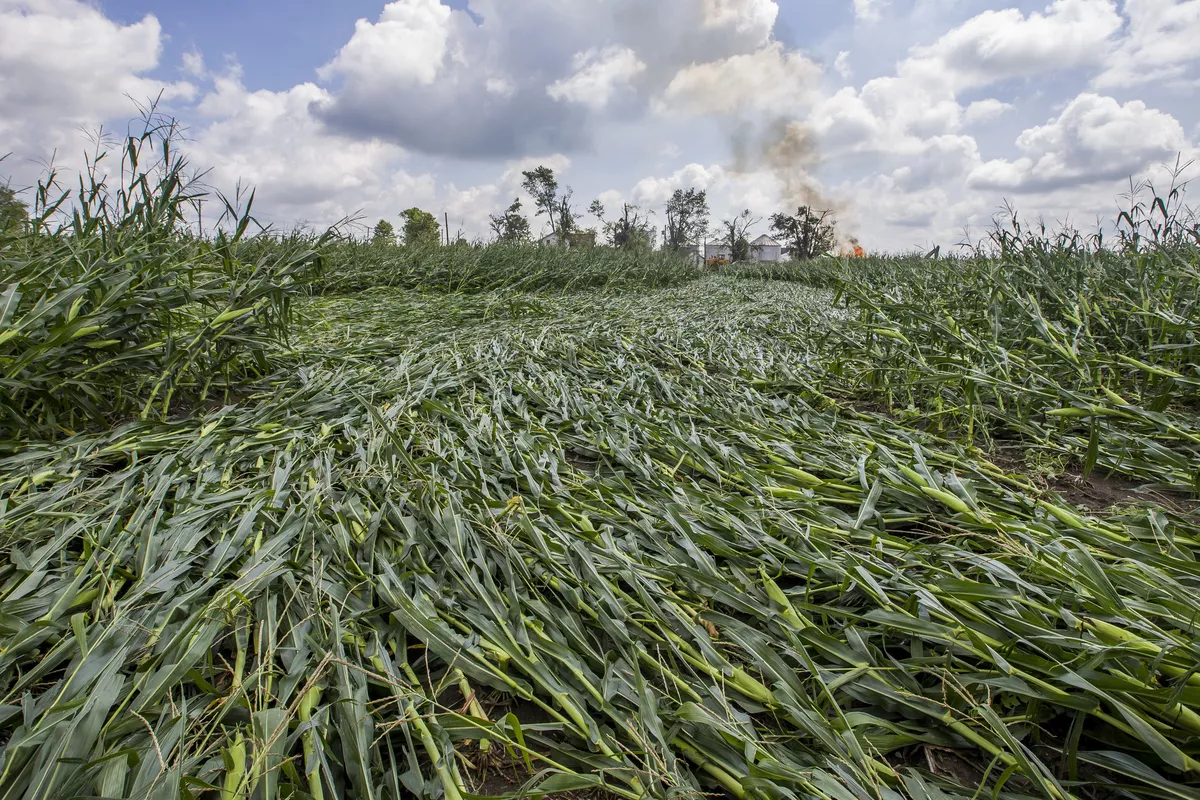
Darren Yanke awakes to the sun. It’s beating down once again on his family farm, located in central Sauk County near Leland. The fourth-generation farmer, there at Echo-Y-Farms, shakes his head as he cranes his neck up to the sky looking for clouds or, better yet, rain. He and his grass-fed cattle need it. His 1,500 acres needs rain.
But it’s sunny, yet again, near Leland and throughout the state. According to an National Weather Services' drought report, released August 3, "extreme drought" persists across much of Sauk and Columbia, northern Iowa, and Dane counties. "Severe drought," is found across much of the lower half of Wisconsin.
Wisconsin had the fourth-driest May on record (since 1895), said Steve Vavrus, Wisconsin State climatologist and co-director of the Wisconsin Initiative on Climate Change Impacts. June followed suit with the fifth-driest June on record. There was only 1.9 inches of rain averaged statewide.
It was the driest June on record in Sauk and Richland Counties and the second-driest June on record in Dane and Columbia Counties.
“The crop conditions are very poor currently,” Yanke said of his farm, where his Aberdeen Angus cattle graze. “If we get adequate rain for the rest of the growing season, the damage has already been done, and the crops will not fully recoup from the extreme drought.”
With the drought conditions, Yanke has had to change the way he operates. “We changed the way we grazed the cattle to allow for a longer rest period for the pastures since there was no regrowth after the cattle grazed.” The pastures have been turning brown.
But he feels better than some about his pastures in that they have better water-holding capacity than a standard grazing pasture system.
“Our local farmer-led watershed group called Sauk Soil and Water Improvement Group has been helping farmers hold their soil water-holding capacities by implementing rotational managed grazing on farms across Sauk County,” Yanke said.
“There is little that can be done by the general public except be supportive of our area farmers who are very concerned at this point,” said Sam Bibby, UW-Madison Division of Extension regional crops educator for Sauk, Vernon, and Juneau Counties. “Farmers are likely to be hit extra hard, as they are facing declining commodity prices at the same time as lower crop yields.”
Though there is little one can do about the rain, Bibby notes steps can be taken to help minimize the drought’s impact.
In corn fields with very low pollination, for example, farmers have the option to harvest early as little dry matter will be added to the plant in this case. Bibby said, “This opens the opportunity to grow a late season annual forage, such as sorghum or millet, assuming we get more precipitation.”
That’s a big if, and the government has recently taken notice of Wisconsin’s conditions.
U.S. Agriculture Secretary Tom Vilsack recently designated 27 Wisconsin counties, including Columbia, Dane, Dodge, Iowa, Juneau, and Sauk, natural disaster areas due to drought.
The designation allows the USDA Farm Service Agency to extend emergency credit to producers recovering from natural disasters.
The emergency loans can be used to meet various recovery needs, including replacing essential items such as equipment or livestock, reorganizing a farming operation or refinancing certain debts.
“For production losses, a producer must have suffered at least a 30% loss of a crop,” said John Palmer, supervisory agricultural program specialist for the Wisconsin State FSA office. “Once determined eligible they can qualify for a loan up to 100% of the total actual production loss on all crops.” The maximum loan amount is $500,000.
It’s hard, Palmer said, to pinpoint how dire Wisconsin’s drought conditions are. “We do know that hay and pasture yields are down. We won’t know actual production losses or forage and non-forage crops until closer to the completion of harvest.”
Yanke, at Echo-Y Farms, already knows the drought has harmed his farm. He said, “Every year is a gamble. Some years, you win. Some years, you don’t.” He hopes the public, during this difficult year, buys local and supports local watershed groups.
Regardless of the type of year it is, he said he’s not quitting. “Farming is in my blood," he said. "I’m going to make it work, one way or another.”
Source - https://wiscnews.com