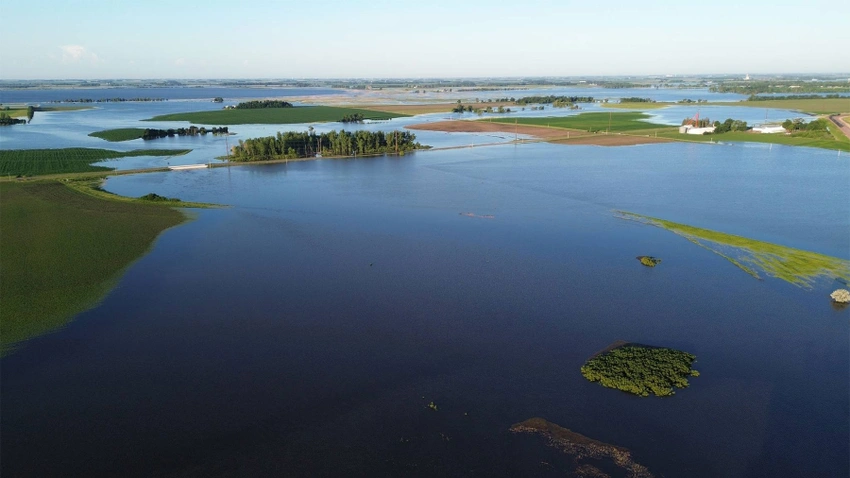
Heavy June rains flooded Minnesota lakes, rivers and streams, causing them to spill over into communities and farm fields, adding to an already stressful 2024 growing season.
“South of the Twin Cities, there are areas getting anywhere from 6 to 15 inches of rain in a short amount of time last week [June 16-22], and that really impacted [the land] because the soils were already saturated before these rains,” says Thom Petersen, Minnesota Department of Agriculture commissioner.
Petersen toured south-central Minnesota on June 25 with Gov. Tim Walz and Sen. Amy Klobuchar, and southwest Minnesota on June 26 to get a better assessment of the situation from the skies and on the ground.
When meeting with farmers whose fields are flooded or flooding, Petersen reminds them to assess damages incurred and head to the county Farm Service Agency office. “You’ll want to report damage,” he says, “whether that’s lost cattle, whether that’s drowned-out acreages. You want to be working with your crop insurance adjuster right away just to get it on the books.”
The threshold to unlock a USDA secretarial disaster declaration is a 30% crop loss in a county, and he says that may not be possible in some counties. While some farmers may be impacted by river and lake overflow, producers in another part of a particular county may not be impacted as heavily — if at all.
With that in mind, a second track is to unlock a presidential disaster declaration to provide emergency loans, both at the federal and state levels. “Not that farmers need another loan, but the interest rates are good, and it does help with cash flow and repayments are favorable to farmers,” Petersen says, adding that this would also makes farmers eligible for future ad hoc disaster programs that Congress may pass.
Petersen reminds those affected that all losses from recent events should be reported to the FSA office, whether it’s crop, livestock or a farm’s infrastructure.
The MDA has a growing list of flood resources on its website for farmers and agribusinesses to refer to work through this situation.
What to do?
After farmers report their damage losses to their county FSA office, they also face decisions on what to do about the crop-loss acres.
Liz Stahl, University of Minnesota Extension crops educator based in the Worthington Regional Extension Office, says there are fields “here and there that were not able to be planted in the first place, so now we have prevent-plant. We also have fields that were planted and now are either partly or completely underwater.”
Looking at the calendar and the reality of when fields might dry out, putting in soybeans may not be an option. “Then there’s the option of looking at cover crops,” she says, “which can help suppress weed populations and provide ground cover to prevent erosion.”
Another option is to do nothing, but then “weed control is an issue,” Stahl says. “That’s just a great spot for waterhemp, for example, and other late-emerging weeds. If you’re not controlling the weeds, you’re going to build up a tremendous resupply to the weed seed bank, and you’ll deal with those issues for years to come.”
Repeated tillage may be an option for weed control, if there is access to the drowned-out spots. “Hopefully you do have crop around these spots,” she says, “so you have to be thinking ‘Can I get to this area without driving over standing crop?’” This option does not help soil health either.
Getting back to the option of planting cover crops once an area dries out, Stahl says that may benefit livestock producers seeking additional forage. “That’s one thing that has changed since the last time we dealt with prevent-plant. Now if you plant a cover crop, you can harvest it for forage.” She advises checking with your crop insurance agent to verify the details.
Cover crop option trials have been conducted at the Southwest Research and Outreach Center at Lamberton, Minn., and Stahl says sorghum sudangrass shows the most promise in producing a large amount of biomass: “If you’re planting in the middle of July and you’re looking for a forage, that has just knocked it out of the park.” Millets, like Japanese millet and pearl millet, also produced substantial biomass.
At this stage she suggests not getting too carried away with a cover crop mix, suggesting cereal rye, oats and tillage radish as economical options if you don’t need to forage.
Seed choice may depend on availability and cost, and Stahl strongly recommends sticking with reputable seed retailers. For instance, Palmer amaranth is a prohibited-eradicate noxious weed in Minnesota. Seed from states where Palmer is prevalent risks being contaminated with this noxious weed.
She also urges caution to know the herbicide history of the crop ground in question. Previously applied herbicides may affect cover crop establishment, and rotational restrictions must be followed if the cover crop will be used for forage.
“If you weren’t able to put down a residual herbicide, most cover crops should establish,” Stahl says. “You just need to be aware of what you are working with.”
Source - https://www.farmprogress.com