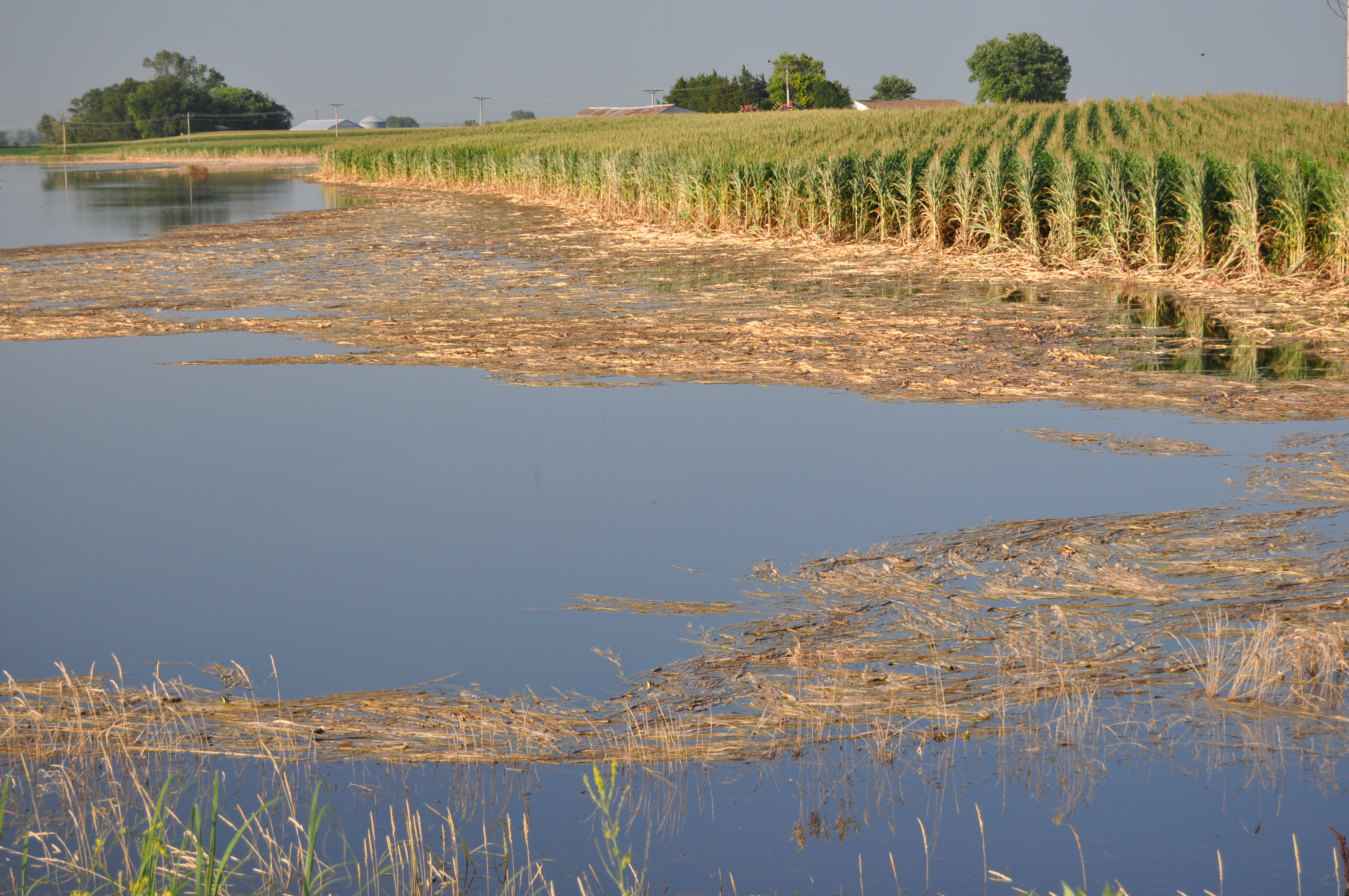
Excessive rainfall events (aka “goose-drownders”, “toad-stranglers”) that occur late in the growing season can cause flooding of rivers, creeks, and streams as well as ponded areas within fields distant from floodwaters.
The consequences to grain yield and quality from the damage caused by such flooding/ponding are difficult to pinpoint with much accuracy because little research exists that addresses these chance-occurring yield-limiting factors. Risks and expectations, however, can be outlined.
Crops inundated by standing water at this time of the year typically do not survive as long as those similarly affected earlier in the season due to the warmer air and soil temperatures. Oxygen deprivation in saturated soils quickly causes significant deterioration and death of above- and below-ground plant tissue. Affected crops may only survive a few days with typical July or August temperatures.
Physical crop damage (soil erosion, washing away of plants, lodging of plants, and plant tissue damage) occurs from the force of the flowing water on land adjacent to flooded creeks and rivers as well as from any debris caught up in the floodwaters.
Deposits of sediment and crop residues that remain on crop plants once the water recedes can either outright smother any surviving plants or greatly reduce their ability to capture sunlight and photosynthesize carbohydrates.
Mud and crud that cakes the leaves and stalks encourage subsequent development of fungal and bacterial diseases in damaged plant tissue. In particular, bacterial ear rot often develops when flood waters rise up to or above the developing ears of corn plants.
Crops that technically survive less severe bouts of ponding and saturated soils nevertheless suffer significant damage to their root systems. The immediate effects will be stunting of plant development.
In the longer term, root systems compromised by ponding and saturated soils today will be less able to sustain the crops during the remainder of the grain filling period. The effects of such compromised root systems will be more dramatic if hot and dry conditions prevail over coming weeks.
For corn, damage to its root system today will predispose the crop to the development of root and stalk rots later by virtue of the photosynthetic stress imposed by the limited root system during the important grain filling period following pollination. Corn often responds to severe shortages of photosynthate by remobilizing stored carbohydrates from the lower stalk tissues to the developing grain.
Not only does such remobilization weaken the lower stalk tissue, but it also increases the vulnerability of those “cannibalized” tissues to infection by root- and stalk-rotting fungal organisms. Monitor affected fields later in August and early September for the possible development of stalk rots and modify harvest-timing strategies accordingly.
Loss of soil nitrate nitrogen in saturated soils due to denitrification or leaching processes can be excessive, especially given the current warm soil temperatures. Effects of such nitrogen loss on crops this late in the growing season are difficult to estimate, but, coupled with significant root damage by saturated soils, will contribute to increased stress in corn during the remainder of the grain filling period.
Assessing the effects of hail damage to corn can be challenging. Important factors include the amount of defoliation and stalk bruising caused by the hail stones relative to the growth stage of the crop. While hail damage can result in severe yield losses in corn, most of the time the human eye perceives greater damage than truly exists.
Wind damage to corn occurs either as stalk breakage (aka “green snap”) or root lodging (plants uprooted and laying nearly flat to the ground). The yield effect of “green snap” damage depends on the percentage of field affected and whether the stalk breakage occurs above or below the ear, but is usually serious regardless.
Obviously, stalk breakage below the ear results in zero yield for that plant. Stalk breakage above the ear results in significant yield loss due to the loss of upper canopy photosynthesis capacity for that plant. Root lodged corn will recover or straighten up to varying degrees depending on the growth stage of the crop.
Generally, younger corn has a greater ability to straighten up with minimal “goose-necking” than older corn. Yield effects of root lodging depend on whether soil moisture remains adequate for root regeneration, the severity of root damage due to the uprooting nature of root lodging, and the degree of “goose-necking” that develops and its effect on the harvestability of the crop.
Source - https://agfax.com