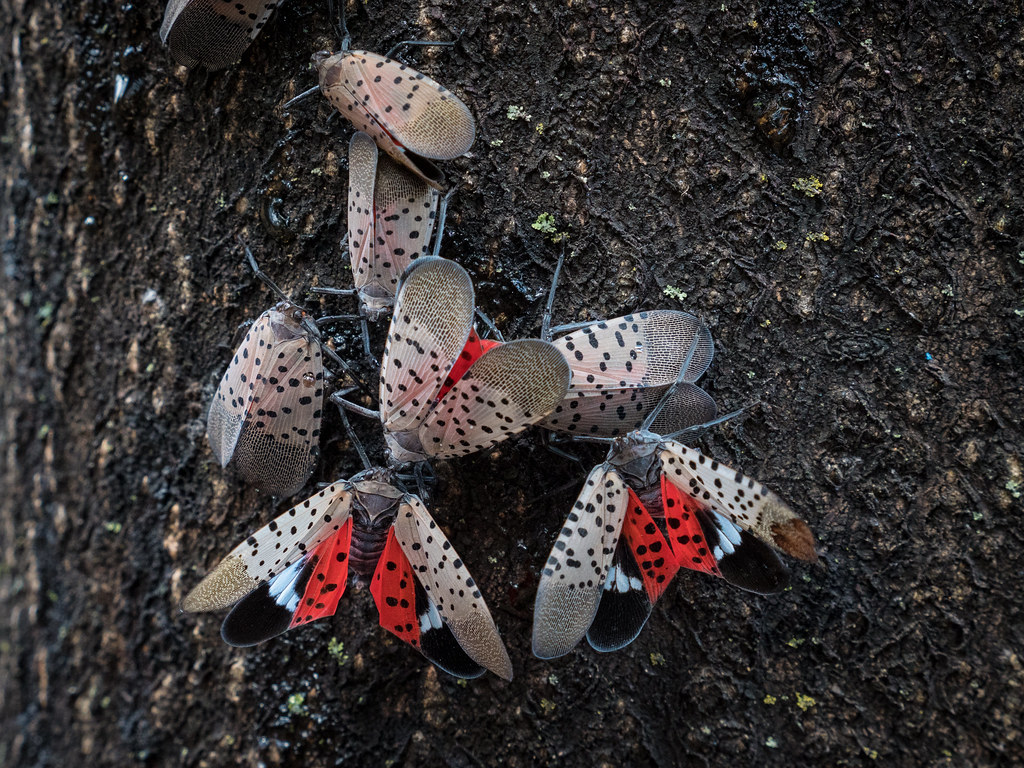
While heavy infestations of spotted lanternfly on grapevines — especially in successive years — can result in their demise, most vines may be able to survive lighter infestations with few ill effects.
That conclusion — reached by a team of Penn State researchers who conducted a new study of the invasive planthopper’s effect on grapevine biology — may reassure vineyard owners nationwide who fear that the onslaught of hordes of the ravenous sap-sucking insects will devastate their businesses. But the jury is still out, pending more research, according to Andrew Harner, postdoctoral scholar in the Department of Plant Science, who spearheaded the study.
Since spotted lanternflies, native to East Asia, showed up in the United States in 2014, large infestations and subsequent economic damage have been reported in cultivated grapevines. Starting in 2017, some Pennsylvania grape growers have reported severe damage to their vineyards from phloem-feeding— or sap sucking — by heavy infestations of adult spotted lanternflies (more than 100 insects per vine) across multiple seasons. Damage varied from reduced yields, up to 90% in some instances, to vine decline and death.
Grape growers often spray insecticide to kill spotted lanternflies because they are afraid the insects can damage their vines and decrease fruit quality, but researchers have seen that they can reinfest the vineyards very soon after chemical control — in some cases within a couple days.
“Little is known about what the spotted lanternflies are doing to the vines or fruit when they feed,” Harner said. “Also, we do not know if optimal management of spotted lanternfly populations involves applying insecticides only once a certain population threshold has been reached in the vineyard, similar to how other insect pests are managed.”
The research aimed to provide a first look at how spotted lanternfly feeding can affect grapevine biology and the fruit, and hopefully it can be used to help the development of a targeted action threshold, noted team leader Michela Centinari, associate professor of viticulture. Her research group in the College of Agricultural Sciences has been working with vineyard owners in Pennsylvania over the last five years to gauge the threat posed by spotted lanternflies.
This study could help lower management costs for growers and reduce the ecological effects of increased insecticide usage that occurs when vineyards are repeatedly reinfested, she believes.
“Our study presents novel insights into spotted lanternfly-grapevine interactions and identifies avenues of future spotted lanternfly-plant research,” Centinari said. “For the first time, we investigated grapevine-spotted lanternfly interactions, detailing how different infestation densities affect leaf gas exchange and end-of-season concentrations of carbohydrates and nitrogen in the tissues of two grape species.”
The study consisted of two experiments conducted on two species of grapevines. The first, conducted on field-grown Riesling grapevines at a commercial vineyard in southeastern Pennsylvania, while the second experiment was carried out on a hybrid grapevine species, Marquette, grown outdoors in plastic containers at Penn State Berks. The second experiment was conducted to confirm and compare findings to another grape cultivar, because grape growers statewide grow a number of different cultivars.
Insecticides were not applied throughout the duration of the experiments. Adult spotted lanternflies — collected by the researchers in areas of Pennsylvania experiencing heavy infestations — were used for both experiments. The adult stage of the insect is typically the most present in vineyards and the stage of most concern to producers, because they infest vines during fruit ripening and harvest.
Vines in the study were repeatedly infested by the researchers for almost a month to mimic how insecticides only temporarily reduce spotted lanternfly populations, and to assess whether repeated infestation and feeding had cumulative effects.
In findings recently published in Plant Direct, the researchers reported that phloem feeding by low-to-medium populations of spotted lanternflies — up to 60 insects per vine — had minimal effects. But greater populations of lanternflies — 70 to 200 per vine — increasingly affected carbohydrate and nitrogen dynamics in both grapevine species, two elements important for crop production and plant health.
Phloem feeding can deplete plant tissues of important resources, mainly starch in woody roots, a form of carbon necessary for long-term plant growth and functioning, and soluble sugars in fruit, which are critical for grape and wine quality, according to the researchers. High numbers of spotted lanternflies strongly reduced leaf photosynthesis, which likely played a role in these effects.
“We conclude that intensive, continuous late-season feeding by large adult spotted lanternfly population densities — 70 to 200 lanternflies per vine — can induce carbon limitation,” Centinari said. “That has the potential for long-term negative effects in cases of severe carbon depletion in roots.”
Follow-up research is needed, she added, to study disruptions caused by spotted lanternfly feeding to yield, fruit ripening and quality, as well as effects on aspects of grape and wine chemistry important for wine flavor, in multiple grape cultivars.
Ongoing research to explore these aspects of spotted lanternfly-grapevine interactions — including how multiple years of feeding by different life stages of spotted lanternflies affects grapevines — are underway at the Penn State Fruit Research and Extension Center in Biglerville, in collaboration with Flor Acevedo, assistant professor of entomology and arthropod ecology at Penn State.
Heather Leach, former spotted lanternfly extension associate in the Department of Entomology, and Lauren Briggs, research technician, contributed to this research.
This research was supported by the Pennsylvania Department of Agriculture, the Pennsylvania Wine Marketing and Research Board, and the U.S. Department of Agriculture’s National Institute of Food and Agriculture through its Specialty Crop Research Initiative.
Source - https://www.psu.edu