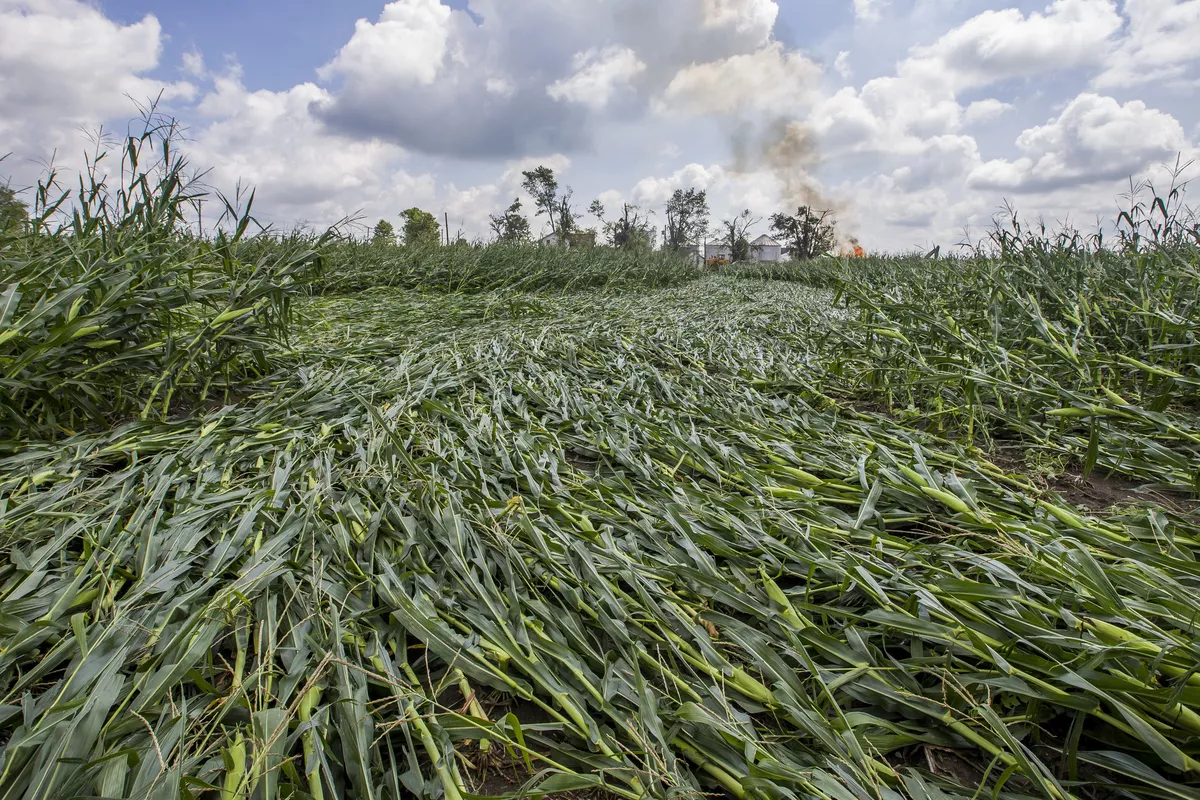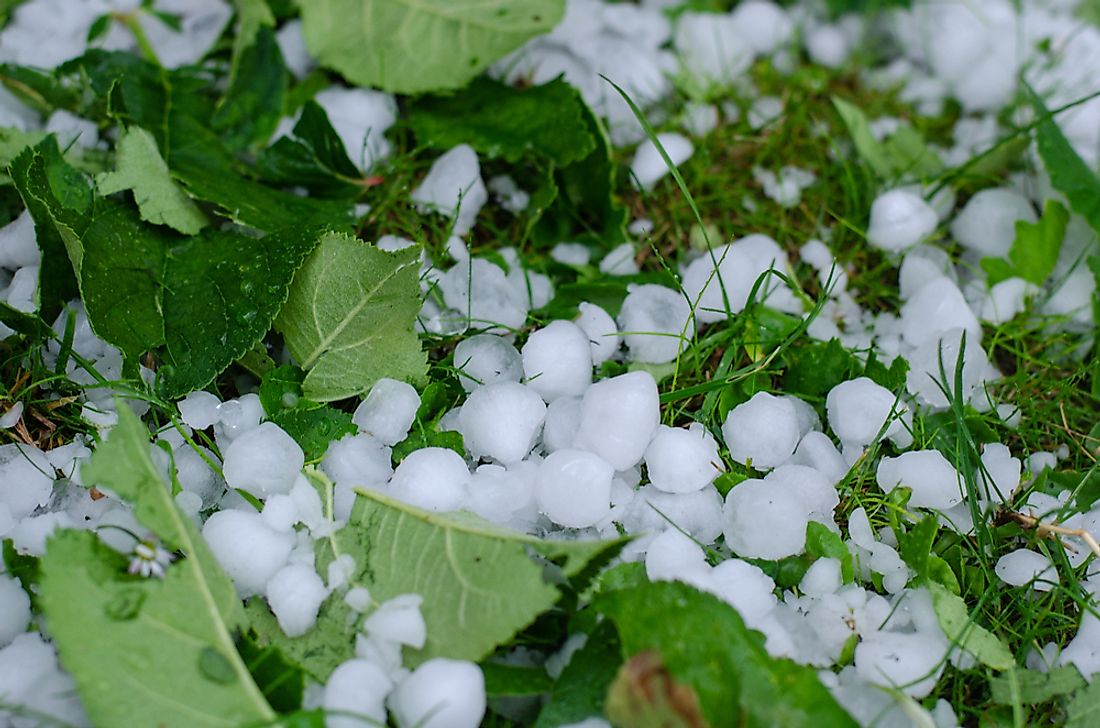
While the damage was not widespread, there has been some severe hail damage in different parts of Ohio in July.
Soybean plants were at approximately the R2 (full flower) growth stage. Corn was at late vegetative stages to early reproductive stages (R1). If you experience hail damage, be sure to talk to your crop insurance provider. Two conditions must be considered in hail damage: hail characteristics (e.g., hail size, number, speed) and the characteristics of the target (e.g., crop, stage, variety/hybrid), as some of the outcomes may be driven by these factors.
Soybean
Hail damage to soybean plants may include defoliation, node loss, stand loss, and/or bruising. At the vegetative growth stages, yield loss due to defoliation is minimal; however, stem damage and node loss can reduce soybean yield. Soybean plants are most susceptible to hail damage and yield loss during the reproductive stages. The degree of yield loss can vary among soybean varieties (e.g., differences in leaf morphology and relative maturity) and subsequent weather after the damage was incurred. To assess soybean yield loss, the stand reduction, defoliation percentage, and nodes cut off/broken over percentage needs to be estimated from the field. After assessing the Preble County location, we estimate defoliation to be around 90% (Figure 1). (We also noted some hail damage in Clinton County, but to a much lesser extent with approximately 15% defoliation.) While the defoliation is not ideal, yield losses are less than one might expect as the soybean plants will continue to grow and put on new leaves. Data from the University of Wisconsin- Madison shows 33% yield loss with 100% defoliation when defoliation was at the R3 growth stage or earlier. At the Preble County location, in addition to defoliation, some of the stems were broken (node loss). Research at University of Wisconsin- Madison estimates a 15%, 24%, 37%, and 59% yield loss with 20%, 40%, 60%, and 80% main-stem node removal, respectively. The University of Nebraska- Lincoln organized a soybean yield loss worksheet and charts to help calculate the soybean grain yield loss caused by hail damage.
Corn
Hail damage in corn can lead to reduction of plant stands (early in the season, vegetative stages), leaf defoliation and stalk damage (mid-season, vegetative and reproductive stages), and damage to ears and stalks and grain quality (late in the season, reproductive stages). The stage of corn at the time of hail affects the level of damage to the crop. For example, hail damage to young plants (before the V5 stage) can be low since the growing point is at or below the soil surface and plant recovery is expected. However, during mid-season (about V10 stage to tasseling or silking) when corn nutrient, water, and dry weight accumulation increase, hail damage to corn can be more detrimental, depending on the percent of destroyed leaves. Usually, the larger the percentage of defoliation, the more significant the yield loss. Research on stand losses in Ohio reported that 17–50% stand loss at the 7-leaf stage resulted in 6–16% yield loss. Yield losses at the 10-leaf and 13-leaf growth stages were similar to the 7-leaf stage when stands were reduced by 17% and 33%. When plant stands were reduced 50%, yield losses were closer to 20%. At the 17-leaf growth stage, 50% stand reduction resulted in an overall grain yield reduction of 30%. This helps illustrate what yield loss may occur from reduced stands. On the other hand, other Ohio studies on leaf defoliation reported that defoliation at the 10-leaf stage or earlier may not dramatically affect grain yield. Loss of 50% to 100% of leaf area at the 10-leaf stage resulted in less than a 5% yield loss, but tassel deformation could occur (hybrid specific) after 100% defoliation. Loss of 50% of leaf area at the 15-leaf growth stage resulted in 12% yield loss, and 100% defoliation caused 35% yield loss. Defoliation during grain fill reduced grain yield by 23, 14, and 7% at blister (R2), milk (R3), and soft dough (R4) stages, respectively. Additional effects of hail damage in corn production can include more weed pressure (due to lower corn competition), tassel deformation, twisted leaf whorls, stalk rot and lodging, grain quality concerns, lower test weights, and grain moisture at harvest. If you were affected, keep an eye out for these issues.
For both corn and soybean, if hail damage occurs, it is recommended that field inspections (e.g., assessments, adjustments) are delayed a minimum of 7 days for a more accurate assessment of the actual damage to stands, canopy, and crop recovery.
Source - https://ocj.com