

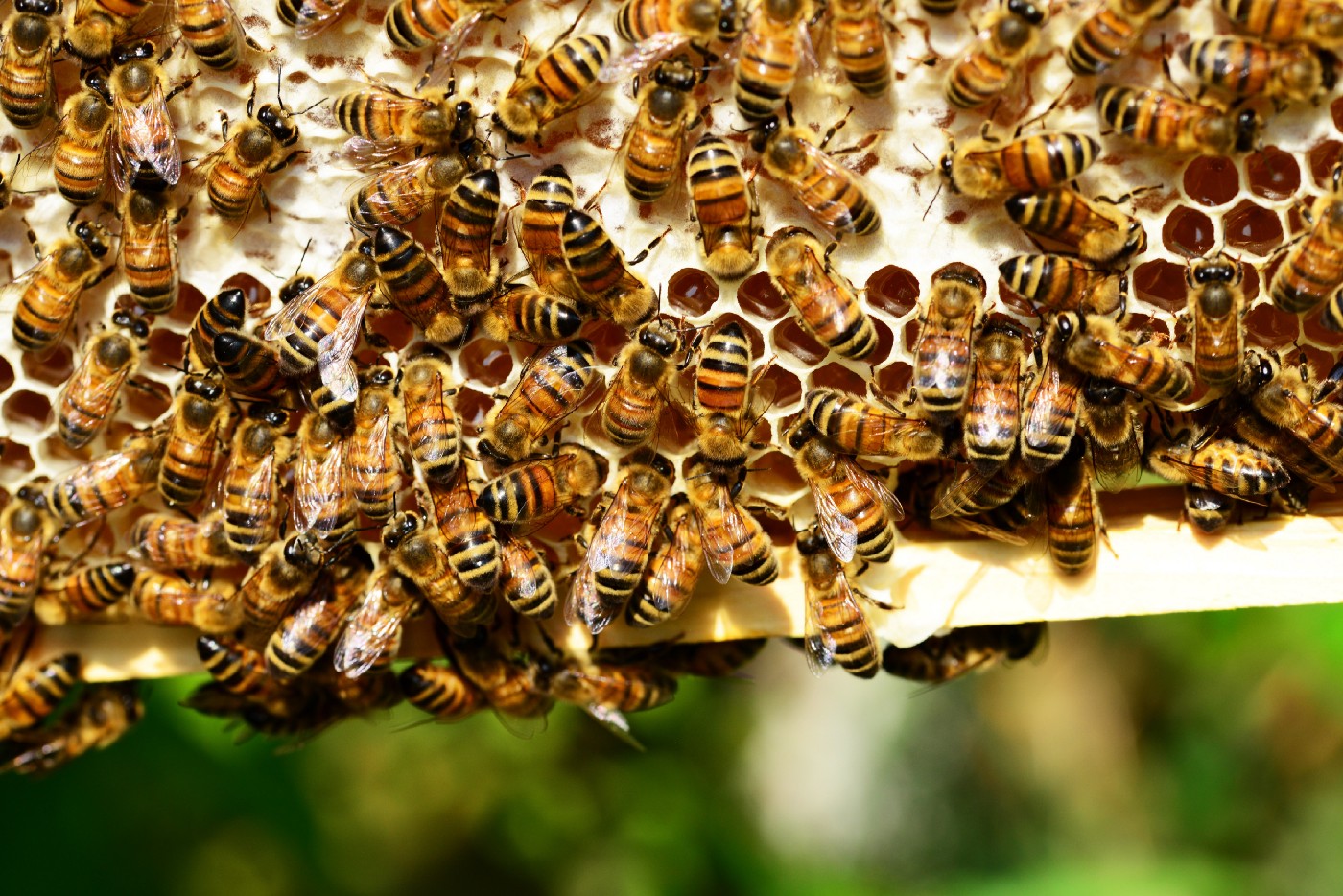
Recent survey results show commercial honeybees are on track to have another year of colony losses. A decline in these essential pollinators could hinder food production.
Apart from his full-time job, Dane Strickland cares for nearly 100 honeybee colonies daily. He first started beekeeping 15 years ago after researching the health benefits honey could provide to his children.
“I thought to myself, ‘I want to be a beekeeper — that doesn’t look too complicated,’” Strickland said. “That right there is a joke in itself, because there's way more to keeping bees than just having a box in the backyard.”
Strickland now understands how challenging beekeeping can be, especially as honeybee colonies decline nationwide.
He’s president of Northeast Oklahoma’s Beekeeper Association and one of the few beekeepers in the the state to participate in the Bee Informed Partnership’s Loss and Management Survey annually.
This year, the nonprofit organization’s preliminary results show commercial beekeepers in the U.S. lost about 39% of their honeybee colonies from April 2021 to April of this year. That’s an improvement from last year’s record-breaking loss of more than 50% of all hives. But despite colony losses being down slightly, the partnership’s science coordinator and researcher Dr. Nathalie Steinhauer said it’s still a very high rate.
“We don’t want to minimize the stress that puts on beekeepers and bees, but this is also pretty much on par with what we’ve observed in the last 10 years,” Steinhauer said. “That doesn’t mean it’s okay or good, it just means it wasn’t an unexpected high this year.”
The phrase “bee colony loss” doesn’t mean nearly 40% of honeybees vanish every year. Instead, Steinhauer said loss rates are used as the mortality rate measure for bees. Meanwhile, the natality rate, or birth rate, is equivalent to beekeepers replacing their losses by splitting their colonies to make new ones.
“In order to see if a population is growing or declining, [researchers] look at the mortality rate and the natality rates,” Steinhauer said. “For bees, the mortality rate is what [the partnership] calls the loss rate because we count colonies, not the individual bees.”
Loss of pollinators
Commercial honeybee colonies pollinate at least $15 billion worth of food crops each year, according to the U.S. Department of Agriculture.
Steinhauer said because honeybees, a nonnative pollinator, have been managed for so long, some consider them livestock. Honeybees are often shipped across the country to pollinate essential agricultural crops such as almonds, apples and blueberries. Minimizing beekeepers' losses and ensuring the health of honeybee colonies is critical to food production.
“A lot of monocultures don’t support native pollinators where they’re at,” Steinhauer said. “So unless we revert back to lower-size farming and increase the diversity of native plants, we’re going to need to rely on the professional pollinators that are honeybees.”
Major factors that cause beekeepers to lose their hives include pesticides, parasites and “poor forage,” said Randall Cass, bee specialist at Iowa State University’s Extension Office. Poor forage means not enough diverse flowers bloom throughout the year, which makes it difficult for bees to find food and habitat. That’s especially true in prairie land that’s been plowed up for agricultural use, like in Iowa, Nebraska and Oklahoma.
“Here in Iowa, that's a major issue,” Cass said.“We've definitely got poor forage availability because so much of our land is put into agricultural production — around 85% of the state’s land is in agriculture.”
Encountering pesticides while collecting pollen and nectar from crops also significantly hurts bees. If the pesticide doesn’t kill the exposed bee, Cass said the bee could bring the pesticide back to the hive and hurt the bees’ health by reducing their ability to navigate and causing them to forage less.
Parasites are one of the biggest challenges beekeepers struggle with. The varroa mitein particular is a leading cause of bee mortality, especially for beginning beekeepers, Steinhauer said. These tiny red-brown parasites weaken honeybees by feeding and living off of them. They also affect colony health by spreading viruses across bees.
“Combine these three things together and it creates a perfect storm of a terrible environment for honeybee health,” Cass said.
Potential solutions to ‘save the bees’
Research conducted at Iowa State University shows a small strip of prairie land could help bee colonies from starving on farm fields. Researchers tracked how well bees would thrive in prairie land versus agricultural land, such as soybean fields.
To their surprise, bees gained more weight living near soybean fields but maintained weight better living near prairie sites. Cass said one of the researchers referred to it as the “feast-and-famine effect” of the Iowa landscape.
“The soybean provides a flower in July, that's a feast for the bees, and it's followed by a famine [in August] where there aren't any floral resources for them,” he said.
Cass is currently researching how beekeepers could take advantage of the resources each landscape provides and keep more bees alive through the winter. Introducing prairie strips onto farmland might be one solution, he said.
“What's great about prairie strips is that I see it as a really good compromise,” Cass said. “Prairie strips not only offer benefits to our bees, they also offer great benefits to farmers that include drastically reducing the runoff of fertilizers and reducing erosion quite a bit.”
Non-beekeepers can help save the bees by planting flowers native to their area that especially benefit native bees. Supporting native bee species to Midwestern states, such as the endangered Rusty Patched Bumblebee, plays just as an important pollinator role in crop production.
For beekeepers, Steinhauer said being active is the best thing one can do to improve the odds of their colonies surviving. Her advice especially applies to beginner beekeepers, she said.
Backyard beekeepers, or beekeepers managing less than 50 colonies, are on track to have a record-high colony loss rate of 58.8%, according to the partnership’s survey.
“Try being proactive, rather than reactive,” Steinhauer said. “Monitoring colonies for pests and diseases is something that needs to happen all season long, not just in the fall.”
As for Strickland, he’s found that understanding the history and biology of the bee, and persistence are the keys to being a successful beekeeper.
“Focus on the things you can control,” Strickland said. “You’ve got to be persistent. And if you understand the biology of the bee and its adversaries, then you can take the actions to increase the survival potential of your colonies.”
Source - https://www.kcur.org










