Plant diseases limit the output of agricultural workers and cause hundreds of billions of dollars in global crop production loss each year. When plants get wet they are at risk of contracting diseases as pathogens germinate and grow on the surfaces of their leaves. By measuring how long a particular type of plant’s leaves stay wet, farmers, gardeners, and researchers can improve disease forecasting, making better decisions about management strategy.
Commercial leaf wetness sensors exist, but are not able to provide an estimate that is specific to any particular type of plant, and so are often inaccurate. But through a collaborative effort, UC Santa Cruz Professor of Electrical and Computer Engineering Marco Rolandi, Professor of Environmental Studies Gregory Gilbert, and former electrical engineering graduate student Brian Nguyen have found a solution to this problem: a simple biomimetic sensor that replicates the surface traits and water resistance of actual leaves of any plant to provide a highly accurate measurement of leaf wetness.
These novel custom sensors are fairly inexpensive to produce and can be used to study any crop, horticultural plant, or wild species. This research was described in a new paper in Advanced Sensor Research, a leading journal for sensor engineering.
The longer a leaf stays wet, the more likely it is to develop disease, as plant pathogens germinate and initiate infection after several continuous hours of moisture. But with more accurate disease forecasting, better management strategies can be applied to reduce crop loss, improve irrigation techniques, and limit the release of unnecessary pesticides into the environment.
“The better the disease forecasting models are, the better it is for the environment, for people working on the farms, for the farmers economically, and for consumers,” said Gilbert, who has been studying plant pathogens for decades.
The new technology uses a biomimetic approach to replicate the specific and widely variable surface properties of any leaf. There are different factors that play into how long a leaf stays wet, including its shape, angle, texture, and its hydrophobicity — how easily the plant repels water. Plants have developed traits to prevent water from accumulating on their leaves in order to stave off disease and allow for the exchange of gas that enables photosynthesis and other important functions of the plant.
The new sensors address all of these factors that play into leaf wetness. They use a silicone polymer to create a mold that replicates the surface properties of the leaf of interest, such as shape, size, and texture. Additionally, they adjust the ratio of ingredients in the silicone used for each replica plant surface, so that hydrophobicity of the replica leaf matches that of the leaf of interest. 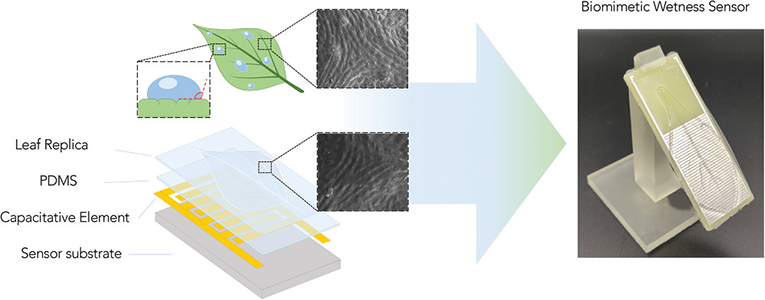
“The idea is that we try to mimic nature,” Rolandi said. “We are trying to make our sensor as similar as possible to the real plant.”
The replica leaf surface is then placed on top of a humidity sensor – a chip designed for this task – so that now the sensor measures the amount of water on the replica leaf rather than just the flat surface of the typical sensor.
The researchers tested their replication technology with three different types of leaves with varying surface properties from plants found on the UCSC campus: a California bay (which is often an important host of the pathogen that causes the devastating Sudden Oak Disease), a sycamore, and an escallonia. These tests showed that the new biomimetic sensors were able to provide a much more accurate measurement of how long the leaves stayed wet, proving their technology to be useful.
The researchers envision that their simple sensing solution made from relatively cheap parts could easily be brought to market and used by farmers to manage the crops they grow. Beyond just commercial farms, they imagine that this technology can be useful on smaller and organic farms as a useful and inexpensive addition to their existing rain and temperature monitoring systems.
Next, the researchers hope to deploy their technology in the field, both on the farm at UC Santa Cruz and with local farmers. Gilbert hopes that the sensors can also be used to study disease forecasting in wild ecosystems, especially as the changing climate makes it all the more important to understand shifts in moisture temperature, timing, and amount.
“That's going to change the kinds of diseases that we see developing everywhere,” Gilbert said. “It’s a really important time to be studying this.”
Rolandi received funding to work on this project through a seed grant from the UCSC Office of Research in 2020. The researchers are interested in follow-up funding to explore different leaf types, improve accuracy and simplicity, and make production more effective.
Source - https://news.ucsc.edu