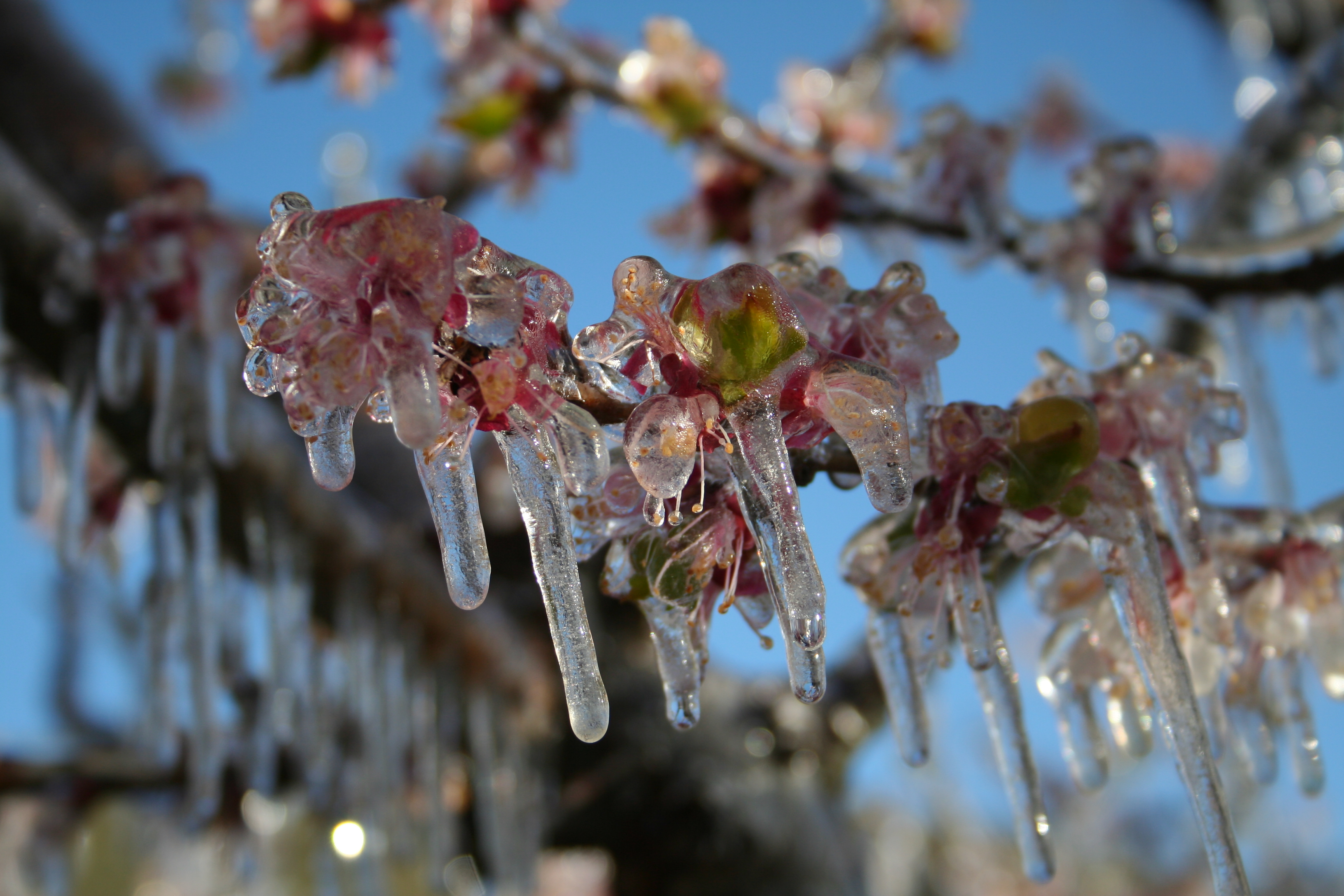
A week of hard night freezes followed by stiff north winds left almond orchards decimated in the Upper Sacramento Valley, leaving growers with nothing to do but look ahead to next year's crop.
Trees once full of blossoms and the promise of a bumper crop in February, stood over a blanket of red in March, the ground covered in dead nutlets and petals.
Almond growers were delighted with the potential crop in late winter as warm weather kept the bees humming in the orchards.
Then came the freeze.
In late February nighttime and early morning temperatures dipped into the low to upper 20s in many areas of the valley.
“For six nights in a row, for five hours or more we saw temperatures at 32 to 21 degrees, and that was just too much,” said DC Felciano, manager of 160 acres in almonds in the valley owned by Jack Brower of Escondido.
Growers desperately fought the freeze. Sprinklers ran and helicopters hovered in an attempt to save the vulnerable infant almonds.
It appears the range for almond loss is 60 to 100 percent in the Upper Sacramento Valley's and a year of work and investment is lost.
“Everything you see below the trees, all of that red, that's this year's crop,” said Felciano. “Every dead blossom contains a nutlet.”
Picking up a blossom from the ground he cut open the tiny nutlet.
“See how it is black in the center? That shows it is dead. Otherwise the center would be a very soft green color, almost white, definitely not black,” he added.
Pointing to a branch on a tree, Felciano noted the branch should be covered with small, developing nuts.
Instead, as was the case with all of the branches and trees around, it held about four.
“This branch alone should have 40 almonds on it, not four,” Felciano said. “For this 70 acres orchard here in Vina, it's a total disaster, pretty much a 90 percent loss.”
Like many growers assessing the crop in late March, Felciano said it is still too early to know whether it will be worth harvesting what little of a crop they may have.
“And we aren't through with the inclement weather yet. There is always the potential for hail damage, extreme winds and yet another frost. Many things are still unknown,” he added.
Most growers will be able to collect frost insurance on their failed crop at $2.35 cents a pound on a five year average.
“Most almond growers I know in this area are just calling this year a loss and will be collecting their insurance. If there is any upside to this it is that frost insurance will likely be paying out more than the open market, which I expected to see paying out only $1 a pound due to high storage levels,” Felciano said. “Some growers may come out ahead if they carried insurance, but not everyone does.”
The orchards Felciano manages are not covered by insurance and he said the owner will just have to take the year as a loss.
The frost impacted different areas of the Northstate differently, however, it was the Upper Sacramento Valley which took the worst of the freeze.
Even within the valley different areas suffered different levels of loss.
“From about Arbuckle north took the worst hit in the state,” Felciano said.
He explained the range of loss also depended on the almond variety.
“Some varieties are more susceptible to freeze hours than others. Monterey's are frost hardy, and we are finding Independence is frost hardy as well. It was the early varieties, like Nonpareils, Sonora, Ne Plus, which have shown to be much more susceptible to frost damage,” Felciano added.
On the upside, if it can even be considered that, the dead blossoms on the orchard floors can stay right were they lie and become organic matter that will feed the trees in return for their loss.
“Even in the face of this loss, people need to realize, growers will have to continue farming as we always do because we are now farming for next years crop. The work we do today is for one year ahead, we just have to look forward,” Felciano explained.
Fertilizers will still need to be applied, irrigation will need to run, soils and leaves tested, all for next year's crop.
“However,” Felciano explained, “on a frost year like this one, when growers lose their crop or a good percentage of it, we cut back on all our inputs. We will fertilize the trees, we will water the trees, but we won't do a lot of extras because the revenue isn't coming in this year and the trees won't be putting out energy in developing this year's crop.”
And now, with fuel costs skyrocketing, keeping a tight rein on the financial bottomline is essential.
Source - https://www.appeal-democrat.com