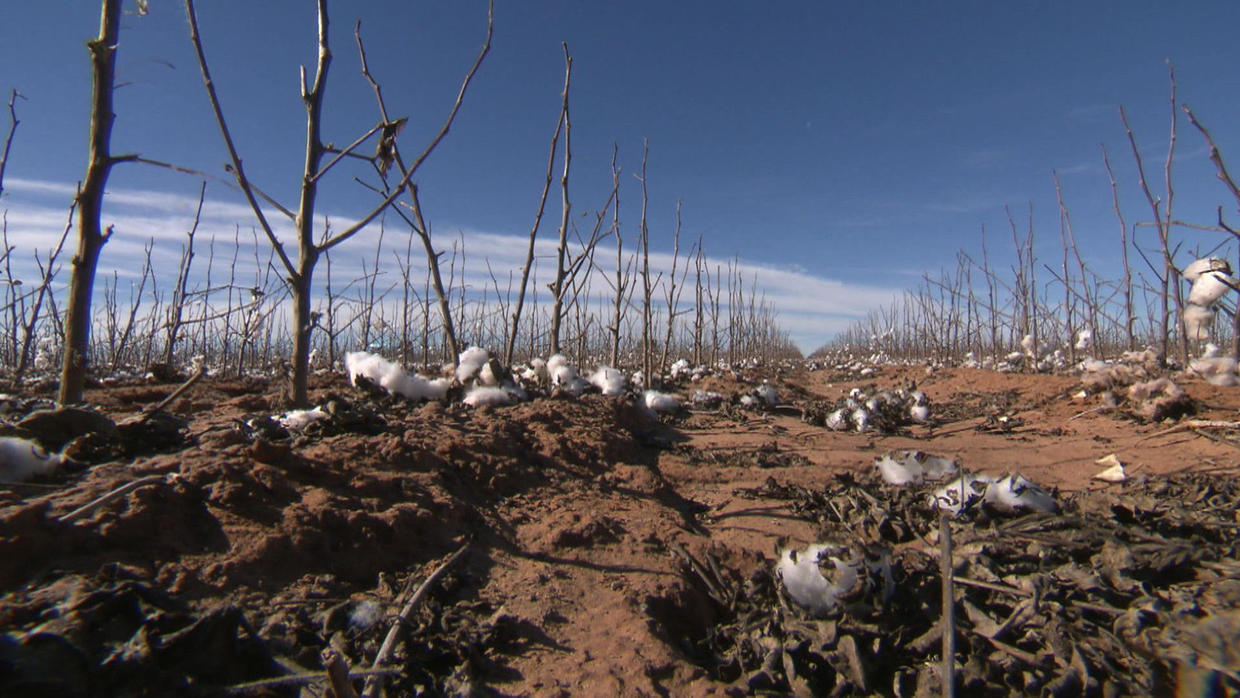
Cotton farmer Steven Walker stands on a patch of dry soil on his 2,500-acre farm, surveying the fields of bare dirt around him and reflecting on what he saw before the “exceptional” drought conditions of 2022.
“Every field around here would have cotton on it,” Walker said. “A year like this, where everything is disaster, is just, I’d say, devastating.”
The majority of Walker’s cotton fields are dryland, which means they are entirely dependent on rainfall to grow. In 2022, every one of his dryland fields failed, yielding no cotton. His irrigated lands produced only 75% of what they would in a typical year.
“It’s so frustrating.” Walker said. “It really runs your emotions through a rollercoaster.”
Walker is not alone in watching vast fields of crops wither and fail. Much of the Texas Panhandle and South Plains was in a state of “exceptional” drought in 2022, the U.S. Drought Monitor’s most severe category. More than 70% of all acres in the region failed. It’s one of the worst cotton production seasons the area has seen since the 1950s, according to Plains Cotton Growers, a nonprofit organization of cotton producers from a 41-county region in the northernmost part of the state.
This loss in cotton production will have widespread effects on the rest of the economy.
“This present drought has spelled disaster for the state’s cotton industry,” Texas Comptroller Glenn Hegar said in a statement last week. “One estimate says cotton producers, which are concentrated in the Panhandle, will lose about $2.1 billion in total economic activity, not including the losses covered by crop insurance. Although crop insurance helps producers recoup revenue losses, it doesn’t help businesses and consumers further down the supply chain.”
The estimates come from a brief co-authored by Darren Hudson, a professor of agriculture and economics at Texas Tech University.
“If you talk about the High Plains region, roughly a third of the total economic activity is agriculturally related,” Hudson said “But one of these smaller towns, probably, 80% of their economic activity is related to agriculture in some way. So when you see a loss like this, it impacts those communities much more severely than it does a major metro area.”
This year’s drought doesn’t spell the end for most cotton farmers. The federal government offers an insurance subsidy that allows farmers like Walker to break even on their expenses.
But breaking even doesn’t mean farmers are in the clear.
“We can only do that so many years before it really catches up to us and we’re behind on keeping up our equipment,” Walker said.
At the end of the day, Walker is worried about the impacts this year’s drought will have on his children and their perception of farming.
“It becomes really hard to show them the importance of hanging on and just gritting it out through another year,” Walker said. “I have to really work to make sure that they see that even in the hard years, we’re thankful for what we have.”
Source - https://www.texastribune.org