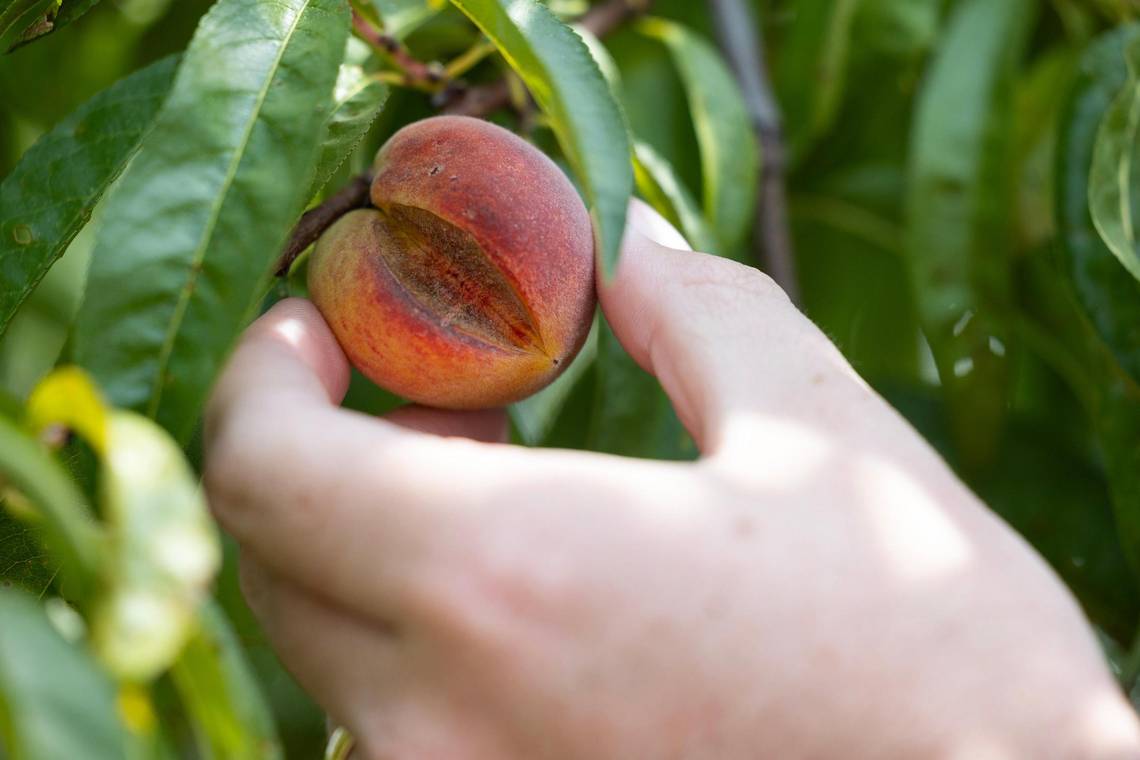
Despite the chatter and hustle of a dozen or so workers, the production line at Flamm Orchards in deep southern Illinois sits mostly quiet this summer. A cold spell in late December knocked out a vast majority of the 300-acre farm’s peach crop.
“To have a loss as bad as we’ve had this year, it’s very rare,” said Austin Flamm, the farm manager of the family orchard. “This is the worst loss we’ve had in about 16 seasons.”
There are so few peaches that Flamm Orchards is processing their fruit by hand and selling very little wholesale to grocery stores.
It’s been a tough year for the fuzzy fruit, not only in southern Illinois, but in the big peach-producing states of Georgia and South Carolina. While cold weather affected the peach crop in Illinois, warm weather was the culprit in the southeast — all of which is leading to a national shortage.
Although California leads the U.S. in peach production and had a solid crop this year, Kay Rentzel, the executive director of the National Peach Council, said losing peaches from the South has an impact.
“With such a significant number and volume of fresh peaches coming out of Georgia and South Carolina in any typical year, it does make a big difference to the marketplace and the availability of fresh peaches,” she said.
Georgia’s production in 2023 is down 90-95% of the state’s usual numbers, and South Carolina’s will be down 60-70%, Rentzel said.
Duke Lane III, president of Georgia’s Peach Council and also a farmer himself, said this year was the worst since 1955 for the state.
“It’s devastating for all the people that are involved in that — from the farms to the employees to the transportation companies and, obviously, our retail partners,” Lane III said. “It’s a pretty big ripple effect when the Georgia peach doesn’t really have much of a crop.”
Even with bad conditions, consumers will still see peaches on their grocery store shelves — just fewer local varieties and at a higher cost.
Prices are up anywhere from 20-50% nationally, estimates Chris Eckert, a former president of the National Peach Council, who raises peaches and apples at Eckert’s Family Farms in southwest Illinois.
Eckert said he won’t know exact figures until the season’s over and he’s done all his math, but it’s clear it hasn’t been a good year for what’s usually a multimillion dollar crop.
“We're going to be pretty excited about a half a crop — if we can get that,” he said.
Every decade or so, peach farmers expect a bad year, Eckert said. Their last was in 2014, but this year’s shortage brought something he’d never seen before.
The frigid December temperature knocked out nearly all of the trees that grow the GaLa variety of peaches, while just a few rows over, the Red Haven variety remained unscathed. On one side of the hills that cut through his orchard, some varieties did well. And on the other side, no peaches survived.
It's a strange outcome that he, his peers and other experts from the industry haven’t been able to diagnose. But then again, farmers expect nature to produce curious outcomes, he said.
“These types of one-off situations are not that unusual,” he said. “In our world, it’s like, ‘Well, that’s never happened before.’”
Why peaches at Eckert's fared better than those at Flamm Orchards, just two hours away, also remains a mystery.
Austin Flamm estimated they lost 90-95% of their peaches this year. While a partial crop seems better than a total loss, Flamm said it’s hard to cover labor, chemicals and other costs for such a small share.
“We'd have been better off without any, but it is what it is,” Flamm said. “You got to play with the hand you're dealt.”
Despite the poor year, there are reasons to be optimistic, the farmers said. The U.S. Department of Agriculture offers crop insurance; other crops seem to be doing well this season; and next year will likely be better.
“Generally, in fruit and vegetable crops you have to be prepared for off years. Those are inevitable. We learn from it,” Lane III said. “We are super optimistic and super excited about next year.”
Source - https://nebraskapublicmedia.org