After hurdling over a blast of arctic air earlier this month, Massachusetts is seeing a sudden change in weather as temperatures rise into the 50s.
The inconsistent weather — “global weirding,” as some scientists call it — is becoming all the more common due to climate change, and has disturbed farms across the state, creating smaller yields of particular fruits and an earlier maple tree sap run.
In the aftermath of the recent deep freeze, farms across the state are seeing damages in peach trees.
New England’s subzero temperatures, with wind chills dropping as low as minus 30, have caused some farms to have a smaller peach yield, while other farms say their peach crops are completely dropped.
“Unfortunately, I think there’s 100 percent damage out there, and we’re not going to see a single piece of stone fruit this season,” said Ryan Marshall, a general manager at Ward’s Berry Farm in Sharon.
Marshall says the last time the farm lost its entire peach crop was in 2016, which was also the last time temperatures dropped to or below minus 10, cold enough to kill peach blossoms even when they are dormant.
“We feared this was coming,” Marshall said. “We haven’t seen anything quite as bad since 2016, this sort of catastrophic damage.”
Eric Rosado, a farm manager at Ward’s Berry Farm, said peach trees and stone fruit — fruits with pits, such as peaches, plums, and cherries — are typically more vulnerable to frigid temperatures, compared to apples, which can withstand lower temperatures.
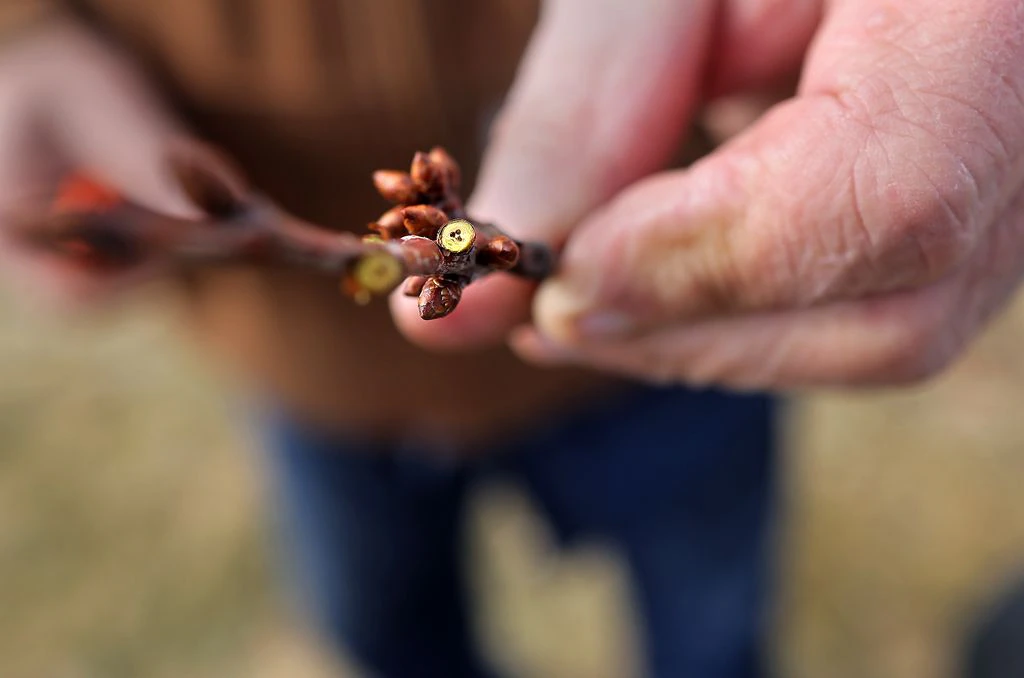
“The actual tips of the branches with the buds are what gets damaged,” Rosado said. “They are typically grown in warmer climates, but when it gets that cold, they can’t handle it.”
Other farms such as Cider Hill Farm in Amesbury and Carlson Orchards in Harvard are also expecting a complete loss in peach crops.
Franklyn Carlson, one of Carlson Orchards’ owners, said there’s little that can be done to protect peach trees from the sudden drops in temperature and wind chills.
“They’re out there, they’re dormant, but we just can’t protect them,” Carlson said.
Marshall said the only way to protect fruit trees from the cold would be to cover them, but even that would prove to be difficult because of how large their orchard is and the strong wind.
“It’s really just not feasible to do any kind of covering of something that’s so far off the ground,” Marshall said.
Laura Neville, the marketing director of Lookout Farm in South Natick, said the farm was lucky enough not to have suffered any major damages to their peach trees as the buds were not developed enough to be severely damaged by the cold.
“We were on the line on the cusp of the extreme for what peach trees can handle in New England,” Neville said.
She said the farm will have to wait until spring to determine its peach yield by waiting to see if flowers bloom on their peach trees.
However, Marshall said farmers can also cut open the buds on peach trees to see how much damage has been done.
“When [the inside of the bud] is brown, you know that bud is not going to open into a flower in the spring,” Marshall said.
Although the loss of peach yield is disappointing, Carlson said crop insurance will help with some of the expenses used to grow new crops or take care of the peach trees.
“We buy crop insurance, but insurance is insurance,” Carlson said. “It’s doesn’t replace the harvest, but it helps.”
Marshall said while Ward’s Berry Farm expects its peach trees to bear no fruit this year, they will continue to care for the trees in hopes of a better peach yield next year.
Though this month’s damage on peach trees was more than usual, Neville said damage to fruit trees is always anticipated during the winter.
“We can’t control mother nature, so all we can do is work with her,” Neville said.
However, the inconsistent weather has impacted more than just fruit trees. Maple syrup producers are tapping their trees earlier than usual as temperatures rise.
Winton Pitcoff, coordinator of the Massachusetts Maple Producers Association, said that the weather has been inconsistent for the past few years, making it difficult for producers to predict sap runs.
The maple sugaring season usually lasts three to four weeks starting late February or early March, but Pitcoff said that recently, this process can take up to three months any time from January into April.
“We’ve had to create new thinking of how we tap trees since we don’t want to drill holes [in the trees] more than once a year,” Pitcoff said.
While earlier tree tapping has not had an overall impact on how much maple syrup is produced every year, Pitcoff said changing weather conditions can disrupt sap harvesting.
He said maple tree sap requires ideal weather conditions to run, specifically when it is below freezing at night and above freezing during the day.
John Gomersall, owner of Mendon’s Quissett Hill Farm, said he used to start tapping trees in the middle of February, but the changing weather has forced him to tap his trees earlier every year. This year, he started the sugaring process on Jan. 26.
“If you walk around and see the maple trees, you start to see the buds coming in and that’s not supposed to be happening in February,” John said.
Pitcoff said the unpredictable maple sap harvesting can be disruptive for producers who have jobs outside the farm. Not having a consistent harvesting season can make it difficult for producers who need to know what days to take off from work to harvest maple syrup.
Nevertheless, fruit and maple syrup producers alike can do nothing but adjust to the changing weather.
“We’re all experiencing the weather, and the reality is that you can’t force mother nature,” Pitcoff said.
Source - https://www.bostonglobe.com