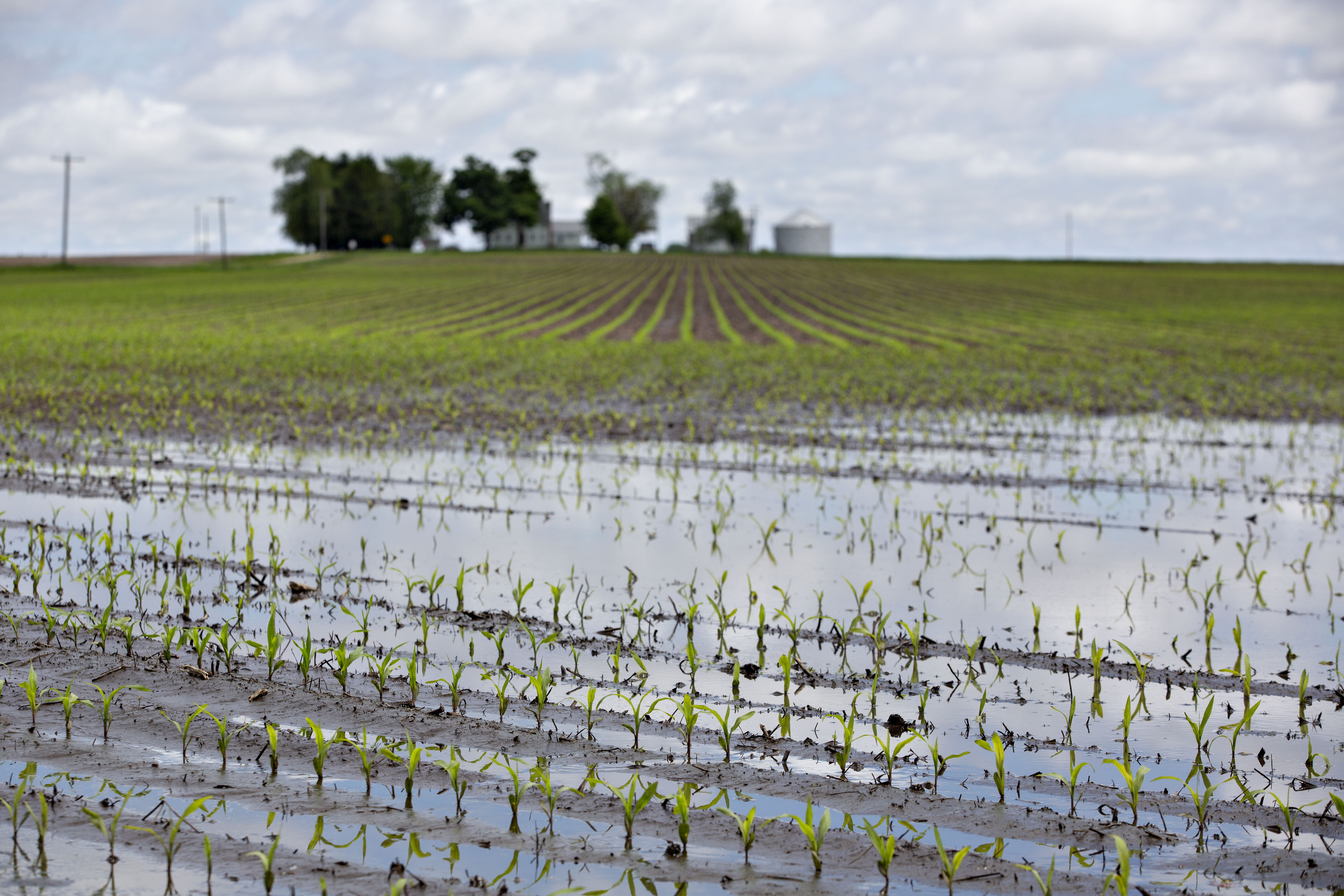
As farmers ready for planting season, a new study examines the flood risk for all cropland in Iowa.
The study from IIHR–Hydroscience and Engineering at the University of Iowa is the first to detail the flood risk to farmland statewide. The researchers used flood maps developed at the Iowa Flood Center, and incorporated data from the Federal Emergency Management Agency (FEMA) and the U.S. Department of Agriculture to create the crop flood-risk analysis.
Among the main findings:
- Nearly 450,000 acres of Iowa farmland are located in a two-year flood return period, meaning there’s a 50% chance the land will flood in a given year. That’s less than 2% of the total farmable land analyzed in the study.
- Iowa agriculture sees crop losses, on average, of $230 million a year due to farming that takes place in flood-prone areas.
The researchers also identified four watersheds as most vulnerable to flooding and crop losses: Middle Cedar in east-central Iowa, North Raccoon and South Skunk in central Iowa, and West Nishnabotna in southwest Iowa.
The new agricultural flood-risk maps developed by the IIHR researchers can be updated to reflect changes in climate; changes in land use, such as a shift in farming in a location; and changes to the landscape, such as the addition of a road or other infrastructure, to give a continuous picture of the flood potential for farmland across the state.
“It’s a comprehensive approach to help create solutions with information that helps farmers take a clear-eyed look at their land and for policymakers and others to use as a starting point to determine how Iowa’s landscape can be best used to reduce flooding,” says Enes Yildirim, graduate research assistant at IIHR and the study’s corresponding author.
The researchers analyzed nearly 25 million acres of agricultural land in Iowa and farming operations from 2016 to 2020 to classify the flood risk according to eight scenarios: 2-year, 5-year, 10-year, 25-year, 50-year, 100-year, 200-year, and 500-year return periods. Cropland located in a 2-year return period has a 50% chance of flooding in a given year; farmland in a 5-year return period has a 20% of flooding in a given year; while farmland in a 100-year return period has a 1% chance of flooding in a given year.
The researchers then incorporated flood maps from FEMA and the U.S. Army Corps of Engineers along with data from the USDA, including crop type, yields, costs and price, planting frequency, and a corn suitability rating, which indexes a farmland’s productivity.
“We have taken all this information from federal agencies and have tailored it to create a more dynamic picture about the current agricultural flood risk in Iowa,” says Ibrahim Demir, associate professor in civil and environmental engineering at Iowa and a study co-author.
Iowa has seen its fair share of flooding. Since 1953, 29 flood-related disaster declarations have been issued for the state, according to FEMA. Major, if not historic, flooding has occurred four times over the past decade and a half alone—in 2008, 2014, 2016, and 2019.
The new maps seek to address objectively the flood stress points, by showing farmland that is prone to chronic flooding and has low productivity yields compared to other areas.
“We highlight the $230 million in average annualized losses to show that there is farmland that is frequently exposed to floods and has a low corn suitability rating—why not consider changing its use?” Yildirim says. “That, of course, would require further conversations, but you have to look at the costs and benefits of continuing to farm that land.”
Policymakers also can entertain what to do with farmland that is prone to regular flooding but is highly productive. That is especially true for cropland in the West Nishnabotna region in southwest Iowa, the researchers found.
“The West Nishnabotna is a region that has a high corn suitability rating but also is exposed to regular flooding,” Yildirim says. “So, it might need extra protection from flooding to maintain food production, such as building a levee, for example.”
The researchers found rotating crops had a negligible impact on flood losses.
The study, “Agricultural flood vulnerability assessment and risk quantification in Iowa,” was published online Feb. 26 in the journal Science of the Total Environment.
Source - https://now.uiowa.edu