Washington wine grape growers’ freeze response ushered in a full crop.
Following a deep winter cold spell, many Washington wine grape growers opted to leave more buds on longer spurs this year.
For the most part, it worked. By September, growers in Washington ended up with a full crop that met quality expectations.
“We recovered,” said Michelle Moyer, the viticulture extension specialist for Washington State University. “As an industry on the whole, we did a lot better than we thought we would.”
To cover the freeze response, Good Fruit Grower visited two Walla Walla-area wine grape growers in mid-February, shortly after the freeze, to see how their crews pruned, then returned in early September near harvest and found an ample crop of mature clusters.
In February, Jason Magnaghi, viticulturist for Figgins Estate Vineyard, was afraid his company would lose most or perhaps all of the crop from a Cabernet Sauvignon block.
In September, he said he was “surprised by the volume.”
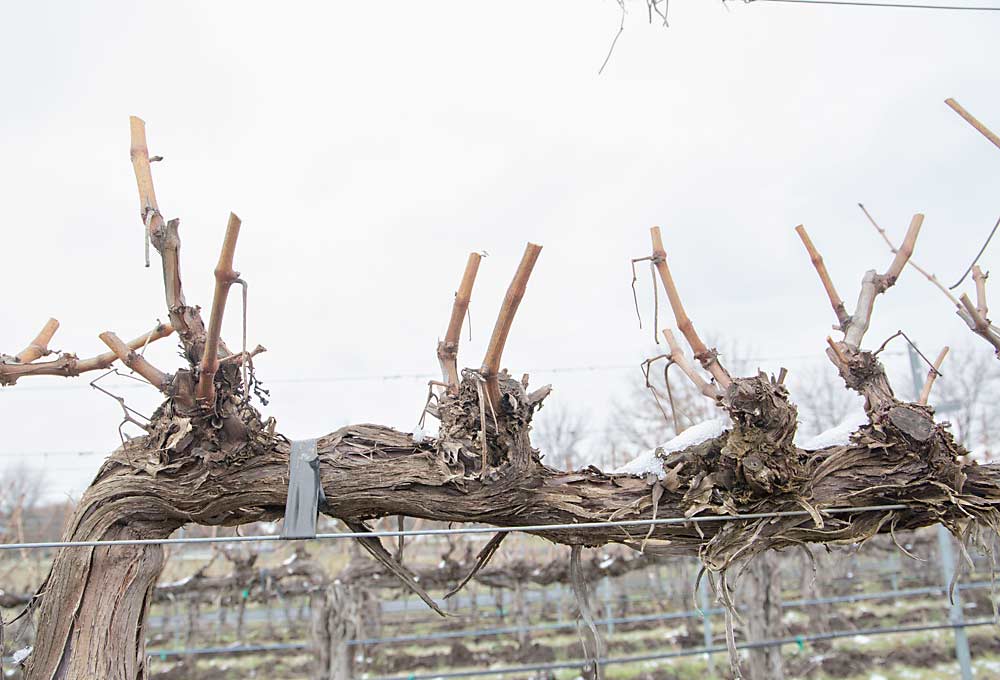
In response to a deep, prolonged winter freeze, crews at Figgins Estate Vineyard “dog ear” pruned these Cabernet Sauvignon vines, shown in February near Walla Walla, Washington, said viticulturist Jason Magnaghi. The technique left twice the spurs, and therefore double the buds, to hedge their bets against damage.
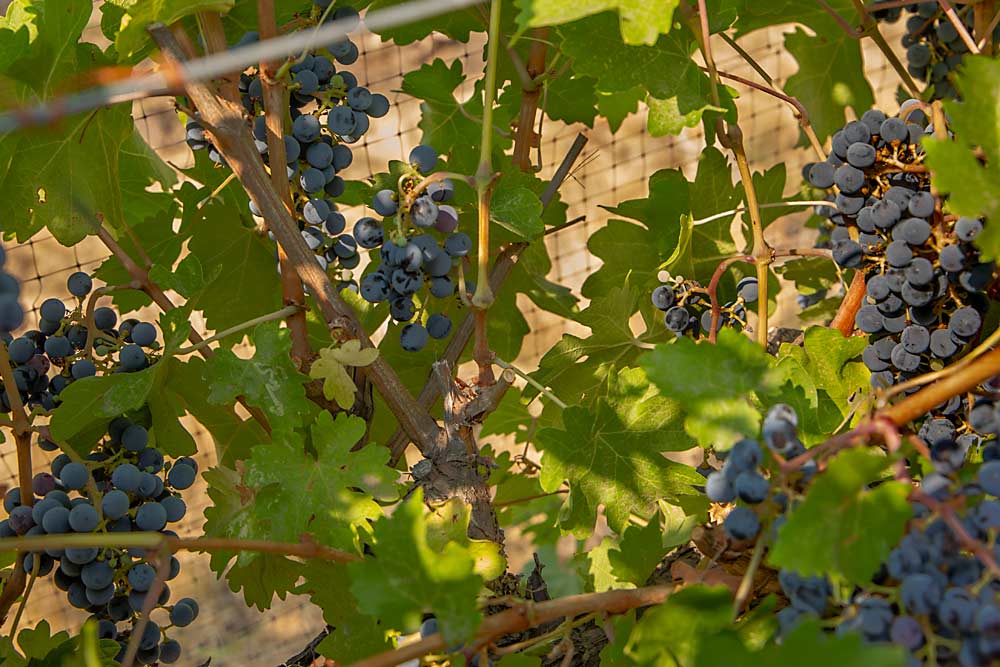
The strategy worked. Those Cabernet Sauvignon vines produced a full crop, shown in early September. The trade-off was a denser canopy with more shoots to thin, such as the two, center, that were stubbed in May when Magnaghi realized they would not be fruitful.
The other grower was Sadie Drury, general manager of North Slope Management, a vineyard operations company for several farms. She also was pleasantly surprised.
“It worked out well,” Drury said. “We have a full crop.”
Not your average cold
Among the state’s viticultural regions, the Walla Walla area was hit especially hard by the freeze, an eight-day streak in mid-January with highs well below freezing and lows in the single digits, according to AgWeatherNet history. It even dipped below zero a few times. The same cold spell caused regional crop losses of stone fruit, pears and cherries elsewhere in Washington.
The temperatures didn’t always cause instant bud death, but it stayed cold long enough to dehydrate buds until they died, Moyer said.
A few days after the cold spell, Moyer organized a virtual grower meeting that attracted more than 250 participants. Many were from British Columbia, where vines got so cold that no number of pruning tricks could have saved them.
But for the Washington growers, Moyer and colleagues reminded them to follow the established guidelines published on WSU’s cold hardiness website, which gives updates of temperature thresholds for 10 percent, 50 percent and 90 percent bud death for 26 varieties weekly throughout the winter. It also features links to published literature about grapevines and cold weather, including how to assess bud damage and prune accordingly, letting growers hedge their bets in case some of the buds don’t make it.
Moyer attributes Washington’s success this year to growers hearing the message early and reacting by the book. Also, the weather hit midwinter, with vines at their hardiest.
Some growers had already pruned and could do little but cross their fingers. Others had pre-pruned mechanically but held off hand pruning or called back their crews to wait and sample. Others hadn’t even gotten that far, which allowed them to wait until March or April to evaluate if they had growing shoots.
On a Merlot block, Magnaghi instructed his crews to “dog ear” prune, leaving two spurs where they would normally leave one. His team typically does that when bud death falls between 50 and 70 percent, he said.
Drury, across the Walla Walla Valley near Milton-Freewater, Oregon, also instructed her pruning crews to leave more buds in a Carménère block by cutting the spurs a little longer to leave up to four buds on each one, instead of the usual two.
Both viticulturists said the techniques paid off with a full crop and no drop in quality. Both examples are estate vineyards. Winemakers using estate vineyards can’t simply buy grapes from somewhere else to replace those lost to cold.
North Slope Management pruned to leave longer spurs with more buds and shoots than usual, said general manager Sadie Drury, as shown on these Carménère vines in mid-February near Walla Walla.
As a result, those Carménère vines yielded a full crop but a denser canopy to manage, shown in this early September photo.
Next year and beyond
There were trade-offs, though. The lighter pruning led to more branches, heavier foliage and denser canopies, meaning even more work come time for shoot thinning, spraying and defoliating.
“We just had to farm harder,” Drury said.
That extra labor will continue, too, Drury and Magnaghi said.
Magnaghi suspects he will need to pre-prune by hand to catch up with the more erratic shoots next year. Normally, his crews pre-prune by machine and follow with hand labor for more precise pruning.
Moyer said she and Markus Keller, a research viticulturist at WSU, are curious to learn more about this type of cold — they called it the “long and low effect.” On one hand, it may have been more damaging to grape buds than typical winter damage, but it also may have caused growers to overestimate damage in some cases, because exteriors of buds died of dehydration while the interiors lived.
The grand lesson for growers now is to resist the temptation to prune too early, Moyer said. Farms understandably want to get ahead of chores while workers are more available, but Washington has a northern climate that comes with risks, despite its warm summers.
The best pruning timing, Moyer said, is “as late as you possibly can.”
Source - https://www.goodfruit.com